
LP-UIT: Decoding the Multimodal DNA of Social Link Formation
LP-UIT: A Multimodal Framework for Link Prediction in Social Networks
The paper introduces LP-UIT, a multimodal framework for link prediction in information-seeking social networks. It integrates textual (long/short-term interests), graph (GCN-based topology), and numerical (social influence and "weak links") data, achieving state-of-the-art performance on Zhihu and Epinions datasets.
TL;DR
LP-UIT (Link Prediction based on User Information and Topology) is a sophisticated multimodal framework designed for social networks. Unlike traditional methods that look purely at graph structure, LP-UIT fuses textual interests (long and short-term), graph topology (GCN), and numerical interaction signals (weak links). It proves that who we follow isn't just about who our friends know, but a complex interplay of our shifting interests and subtle "weak" interactions.
Problem & Motivation: Beyond the "Friend of a Friend" Logic
Most link prediction algorithms rely heavily on structural similarity (e.g., Common Neighbors). If Alice and Bob share five friends, the algorithm assumes they will connect. However, in information-seeking platforms like Zhihu or LinkedIn, this logic is incomplete.
The authors identify two critical gaps:
- Interest Divergence: Our interests are not monolithic. We have "long-term" professional anchors and "short-term" curiosity-driven spikes. Existing models rarely separate these.
- The Hidden Signal of Weak Links: Before we "Follow" someone, we might like their answer or read their review. These are "weak links" that provide a massive evidentiary trail for future "strong" links (follows), yet they are often ignored in pure graph models.
Methodology: The Multimodal Fusion Architecture
LP-UIT approaches the problem as a multimodal fusion task, treating a user not just as a node, but as a collection of behaviors.
1. The Three Pillars of Feature Extraction
- Textual Modality: Using TF-IDF to identify keywords and Word2Vec for embedding, the model captures Short-term interests (from recent 10% of activities) and Long-term interests (from all past activities).
- Graph Modality: A 2-layer Graph Convolutional Network (GCN) processes the global network structure to understand the "topological neighborhood" of each user.
- Numerical Modality: This captures "Social Influence" (content likes, comments received) and "Weak Links" (interaction frequency and quality between a pair of users).
2. The Bridge: Cross-Modal Attention
Simply concatenating text and graph data is "naive." LP-UIT introduces an Attention Layer to find the correlation between what a user says (text) and where they sit in the network (topology). This allows the model to weigh specific interest dimensions more heavily if they align with the local network structure.
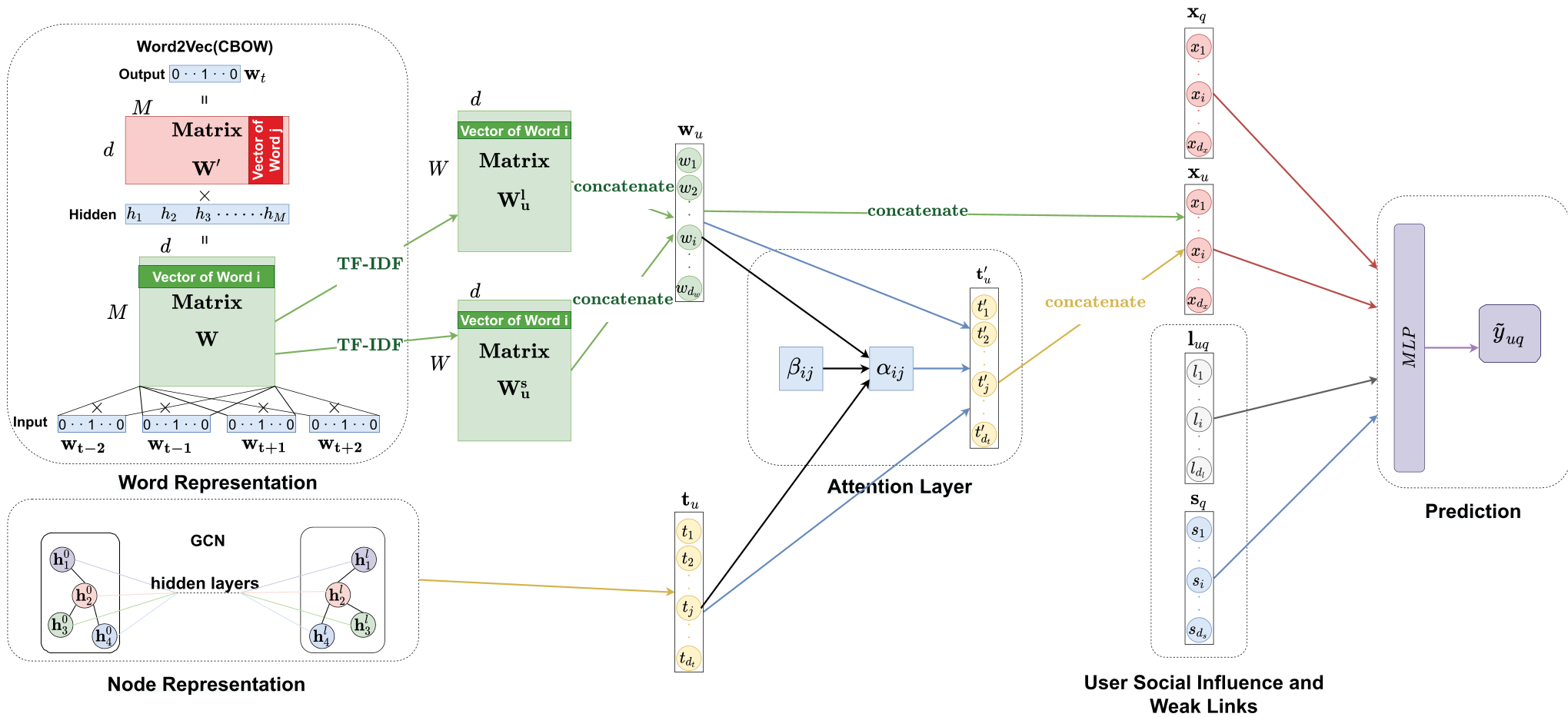 Fig 1: The architecture showing the parallel processing of text, graph, and numerical data followed by attention-based fusion.
Experiments & Results: SOTA Performance
The model was tested on two heavy-duty datasets: Zhihu (Q&A) and Epinions (Trust/Reviews).
Key Findings:
- Superiority: LP-UIT consistently beat state-of-the-art baselines like ARGA (Adversarial Graph Autoencoder) and deepMDBN.
- Ablation Success: Through ablation studies, the authors proved that removing "Weak Links" or "Long-term interests" significantly degraded performance. Interestingly, Long-term interests were found to be more influential in link formation than short-term spikes.
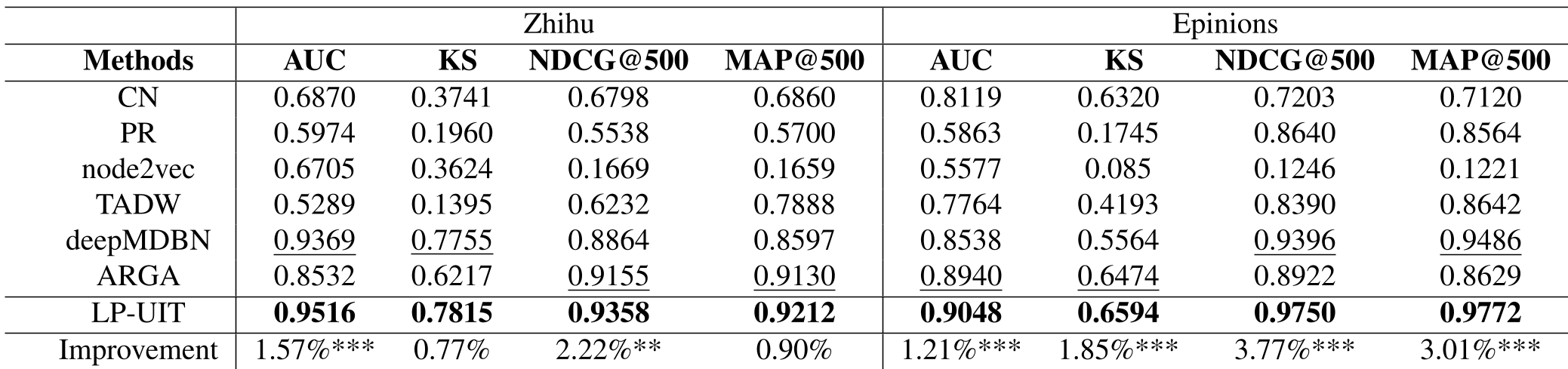 Table 1: Performance comparison. Note the significant improvements in AUC and NDCG for LP-UIT.
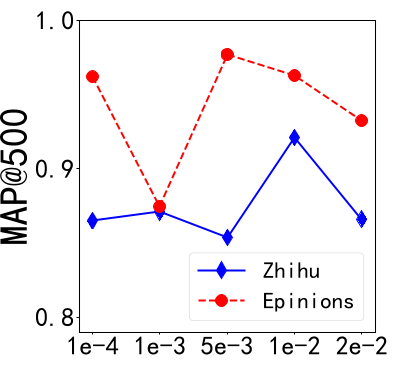 Fig 2: Performance stability across different top-K recommendations.
Critical Insights & Conclusion
LP-UIT’s success highlights a shift in social network analysis: Context is King.
The Takeaway: For platforms looking to improve discovery, the "social graph" is no longer enough. The real predictive power lies in the intersection of content (what we talk about) and pre-link interactions (how we react to others before hitting 'follow').
Limitations: While powerful, the model relies on heavy feature engineering for "weak links." Future work could involve more automated discovery of these interaction patterns via Temporal Graph Networks (TGNs) to capture the exact sequence of events leading to a link.