
LRDM: Securing the "First Mile" of Big Data in Social Networks
LRDM: Local Record-Driving Mechanism for Big Data Privacy Preservation in Social Networks
The paper introduces the Local Record-Driving Mechanism (LRDM), a novel framework for big data privacy preservation in social networks. It focuses on protecting user privacy at the collection stage using an ε-differential privacy-based model and a customized privacy metric to quantify protection degrees against inference attacks.
TL;DR
Current big data privacy focuses on the "aftermath"—protecting data once it's already in the cloud. LRDM (Local Record-Driving Mechanism) pivots the defense to the collection stage. By combining -Differential Privacy with a robust Privacy Metric based on Bayesian inference, it enables users to obfuscate their local records (from phones, PCs, etc.) before they ever reach a service provider, cutting execution costs by half compared to naive baseline methods.
Background: The Hidden Vulnerabilities of the "5V" Era
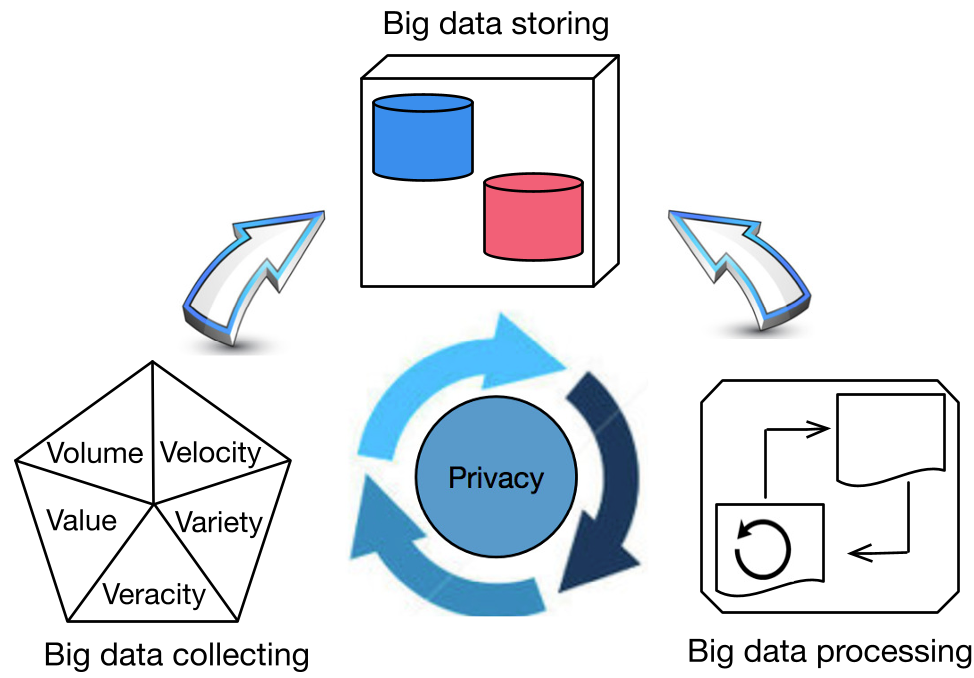
Big Data is traditionally defined by Volume, Velocity, Variety, Value, and Veracity. However, research has mostly tackled privacy within the "Storage" and "Processing" silos. This paper argues that the Collection phase—where ubiquitous social network devices generate 2.5 quintillion bytes daily—is the most critical and overlooked vulnerability. If the data is compromised at the source, retrospective anonymization is often too little, too late.
The Core Problem: Why k-Anonymity is Not Enough
While k-anonymity is a popular industry standard, it remains vulnerable to record linkage attacks and lacks a rigorous mathematical foundation for "guaranteed" privacy. The authors identify that most existing models ignore the original data distribution (profiles) known by an adversary. To solve this, we need a mechanism that:
- Quantifies the adversary’s "Estimation Error."
- Provides a formal "Differential Privacy" guarantee.
- Optimizes the transformation function to maximize user safety.
Methodology: The Local Record-Driving Mechanism (LRDM)
The researchers formulated a general architecture consisting of Three Pillars: Collecting, Storing, and Processing. LRDM sits squarely in the Collecting phase.
1. The General Architecture
2. Privacy Metric & Bayesian Inference
The paper defines privacy not as "hidden data," but as the adversary's expected error. If an adversary observes an obfuscated record , they use Bayesian inference to guess the true record . The LRDM optimizes for the maximum "Dissimilarity" (Hamming distance) between the adversary's guess and the truth.
The objective function is defined as a maximization problem: Subject to:
- -Differential Privacy: Ensuring the output doesn't leak whether a specific record was present.
- Probability Constraints: Ensuring the transformation function is mathematically valid.
Performance Evaluation
The authors used OPNET and Levy walk mobility models to simulate a realistic social network environment with up to 140 mobile users and 1000 records.
Communication & Execution Efficiency
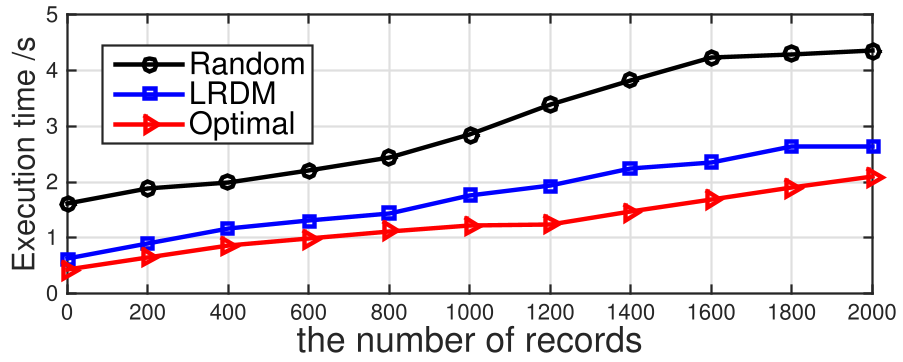
The results demonstrate that LRDM is highly efficient. In Fig. 2, we see that as the number of records increases, both communication cost and execution time for LRDM remain significantly lower than the Random Scheme and track closely with the theoretical "Optimal Mechanism." Specifically, execution time is nearly halved compared to the random approach.
The Impact of Privacy Budget ()
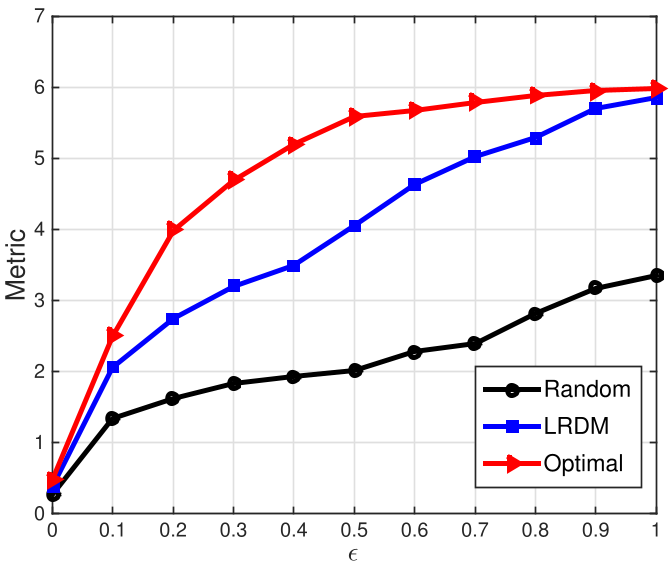
As expected, as the privacy budget increases (meaning less strict privacy), the "Privacy Metric" (adversary error) decreases. However, LRDM consistently outperforms random perturbations, proving its ability to find the most effective way to "noise" the data without destroying its utility.
Critical Analysis & Future Outlook
Summarizing the Contribution: LRDM successfully bridge the gap between abstract Differential Privacy theory and practical Big Data collection. By treating privacy as a "Distance" problem, it gives users a tangible way to measure their safety.
Limitations:
- The current model relies heavily on Hamming distance, which might not capture the semantic sensitivity of all data types (e.g., text or images).
- The computational overhead of solving the linear constraints might become intensive if the "Variety" of record types grows exponentially.
Future Work: Integrating this local mechanism with Self-Sovereign Identity (SSI) and Edge Computing could lead to a world where our personal devices act as proactive "Privacy Filters" for everything we share online.