
Beyond Simple Texture: Amalgamated Directional Transforms for High-Precision Lung Disease Stratification
Lung disease stratification using amalgamation of Riesz and Gabor transforms in machine learning framework
The paper proposes a two-stage cascaded CADx system for lung disease risk stratification (normal vs. diseased) using high-resolution CT (HRCT). The core methodology integrates an amalgamation of 100 grayscale features, primarily featuring Riesz and Gabor transforms, achieved an exceptional SOTA accuracy of 99.53% using an SVM classifier.
Executive Summary
TL;DR: This paper introduces a high-performance CADx system that solves the challenge of lung disease risk stratification by moving beyond 1D/2D statistical textures. By "amalgamating" Riesz and Gabor transforms with traditional texture features (GLCM, GLRLM, Fractal Dimension), the authors achieved a clinical-grade accuracy of 99.53% on HRCT data.
System Position: This work represents a significant leap in Feature Engineering and Machine Learning integration. While the field is rapidly moving toward end-to-end Deep Learning, this paper provides a rigorous mathematical foundation for why directional and scalable features are essential for capturing the complex morphology of diseased lung tissue, outperforming several modern baselines.
Problem & Motivation: The Limits of Human Observation
Lung diseases remain a leading cause of global mortality, yet their diagnosis via HRCT is notoriously difficult. Radiologists must parse hundreds of slices per patient, leading to:
- Visual Fatigue: Massive data sizes increase the error rate.
- Observer Variability: Delineation of diseased regions is subjective.
- Feature Fragmentation: Prior CADx systems often used only a single type of feature (e.g., just GLCM), missing the "holistic" morphological signature of the disease.
The authors' insight was that lung pathologies—like ground-glass opacities or honeycombing—are fundamentally directional and exist across multiple scales. Therefore, a system must "see" in all directions (360°) and at various resolutions to be truly effective.
Methodology: The Power of Amalgamation
The system is built as a two-stage cascaded pipeline.
Stage A: Lung Delineation System (LDS)
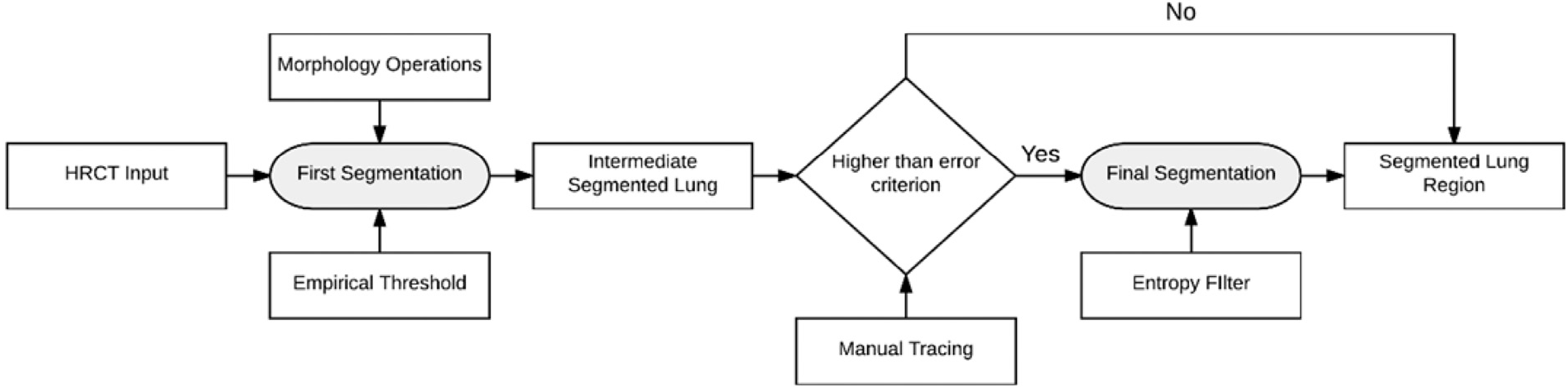
Before characterization, the lung must be isolated. The authors use an entropy-based region extraction combined with morphology operations. This ensures that the subsequent machine learning phase focuses solely on lung tissue, reducing noise from the chest wall or mediastinum.
Stage B: Feature Hybridization (The Core Innovation)
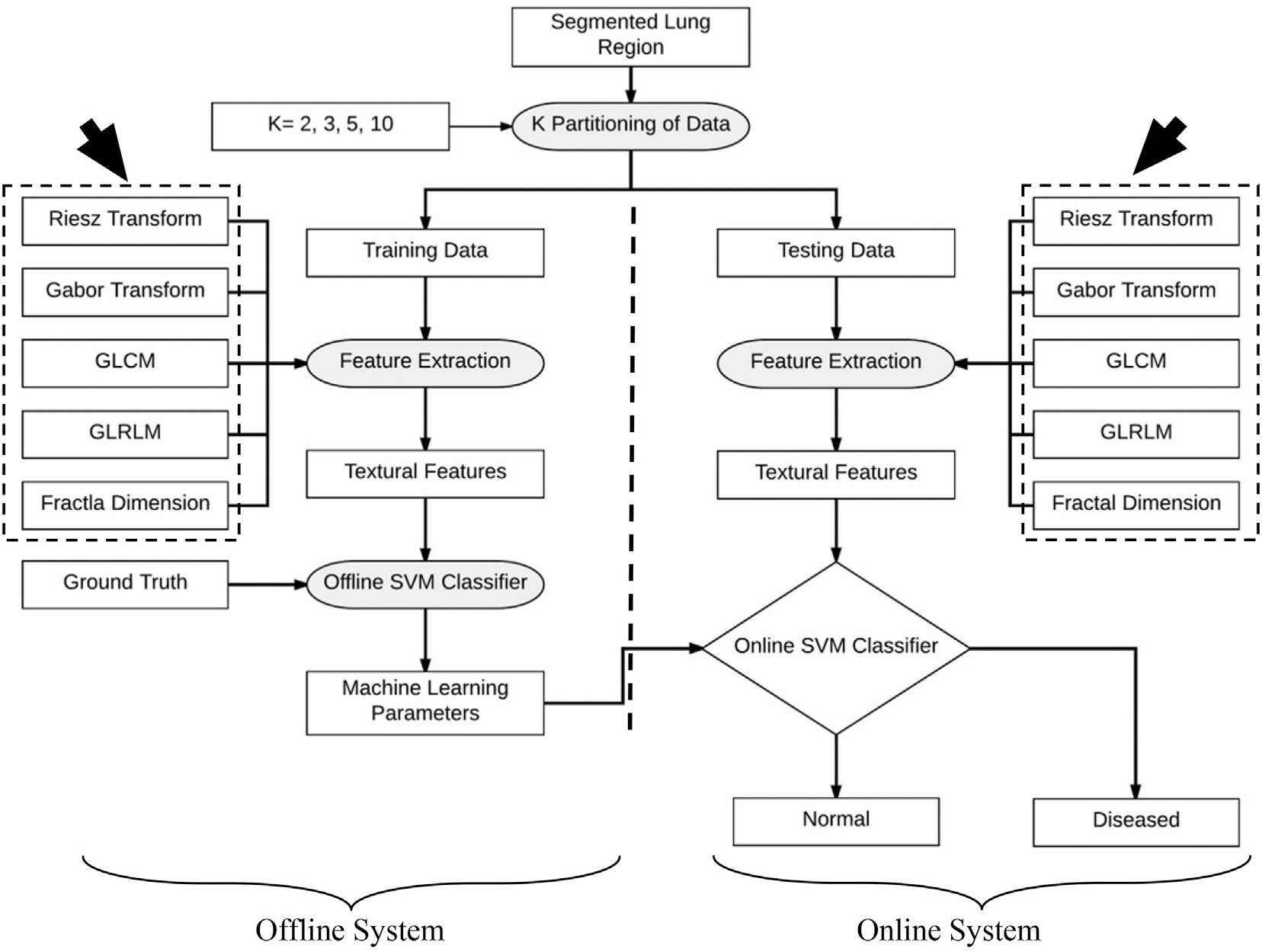
The heart of the study is the use of 100 grayscale features, categorized into:
- Riesz Transforms: Utilizing 5th-order steerable filters to detect texture changes in specific directions.
- Gabor Transforms: Providing multi-scale analysis (fine to coarse) with orientation sensitivity.
- Statistical Textures: GLCM (spatial relations) and GLRLM (run-length patterns).
- Fractal Dimension (FD): Measuring the "roughness" or complexity of tissue scarring.
To handle this high-dimensional space, the authors introduced the Lung Feature Segregation Index (LFSI). This index ranks features by their power to distinguish normal from diseased tissue, allowing the SVM classifier to focus on the most "dominant" signals.
Experiments & Results
The authors tested their system on a database of 96 patients (81 diseased, 15 normal) using a rigorous K-fold cross-validation protocol.
1. The Superiority of Directional Filters
In individual tests, Gabor (98.87%) and Riesz (97.45%) significantly outperformed Fractal Dimension and GLCM (both <80%). This validates the hypothesis that steerability and scalability are the most critical inductive biases for lung tissue analysis.
2. The Multiplier Effect of Amalgamation
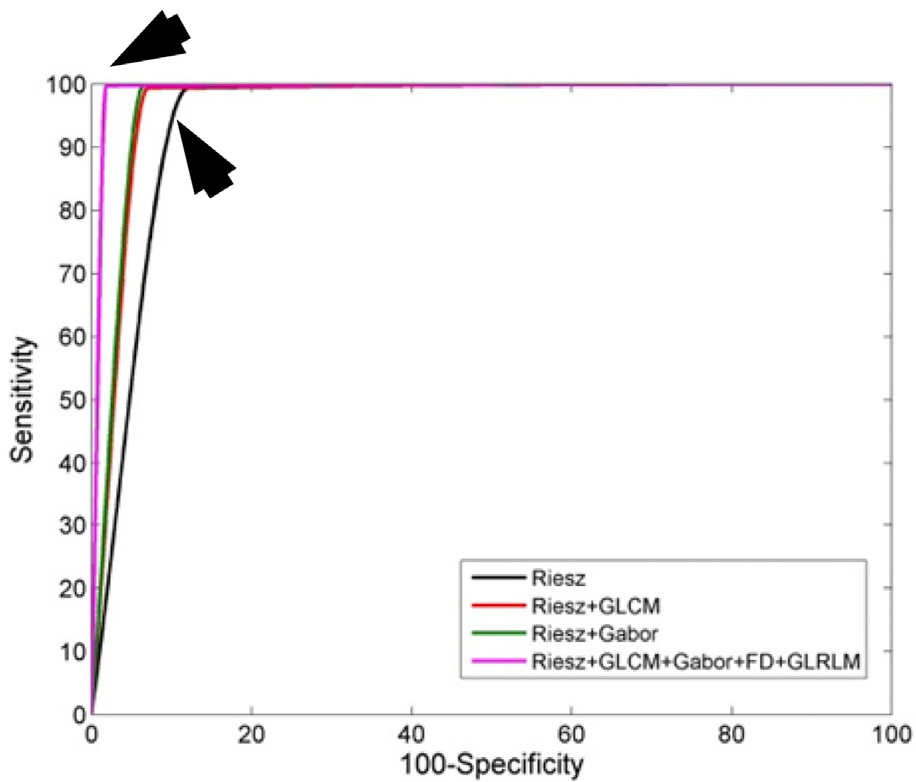
When Riesz was hybridized with Gabor and other features, the accuracy peaked at 99.53%.
| Feature Set | Accuracy (10-fold) |
|---|---|
| Riesz Alone | 97.45% |
| Riesz + Gabor | 98.71% |
| Full Amalgamation | 99.53% |
3. Robustness against Segmentation Errors
A critical practical finding: the authors intentionally introduced "over-segmentation" (dilation) and "under-segmentation" (erosion) in Stage A. The accuracy in Stage B remained stable with less than a 5% drop, proving the feature set is robust to imperfect lung boundary extractions.
 The LFSI plot confirms that Gabor and Riesz features dominate the top 40% of the most predictive features.
Critical Analysis & Conclusion
Takeaway
The amalgamation of directional transforms transcends the limitations of traditional CADx. By mathematically modeling the orientation and scale of patterns, the system approximates the "intuitive" visual search a radiologist performs, but with the consistency of a machine.
Limitations & Future Work
- 2D Constraint: The current study is 2D-based. Extending these transforms to 3D (Spherical Harmonics or 3D Riesz) would likely capture even more context.
- Dataset Balance: The dataset is skewed (81 diseased vs. 15 normal). Future work should emphasize balanced cohorts or synthetic data generation to ensure the specificity remains high in screening scenarios.
- The Deep Learning Question: While this "expert-feature" approach is highly interpretable and accurate, comparing this hybrid model with a 3D-CNN or Vision Transformer (ViT) on the same dataset would be the next logical step in the evolution of this research.