
Lysis: Redefining IoT through Socially Connected Autonomous Objects
15408_Lysis A Platform for IoT Distributed Applications Over Socially Connected Objects.
This paper introduces Lysis, a cloud-based Platform as a Service (PaaS) for the Internet of Things that treats objects as autonomous social agents. By integrating the Social IoT (SIoT) paradigm with distributed cloud computing, it achieves superior scalability and ensures user data ownership through decentralized virtual objects.
TL;DR
The Lysis platform represents a paradigm shift in how we manage billions of IoT devices. Instead of treating "things" as passive data points in a central database, Lysis transforms them into autonomous social agents. By marrying the Social Internet of Things (SIoT) with a PaaS model, Lysis provides a distributed architecture that ensures users own their data, services are highly reusable, and the network scales naturally through "friendship" networks.
Context: In the current landscape, Lysis moves beyond the centralized "Virtual Vertical" silos of early IoT, positioning itself as a horizontal, cross-domain platform that prioritizes privacy and scalability.
The "Silo" Problem and the Social Insight
Most existing IoT platforms (like Xively or early SIoT prototypes) act as central hubs. While efficient for small-scale deployments, they face two terminal flaws:
- Privacy Eradication: Your data lives on the provider's server, not yours.
- Bottlenecked Discovery: Finding a specific service in a sea of billions requires massive centralized indexing, which doesn't scale.
The authors' Insight is elegant: If humans can find information efficiently via social "six degrees of separation," why can't objects? By giving objects the agency to form relationships (Ownership, Co-location, etc.), Lysis allows for a distributed search that actually gets more efficient as the network grows.
Methodology: The Social Virtual Object (SVO)
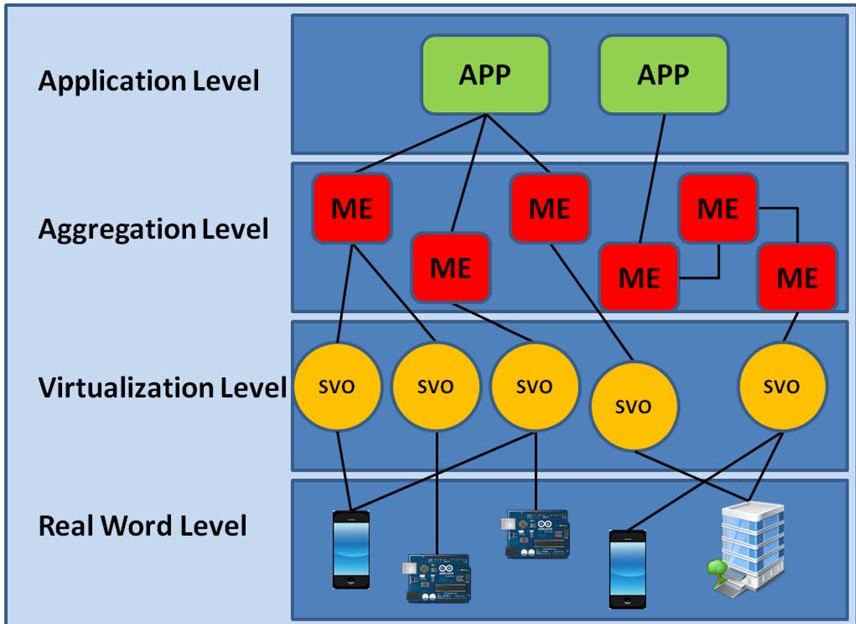
At the heart of Lysis is the Social Virtual Object (SVO). Unlike a traditional Virtual Object that is merely a digital twin, an SVO is an active Web service equipped with a Social Enabler.
1. Architectural Layers
The platform is divided into four functional levels:
- Real World: Physical devices (PDs) and Gateways.
- Virtualization (SVOs): The digital agents running in the user's cloud space.
- Aggregation (Micro Engines): Specialized logic units that combine SVO outputs.
- Application: The user-facing front-end.
2. Trust and Discovery
Lysis leverages an "SVO Root" (the most powerful node owned by a user) to initiate service discovery. Instead of a global search, an object asks its "friends." This social graph effectively filters the search space, prioritizing nodes that are trustworthy and relevant.
Evidence of Superiority
The researchers implemented Lysis on Google App Engine, exploiting its Search and Maps APIs.
Scalability Breakpoint
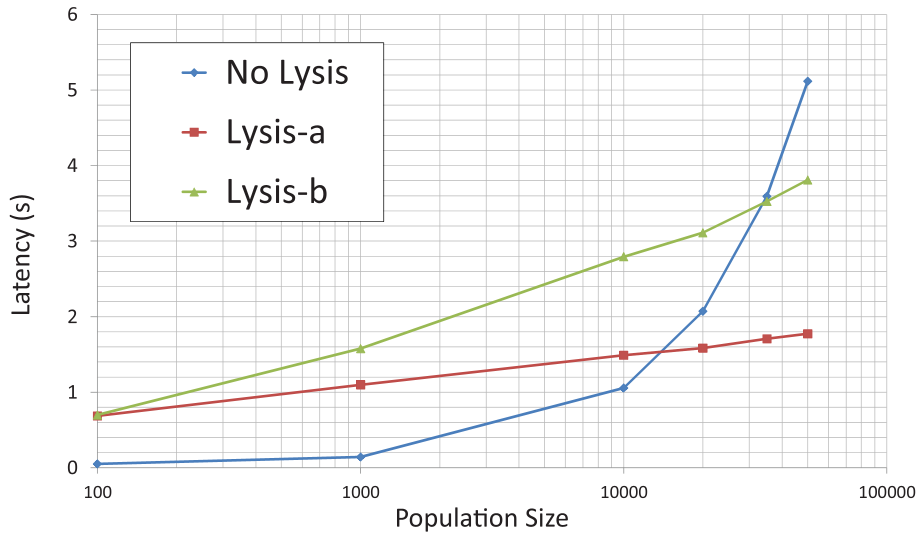
The most striking result is the discovery latency. As shown in the experiments, while centralized NoSQL lookups (no-Lysis) grow exponentially in complexity, the social approach in Lysis (Lysis-a/b) becomes more efficient for large populations.
- The Cross-over Point: Once the network hits approximately 16,000 nodes, the distributed social discovery mechanism begins to outperform traditional centralized databases.
Energy Efficiency
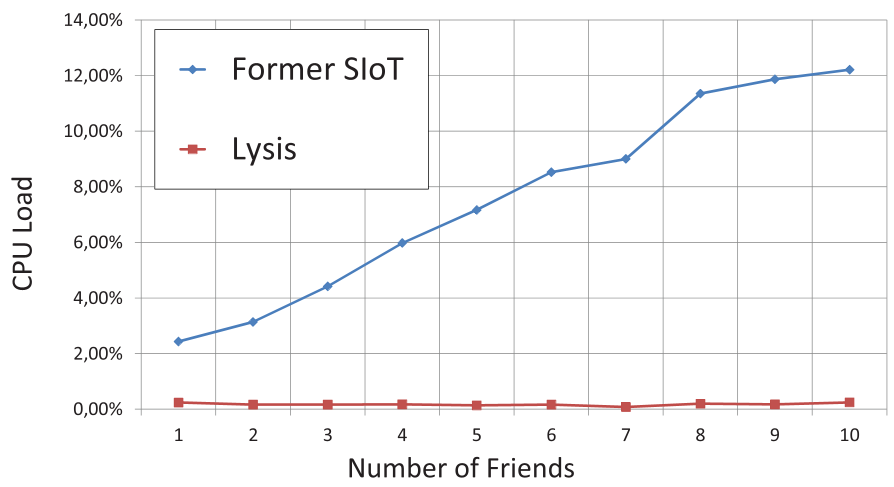
By offloading the "thinking" (logic and aggregation) to the SVO in the cloud, the physical device's CPU load remains flat regardless of how many "friends" it is interacting with. This is a critical win for battery-constrained mobile and edge devices.
Professional Insight & Conclusion
Lysis is more than just another IoT middleware; it is a manifesto for Object Autonomy. By leveraging the PaaS model to host SVOs in individual user containers, it solves the "Data Ownership" problem that has plagued the IoT industry.
Takeaway for Practitioners:
- Reusability: Use the Micro Engine (ME) concept to build modular, sharable processing blocks rather than monolithic Apps.
- Scalability: If your IoT deployment is expected to cross the 10k-node threshold, consider a social-graph-based discovery architecture to avoid database congestion.
Limitations: While Lysis reduces device load, it relies heavily on cloud availability. Future iterations should focus on Edge/Fog deployment of SVOs to ensure functionality during network partitions and to further reduce latency for real-time industrial applications.