
Career Paths as Data Streams: Machine Learning the Next Professional Leap
Machine learned job recommendation
The paper introduces a supervised machine learning approach to job recommendation by formalizing the task as a next-institution prediction problem. Using a DTNB (Decision Table/Naïve Bayes) hybrid classifier trained on over 5 million web-crawled professional profiles, the system predicts the most likely future employer based on historical career trajectories.
TL;DR
Predicting your next career move might be easier than you think—if you have enough data on everyone else. This paper transforms the job recommendation problem into a supervised classification task, using 5 million web profiles to predict which specific company an employee will join next. By treating career histories as directed graphs, the authors achieve up to 86% accuracy, proving that professional mobility follows surprisingly rigid patterns.
The Problem: The Chaos of Career Transitions
Why is job hunting so stressful? Beyond the interview intensity, there is a fundamental information asymmetry. Individuals often don't know which "move" is realistic or statistically common.
Prior work in labor economics often relied on Matching Theory (where both sides rank each other) or Churn Prediction (predicting when someone leaves). However, these don't answer the crucial question: "Where do people like me actually go next?" The challenge lies in the messy nature of CV data: people hold multiple jobs simultaneously, take sabbaticals, or switch industries entirely.
Methodology: Mapping the Job Transition Graph
The authors' core innovation is the formalization of a Job Transition Graph. Instead of looking at a job in isolation, they treat an individual's career as a path where is the current institution and is the destination.
The Temporal Logic
To clean the noisy web data, they applied two strict rules:
- Precedence: The end date at company must be before the start date at company .
- Immediacy: No other institution should exist in the interval between and .
This architecture allows the model to ignore "side gig" noise and focus on the primary career ladder.
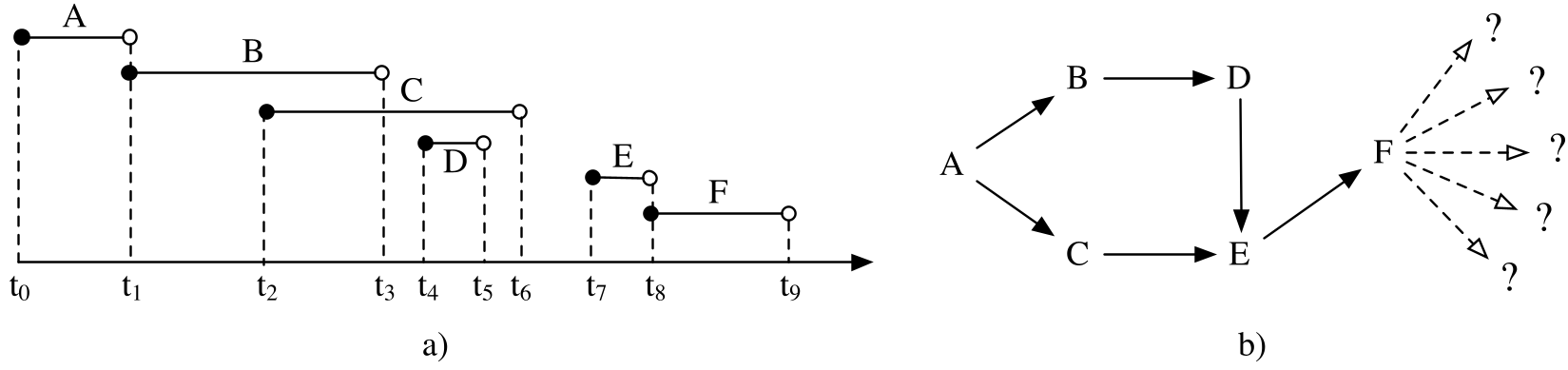 Figure 1: Extracting a clean directed graph from a messy timeline of overlapping employments.
The Classifier: DTNB
The researchers used a DTNB (Decision Table/Naïve Bayes) hybrid. This is clever because it balances the strengths of both: the decision table handles high-impact feature combinations, while the Naïve Bayes handles the probabilistic weight of independent attributes.
Experimental Insights: What Really Matters?
The study categorized features into "Institution" traits and "Employee" traits. Through (Chi-squared) analysis, a clear winner emerged for predictive power: The Current Institution.
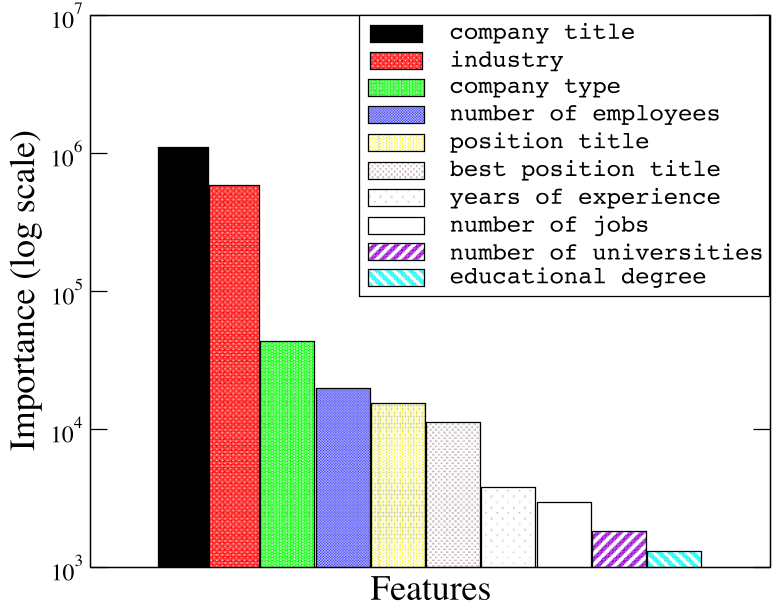 Figure 2: Relative importance of features. Company name and industry significantly outweigh educational degrees in predicting the next move.
Key Results:
- Performance: In Setup III (predicting transitions between top 25 companies), the model hit 86.09% accuracy.
- Baseline Comparison: The majority-class baseline (simply guessing the biggest employer) consistently hovered around 15%, demonstrating that the model is capturing genuine transition dynamics, not just popularity.
- The "First Job" Difficulty: The model struggled slightly more with Setup I (University-to-Company transitions), achieving ~66% accuracy. This confirms the intuition that first jobs are more erratic and less influenced by existing professional "inertia."
Critical Analysis & Conclusion
This work provides a strong foundation for Automated Career Paths. By showing that transitions are highly predictable, it suggests that professional mobility is less about "limitless options" and more about "established pipelines" between specific institutions.
Limitations
- Cold Start: The model relies heavily on current institution features; it likely struggles for users from niche or small companies not represented in the "Top X" lists.
- Semantic Understanding: In 2011, NLP was less advanced; today, we could use LLMs to better parse "Job Titles" (e.g., understanding that "Lead Ninja" is actually a "Senior Software Engineer").
The Takeaway
If you want to know where you're going, look at your current office. For HR tech and recommendation engines, this paper proves that transition history is the most valuable signal, far outweighing the specific university degree or the number of years of experience.