
Detecting Hidden Corporate Malfeasance: AI Insights from Financial Statements
Application of machine learning models and artificial intelligence to analyze annual financial statements to identify companies with unfair corporate culture
The paper utilizes machine learning and AI (XGBoost, Random Forest, DNN) to identify "unfair corporate culture" and significant financial fraud by analyzing annual financial statements. By combining genetic algorithms for feature selection with ensemble methods, the research achieves up to 94.7% accuracy in detecting companies involved in major 20th-century accounting scandals.
TL;DR
Can a company's annual report reveal a "corrupt culture" even if the fraud itself isn't a direct accounting lie? This research proves it can. By applying advanced machine learning models like XGBoost and Random Forests to 20th-century financial scandals, the study reached a 94.7% detection accuracy, identifying indirect "fingerprints" of bribery, tax evasion, and collusion hidden within standard financial ratios.
Background Positioning
In the landscape of forensic accounting, we have transitioned from "White-Box" statistical models (like the 1999 Beneish M-score) to "Black-Box" AI. This paper bridges that gap by using Genetic Algorithms to extract interpretable features from complex AI models, focusing not just on earnings management, but on a broader definition of unfair corporate culture.
Problem & Motivation: Beyond the Red Pen
Most legacy models look for specific math errors or aggressive revenue recognition. However, history shows that massive scandals (like price collusion or bribery) often happen in the shadows. The author’s core insight is that even if a bribe isn't a line item, the contextual behavior—such as high indebtedness, lower liquidity, and unusual cash flows from financing—creates a distinct mathematical pattern that AI can recognize.
Methodology: The Hybrid Approach
The author utilized a massive dataset of 1,317 financial statements, comparing infamous "unfair" companies against "honest" peers.
1. Feature Engineering with Genetic Algorithms
With 289 potential variables, searching for the best combination manually is impossible. The researcher used a Genetic Algorithm (GA)—a search heuristic inspired by natural evolution—to select the 15 most impactful variables for each model.
2. The Model Pipeline
The study tested a suite of algorithms:
- Ensemble Methods: XGBoost and Random Forest.
- Deep Learning: Deep Neural Networks (DNN) with
tanhactivation. - Traditional Stats: Linear Discriminant Analysis (LDA) and Logistic Regression.
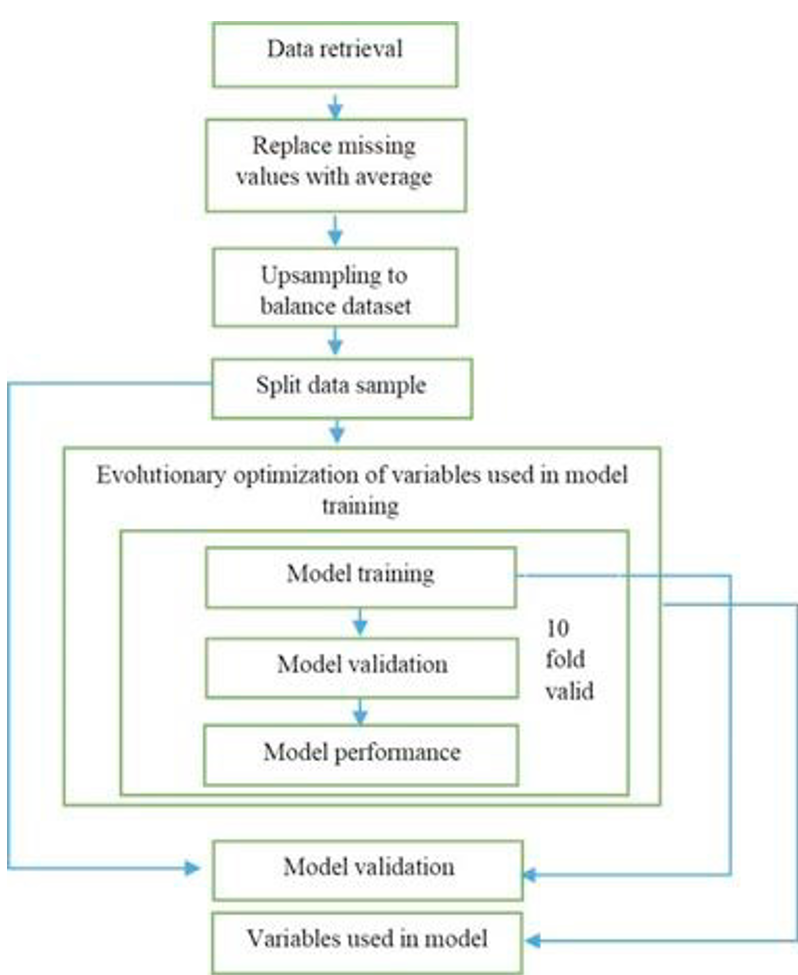 The workflow illustrated above highlights the upsampling process and the 10-fold validation used to ensure model robustness.
Experiments & Results
The "Ensemble" winners clearly outperformed traditional methods. Random Forest achieved an impressive 94.7% accuracy, while XGBoost (93.5%) showed the best balance in minimizing both Type I (false alarm) and Type II (missing the fraud) errors.
Key Indicators of an "Unfair" Company:
- Financial Aggression: High cash flows from financing and short-term investments.
- Tax Discrepancies: High gross profit margins but unusually low tax payments.
- Risk Profile: Higher debt-to-equity ratios and lower narrow-sense liquidity.
- The "Shadow" Signs: More discontinued operations and extraordinary items reported in the cash flow statement.
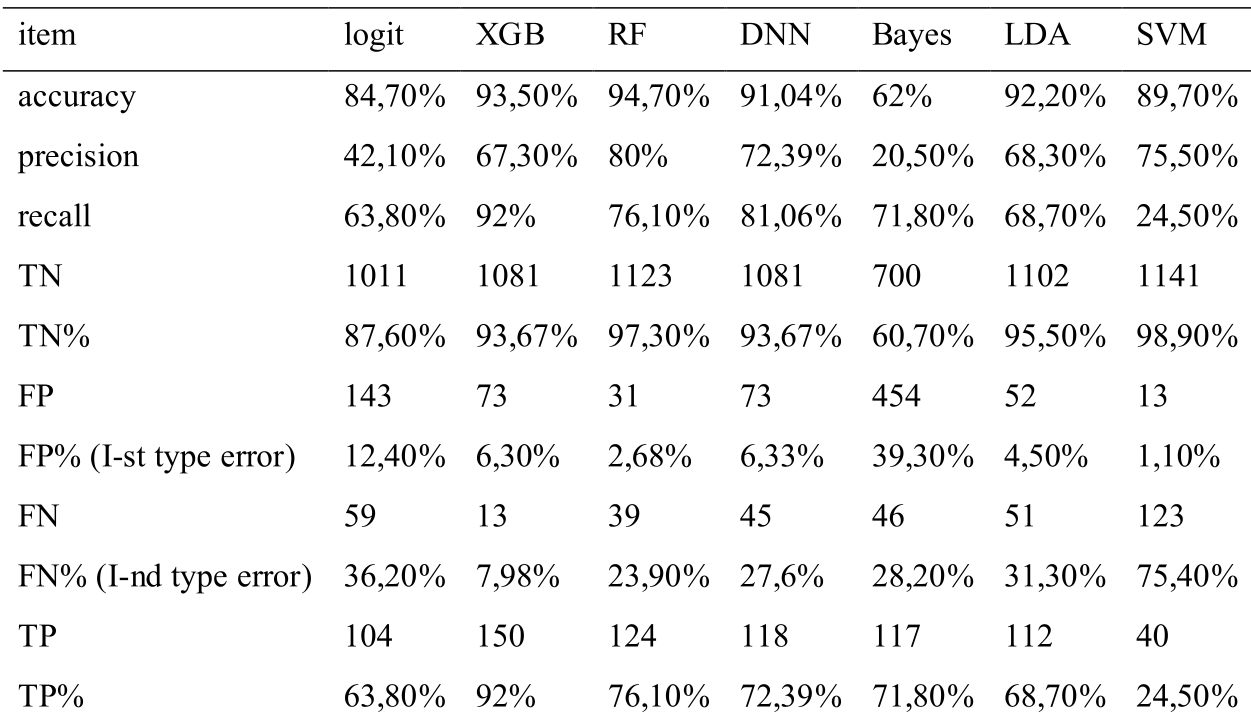 Table 2: Comparison of accuracy, precision, and recall across different AI models.
Critical Analysis & Conclusion
Takeaway
The research successfully demonstrates that machine learning can "read between the lines." By focusing on "Unfair Corporate Culture" rather than just "Accounting Fraud," the models provide a broader safety net for investors and auditors.
Limitations
The study focused on the "most significant accounting scandals." This means the models are trained on extreme cases. In the real world, "micro-frauds" or smaller-scale irregularities might not trigger the same strong patterns, potentially leading to higher false-negative rates in less dramatic scenarios.
Future Outlook
The next frontier is integrating non-financial data (textual analysis of management reports, social media sentiment, and corporate governance structures) with these financial ratios to create a truly 360-degree fraud detection engine.