
Intelligent Guardians: Securing Social Networks via Machine Learning-Based IDS
11181_Machine Learning Based Intrusion Detection System for Social Network of Europe.
This paper proposes a four-tier Intrusion Detection System (IDS) specifically designed for European social networks, utilizing machine learning and text classification. By integrating dictionary-based keyword matching with traffic analysis using the C4.5 Decision Tree algorithm, the system identifies "suspicious traffic" with a high accuracy at the network gateway.
TL;DR
In an era where social media is as much a tool for global coordination as it is for malicious activity, Nandita Sengupta proposes a robust, four-tier Intrusion Detection System (IDS). By blending deep text classification with traditional data mining, this system achieves a 98.3% accuracy rate (using the C4.5 algorithm) in distinguishing malicious social network traffic from legitimate communication at the network gateway.
Background & Positioning
Unlike generic firewalls, this research positions itself at the intersection of National Security and Data Privacy. It argues that security in the social media age requires more than just inspecting packet headers; it requires understanding the intent of the content. It moves beyond simple signature-based detection to a learning-based model that can adapt to new threats.
The Core Motivation: The Encryption-Security Paradox
The primary hurdle in modern intrusion detection is encryption. While end-to-end encryption protects user privacy, it serves as a cloak for criminal coordination. The author identifies that:
- Prior Work often ignores the payload (the actual message) because it is encrypted.
- Research Intuition: By establishing a Memorandum of Understanding (MoU) between governments and providers, messages can be decrypted at a secure gateway, analyzed, and immediately re-encrypted—preserving both security and privacy.
Methodology: The Four-Tier Architecture
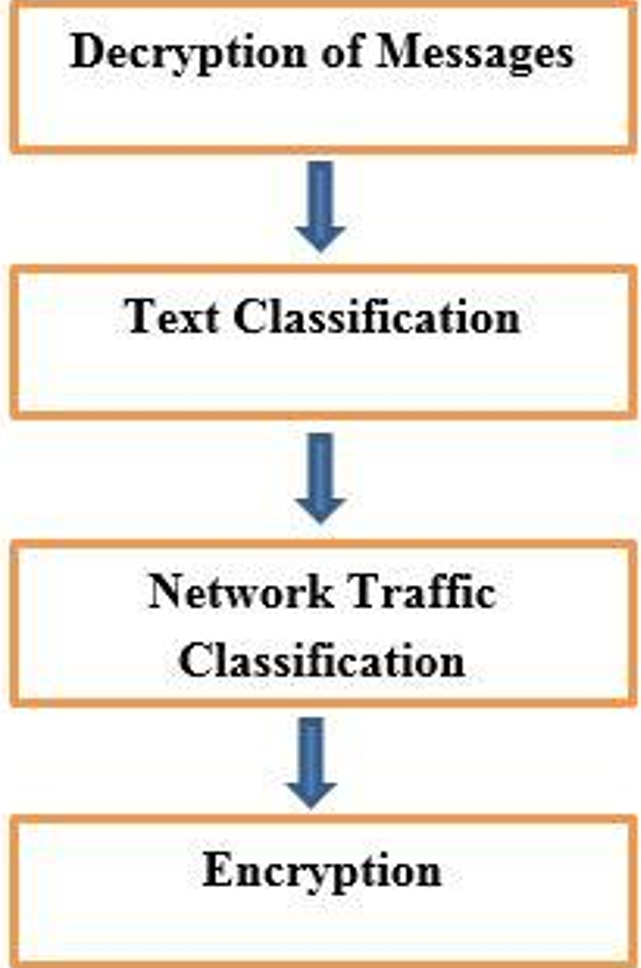
The proposed system doesn't rely on a single check; it uses a defense-in-depth strategy:
- Tier 1: Decryption: Legally mandated decryption at the gateway for inspection.
- Tier 2: Text Classification: Using Information Gain and a specialized dictionary (containing terms like "attack," "rally," or "protest"), the system filters messages that exceed a threshold of suspiciousness.
- Tier 3: Traffic Analysis: Applying machine learning to classify network behavior (IP spoofing, DoS, etc.).
- Tier 4: Hybrid Encryption: Once cleared, the "normal" traffic is re-secured using robust encryption before reaching the recipient.
Performance Benchmarks
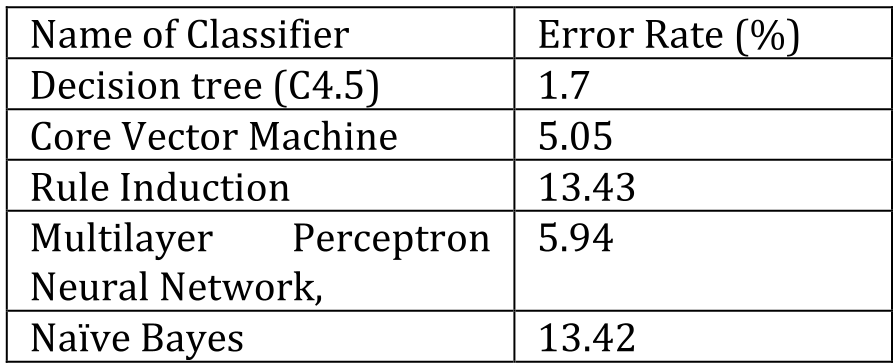
The study evaluated several flagship machine learning algorithms using the NSL-KDD 2009 dataset. The results emphasize that even within "intelligent" models, there is a wide variance in effectiveness:
| Feature | Decision Tree (C4.5) | Core Vector Machine | Multilayer Perceptron | Naïve Bayes |
|---|---|---|---|---|
| Error Rate | 1.7% | 5.05% | 5.94% | 13.42% |
The C4.5 Decision Tree emerged as the clear winner. Its ability to handle large datasets without requiring extensive domain knowledge makes it ideal for the high-velocity data found in social network streams.
Critical Insight & Future Outlook
The brilliance of this approach lies in its Two-Factor Validation: a communication is only flagged if both the text content (Tier 2) and the network behavior (Tier 3) are deemed suspicious. This significantly reduces the "False Alarm" rate that plagues most IDS implementations.
Limitations & Next Steps:
- Data Realism: The current study uses the KDD benchmark. Future work must validate these results against real-world, high-entropy social media traffic.
- Legal Hurdles: The requirement for government-provider "decryption MoUs" remains a significant socio-political barrier.
- Self-Learning: The next evolution of this system will involve a feedback loop where false positives are automatically used to update the underlying model rules.
Conclusion
By moving the "intelligence" to the gateway and combining semantic analysis with traffic metrics, this research provides a blueprint for a safer European digital ecosystem—one where privacy and proactive defense are not mutually exclusive.