
Automated Clinical Decision Support: Bridging Machine Learning and Pediatric Care
Using Machine Learning Classifiers to Assist Healthcare-Related Decisions: Classification of Electronic Patient Records
The paper introduces a three-layered software architecture for the automatic assignment of Surveillance Levels (SL) to pediatric patients using Electronic Patient Records (EPR), employing an ensemble of machine learning classifiers (Vote-SL) and a linguistic module for text normalization. Validated in a Brazilian healthcare setting, the system achieves a classification accuracy of up to 87.81% and an Area under ROC of 0.99.
TL;DR
Researchers have developed a multi-layered software framework that automatically categorizes pediatric patients into "Surveillance Levels" (SL) based on their electronic health records. By combining a domain-specific linguistic module with an ensemble of machine learning classifiers (Vote-SL), the system achieved an impressive 87.81% accuracy. This work acts as a critical second opinion for healthcare professionals, potentially identifying epidemic outbreaks through georeferenced patient data.
Background: The Challenge of Medical Surveillance
In the Brazilian public healthcare system (SUS), primary care is the frontline. However, tracking patient risk factors—categorized as Surveillance Levels (SL)—is a manual, resource-heavy process. Practitioners must weigh medical history, developmental milestones, and social risk factors to assign a level (ranging from Routine to Emergency).
The technical hurdle? Electronic Patient Records (EPR) are messy. They contain unstructured text with varying specialized vocabulary and are often "unbalanced," meaning some risk categories have far more data samples than others.
Methodology: A Three-Tiered Approach
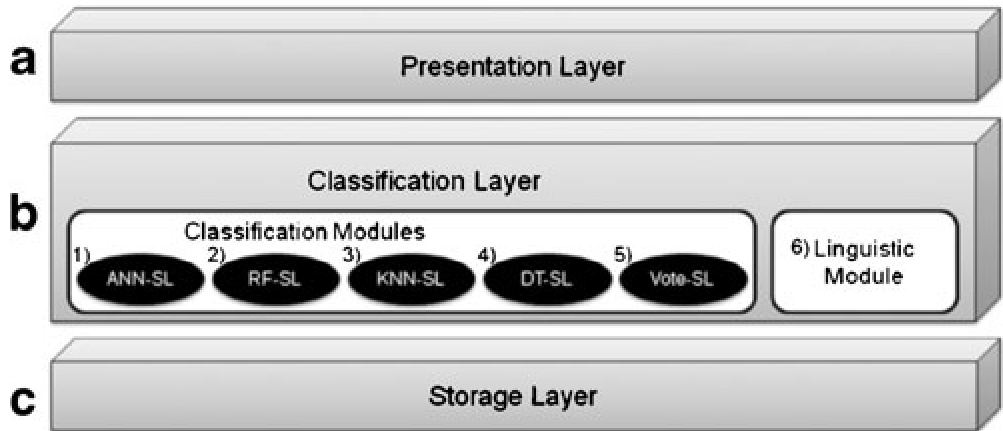
The authors proposed an architecture designed to handle the complexity of medical data through three distinct layers:
- Presentation Layer: A GUI for doctors to receive a "second opinion" and a georeferenced map (using Google Maps API) to visualize high-risk clusters spatially.
- Storage Layer: Handles data extraction from the EPR database.
- Classification Layer: The "brain" of the system, which includes a Linguistic Module and multiple Classification Modules.
The Linguistic Module
This module is the secret sauce for handling medical jargon. It uses the ICD-10 (International Classification of Diseases) and UMLS to normalize synonym-heavy text. By mapping diverse descriptions to unified attributes, it significantly reduces the "dimensionality" of the data, making it easier for algorithms to learn patterns.
The Ensemble Strategy (Vote-SL)
Instead of relying on one algorithm, the system uses a Majority Vote ensemble. If an Artificial Neural Network (ANN) fails on a specific edge case, the K-Nearest Neighbor (KNN) or Decision Tree (DT) might still get it right.
Experiments and SOTA Results
The researchers tested 17 different classifier configurations on records from the Vila Lobato community center. Two major experimental variables were used: Original Data (unbalanced) and Resampled Data (balanced).
Key Findings:
- Resampling is Critical: Accuracy jumped from roughly 64% on original data to over 87% when using resampled data to ensure the model saw enough examples of high-risk cases.
- Ensemble Superiority: The Vote-SL modules (Vote-1 and Vote-2) consistently outperformed individual models like the RF-SL (Relevance Feedback) or specific Decision Trees.
- Area Under ROC: The AUC reached 0.99 on balanced data, indicating an extremely high ability to distinguish between different surveillance levels.

Critical Analysis & Conclusion
This paper represents a robust application of "classical" machine learning to a high-stakes real-world problem. While modern researchers might reach for deep learning models like Transformers today, this study proves that thoughtful feature engineering (Linguistic Module) and ensemble methods can achieve SOTA-level performance with significantly less computational overhead.
Limitations & Future Work:
The dataset was relatively small (534 appointments). Expanding this to a multi-city scale would test the robustness of the linguistic normalization. Looking forward, the authors aim to use Semantic Networks to further automate the normalization of attributes, potentially removing the need for an informatics professional to manually select relevant features.
Takeaway
For healthcare institutions, this isn't just about automation—it's about preventive intelligence. By georeferencing high-surveillance levels in real-time, authorities can move from reactive treatment to proactive epidemic prevention.