
Beyond the Calendar: Machine Learning for Dynamic Biological Age Estimation
Towards the Design of a Machine Learning-based Consumer Healthcare Platform powered by Electronic Health Records and measurement of Lifestyle through Smartphone Data
This paper introduces a consumer healthcare framework that integrates Electronic Health Records (EHR) with real-time smartphone data to estimate Biological Age (BA). By employing a Gaussian Support Vector Machine (SVM) regression model, the system identifies the delta between predicted and real chronological age as a core health sub-index.
TL;DR
Chronological age tells you how many years you've lived, but Biological Age (BA) tells you how well your body is actually functioning. This paper presents a novel healthcare platform that combines professional Electronic Health Records (EHR) with the "digital phenotype" captured by your smartphone. By using a Gaussian SVM to find the gap between predicted and actual age, the system provides a personalized health sub-index that encourages proactive lifestyle changes.
The "Chronological Age Paradox" and Motivation
Two individuals born on the same day can have vastly different health profiles. Traditional methods for measuring this difference, such as Multiple Linear Regression (MLR) or Principal Component Analysis (PCA), often stumble because they treat age as a static destination rather than a dynamic process.
The authors argue that Biological Age shouldn't just be a laboratory curiosity. With the ubiquity of smartphones—which track our movement, social interactions, and even vital signs—we have the potential to monitor our "rate of aging" in real-time. The core motivation is to move away from reactive medicine toward a closed-loop paradigm where lifestyle data informs clinical insights, and vice versa.
Methodology: Fusing Clinical and Digital Phenotypes
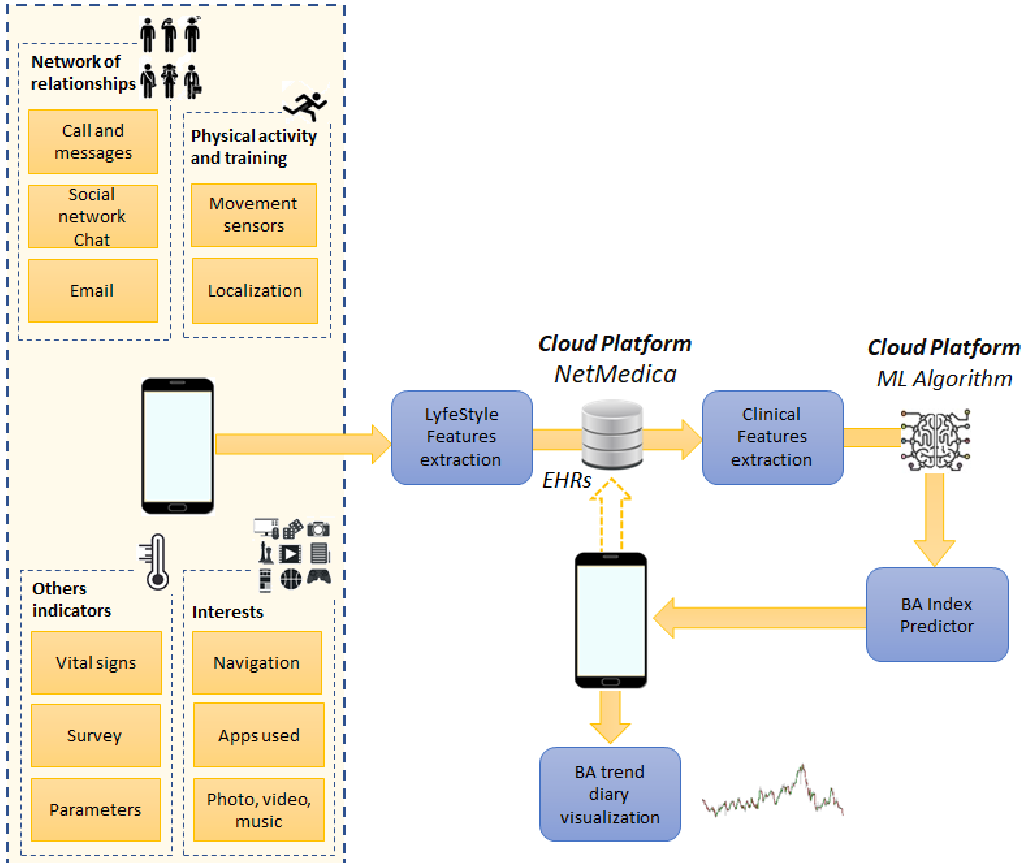
The proposed architecture is built on a "patient-centric" model that draws from two distinct data universes:
- Clinical Features (NMI Cloud): Derived from the Netmedica Italia network, these include official medical records, prescriptions, and historical pathologies managed by General Practitioners (GPs).
- Lifestyle Features (Smartphone): Divided into four macro-groups:
- Relationship Networks: Social interaction frequency.
- Physical Activity: Movement detection and training logs.
- Interests and Indicators: Location data and app usage.
- Vital Signs: Direct measurements like heart rate or sleep quality.
The model leverages a Gaussian Support Vector Machine (SVM) Regression. Unlike linear models, the Gaussian kernel allows the system to capture non-linear relationships between heterogeneous biomarkers.
Deep Dive: How BA is Calculated
The mathematical "trick" here is the use of prediction error. The model is trained to predict a subject's Chronological Age (CA) based on their clinical and lifestyle data.
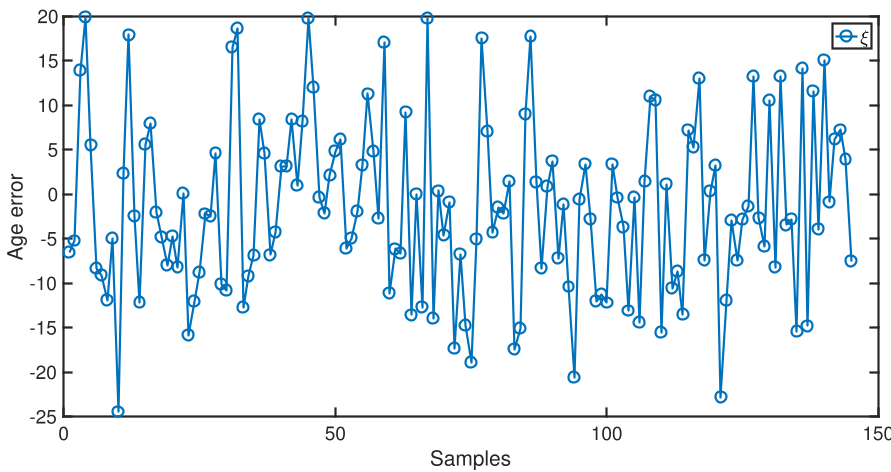
- If the model predicts you are older than you actually are (Positive Error), it suggests a higher Biological Age (poor physical state).
- If the model predicts you are younger (Negative Error), you possess a lower Biological Age (superior health status relative to your peers).
Experimental Results and SOTA Performance
In testing with a cohort of 484 subjects, the Gaussian SVM emerged as the superior model compared to Forest or Tree-based regressions. The researchers achieved a correlation coefficient of ρ = 0.735, indicating that clinical and lifestyle data are highly predictive of the aging process.
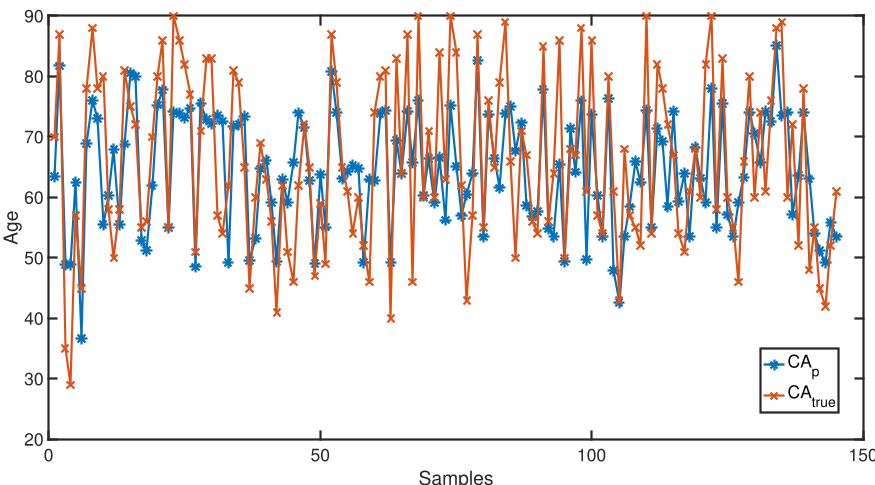
The error distribution (shown below) provides a clear visualization of the "Age Gap." This gap serves as a salient sub-index for BA, allowing users to see the immediate impact of their daily habits on their long-term health trajectory.
Critical Insight & Future Outlook
While this study provides a robust framework, it currently uses a subset of potential lifestyle features. The real power of this platform lies in its future scalability—specifically:
- Georeferencing: Mapping BA variations across different territories to identify environmental causes of aging.
- Dynamic Feedback: Moving from observation to intervention, where the smartphone app suggests specific behavioral changes ("good practices") to "reverse" the predicted age trend.
Takeaway: This work bridges the gap between the doctor’s office and the smartphone in your pocket, turning "aging" from an inevitable timeline into a manageable health metric.