
PSO-LSSVM: Revolutionizing Cost Prediction in Environmental Governance through Intelligent Optimization
A machine learning approach for cost prediction analysis in environmental governance engineering
This paper introduces a hybrid machine learning model, PSO-LSSVM, designed to predict costs for environmental governance engineering. By integrating Particle Swarm Optimization (PSO) with Least Squares Support Vector Machines (LSSVM) and employing Principal Component Analysis (PCA) for dimensionality reduction, the method achieves superior prediction accuracy and robustness compared to traditional Neural Networks.
TL;DR
Predicting the financial requirements of environmental governance is notoriously difficult due to complex variables and non-linear relationships. This paper presents an optimized machine learning framework, PSO-LSSVM, which combines Particle Swarm Optimization with Least Squares Support Vector Machines. By automating parameter tuning and streamlining indicator systems, the model achieves a remarkable MAPE of 1.81%, outperforming traditional neural networks in both accuracy and stability.
Background & Motivation: The Complexity of "Green" Costs
Environmental governance projects—such as air quality control or water remediation—are high-cost endeavors that require precise pre-project evaluation. Historically, industry experts relied on manual estimation or simple BP Neural Networks. However, these methods often fall into local optima or suffer from "over-fitting" due to noise in project data. The authors identified that the core bottleneck isn't just the learning algorithm itself, but the subjectivity of parameter selection and the redundancy of input indicators.
Methodology: The Hybrid Architecture
The proposed solution is a three-pillar system designed to handle the "noise" and "complexity" of engineering data.
1. Feature Engineering & PCA
The authors initially identified 24 indicators across five dimensions (environmental characteristics, structure, modification, construction, and project traits). To avoid the "curse of dimensionality," they used Principal Component Analysis (PCA) to transform these into a compact set of principal components that retain of the original information.
2. The LSSVM Core
Unlike standard SVMs, the Least Squares version (LSSVM) simplifies the computation by solving a set of linear equations rather than a quadratic programming problem. This makes it faster but highly sensitive to its hyperparameters:
- C (Regularization parameter): Balances error minimization against model complexity.
- (Kernel parameter): Defines the influence of a single training example.
3. PSO: The "Global Navigator"
The "Secret Sauce" of this paper is the Particle Swarm Optimization (PSO). It treats potential pairs as "particles" flying through a search space. Each particle adjusts its position based on its own best experience and the group's best result, effectively finding the optimal model configuration without human trial-and-error.
 Figure 1: Conceptual flow of the indicator system and machine learning integration.
Experimental Validation
The researchers tested the model against 33 real-world environmental project samples, using 25 for training and 8 for testing. They compared three distinct architectures:
- BP Neural Network
- Standard LSSVM (Trial-and-error tuning)
- PSO-LSSVM (Proposed)
Accuracy and Stability
The results were conclusive. While BP Neural Networks showed significant fluctuations, the PSO-LSSVM curve closely hugged the "Actual Cost" line.
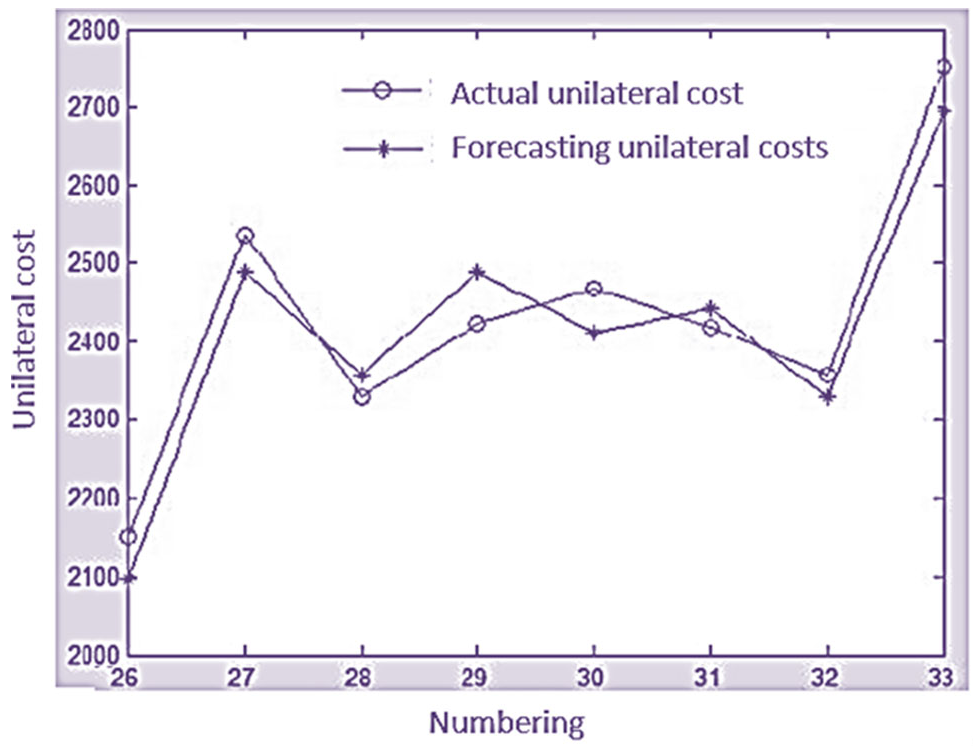 Figure 2: The PSO-LSSVM model shows superior fitting compared to the actual cost values.
| Method | Relative Error Range | MAPE (%) |
|---|---|---|
| BP Neural Network | [-7.37%, 5.64%] | 4.24% |
| Standard LSSVM | [-8.05%, 6.08%] | 3.95% |
| PSO-LSSVM | [-2.65%, 2.51%] | 1.81% |
Critical Insight: Why Does It Work?
The success of this approach lies in its Inductive Bias. By using PCA, the model ignores the "noise" inherent in environmental reporting. By using PSO, it avoids the "human-in-the-loop" bias of picking parameters that look good on training data but fail on test data.
However, there is a trade-off: Computation Time. The PSO-LSSVM took 13.25 seconds to train, compared to just 3.28 seconds for the standard LSSVM. For pre-project cost estimation, this extra 10 seconds is irrelevant, but for real-time applications, this overhead might be a consideration.
Conclusion & Future Outlook
This paper proves that for specialized, small-sample engineering tasks, optimized "Shallow" Learning (SVMs) is often superior to "Deep" Learning (Neural Networks). It provides a robust blueprint for environmental consultants to move away from "gut-feeling" estimates toward data-driven governance. Future work could involve integrating Temporal Fusion Transformers to account for inflation and fluctuating material costs over the project lifecycle.