
MLIA: Bridging the Credit Gap with Machine Learning and Search Behavior
Financial credit risk prediction in internet finance driven by machine learning
This paper introduces MLIA, an improved machine learning algorithm based on gradient lifting (GBDT) and decision trees, specifically designed for internet financial credit risk prediction. By integrating traditional credit features with high-dimensional, sparse search engine behavioral data, the model achieves a state-of-the-art AUC of 66.16% on cross-time verification sets, outperforming standard Logistic Regression.
TL;DR
Predicting credit risk for "credit-invisible" users in internet finance is a major challenge. This paper presents MLIA, a gradient lifting decision tree algorithm that extracts risk signals from sparse search engine data. By combining MLIA's behavioral insights with traditional Logistic Regression, the researchers successfully improved model generalization, achieving a 6.3% relative AUC improvement on cross-time validation.
Context: The Shift from Passive to Active Risk Control
The evolution of credit risk has moved from "passive control" (manual audits and collection) to "active control" (quantitative modeling). However, in the internet finance era, traditional banking data (income, historical loans) is often unavailable. The authors identify a critical gap: How can we use high-dimensional, sparse behavioral data—like what a user searches for on the web—to predict if they will default on a small loan?
Methodology: The MLIA Algorithm
The paper introduces the MLIA (Machine Learning Improvement Algorithm). It is grounded in the principle of decomposing an objective function into a weighted sum of weak learners (Decision Trees).
1. The Mathematical Intuition
The algorithm optimizes a loss function by iterating times. In each iteration , it calculates a step size to minimize the residual error from the previous iteration.
2. Hybrid Modeling Architecture
The researchers didn't just replace old models; they created a sophisticated pipeline:
- Phase 1 (Feature Extraction): Process 1,795 variables including LBS, e-wallet info, and user portraits via IV (Information Value) screening.
- Phase 2 (Behavioral Mining): Use MLIA to model 2,500 dimensions of raw search terms (e.g., keywords related to "gambling" or "cash").
- Phase 3 (Ensemble): The output of the search-term model (a default probability) is fed back into a Logistic Regression model as a core feature.
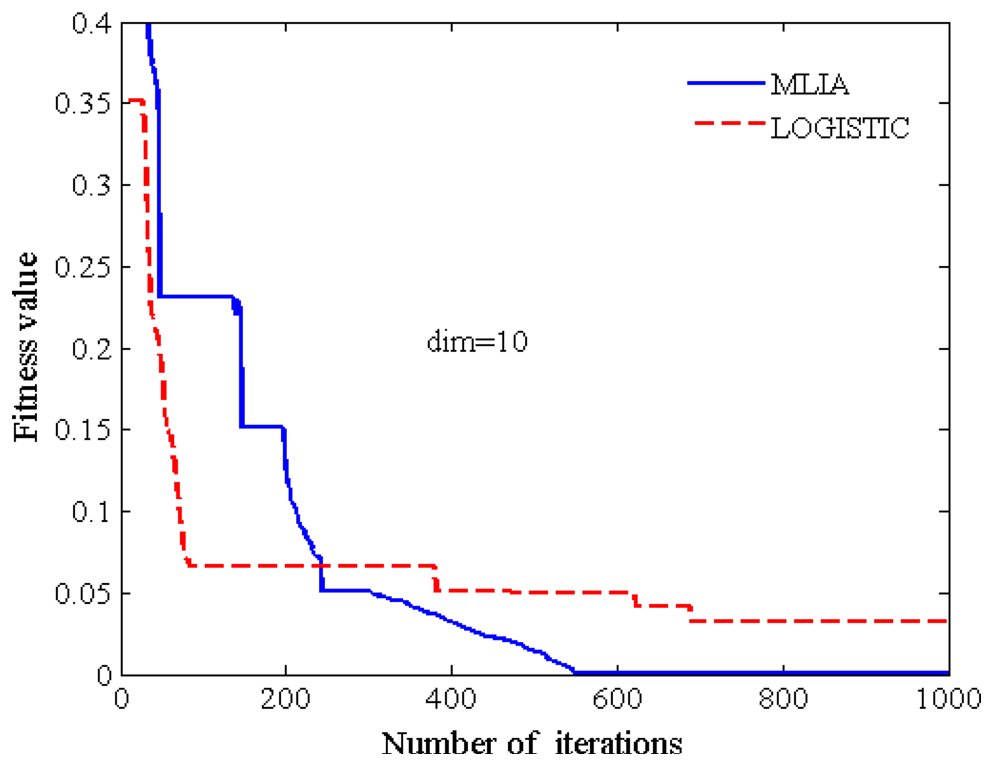 Note: The study highlights how MLIA converges faster and finds more accurate global optima compared to traditional logistic approaches.
Experiments & Results
The authors validated their approach using both mathematical test functions and real-world data from a Chinese internet finance company and a search engine giant (Company B).
SOTA Benchmarking
On complex multimodal functions like Griewank, MLIA significantly outperformed the standard Logistic approach, especially as dimensionality increased ().
Real-World Performance
The most impressive result is the Cross-time Verification. Standard models often "decay" when applied to data from a different time period.
| Model Version | Training AUC | Cross-Time AUC |
|---|---|---|
| First Edition (Basic) | 71.46% | 62.91% |
| Second Edition (MLIA Hybrid) | 77.46% | 66.16% |
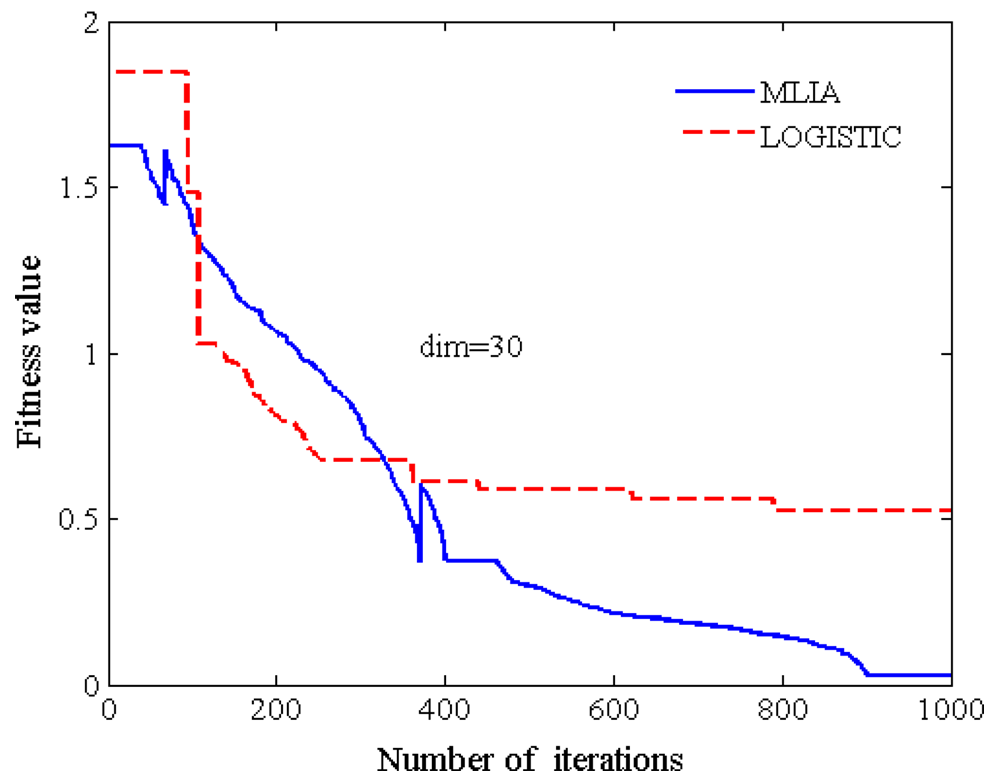 Fig: Iteration curves showing MLIA's superior convergence in high-dimensional spaces.
Insights: What Does the Model "See"?
One of the most fascinating aspects of this research is the Variable Gain analysis. The MLIA model identified specific keywords that strongly correlate with high risk:
- Top Risk Keywords: "Chess game" (internet gambling), "Black households" (fraud/blacklisted), "Ice poison" (illegal activities), and "Small amount cash."
This demonstrates that search behavior acts as a digital proxy for a user's personality and risk profile.
Critical Analysis & Conclusion
Takeaway: The study proves that MLIA is exceptionally suited for high-dimensional, sparse data where traditional regression fails. By creating a "Deep Feature" (the search probability) and using it within a "Wide Model" (Logistic Regression), they achieved a balance of accuracy and stability.
Limitations: The authors acknowledge that search behavior changes rapidly. A model built on today’s keywords might become obsolete in months, necessitating frequent iterations and a robust data pipeline to handle "drift."
Future Outlook: This methodology provides a blueprint for integrating "Big Data" behavioral signals into "Small Data" financial decisions, paving the way for more inclusive financial systems.