
MLDR: Optimizing Smart Agriculture WSNs via Kinematic-Based Data Reduction
Machine Learning Based Data Reduction in WSN for Smart Agriculture
The paper introduces a Machine Learning based Data Reduction (MLDR) algorithm for Wireless Sensor Networks (WSN) in smart agriculture. It utilizes a dual prediction model and kinematic functions to minimize data transmission between sensor nodes and the sink, achieving over 70% reduction in data traffic while maintaining high measurement accuracy.
TL;DR
To address the energy bottleneck in Smart Agriculture WSNs, this paper proposes MLDR (Machine Learning based Data Reduction). By treating environmental data shifts as physical "trajectories" using kinematic formulas, the system enables nodes to predict future values locally. This strategy slashes data transmission by over 70% to 87% compared to traditional periodic reporting, significantly extending the operational life of battery-powered sensors.
Context & Positioning
In the hierarchy of WSN optimization, data reduction sits at the intersection of energy efficiency and network reliability. While clustering and adaptive sampling are common, Dual Prediction Models (DPM) are the "Gold Standard" for high-fidelity monitoring. MLDR positions itself as a refinement of DPMs, specifically targeting the inefficiencies of the "Learning Phase" found in prior SOTA models like AS+TR.
The "Kinematic" Intuition: Why it Works
The core insight of MLDR is treating environmental variables (like temperature) not just as random data points, but as physical signals with momentum. The authors adopt Kinematic Functions:
- Value (val) = Position
- Trend (tr) = Velocity
- Evolution (e) = Acceleration
By using the second derivative (Evolution/Acceleration), the model can handle not just stable trends (linear growth) but also "Unstable Trends" (accelerated heating or cooling) through the formula:
This allows the sink to reconstruct the "path" of the temperature without receiving every single point.
Methodology: Hold vs. Buffer
The authors propose two architectural variants to balance memory and accuracy:
- MLDR-H (Hold): Optimized for memory-constrained motes. When a prediction fails, the node sends a "Hold" message, clears its state, and starts a fresh learning phase.
- MLDR-B (Buffer): Uses a sliding window (Buffer). When a change occurs, it looks back at recent history to immediately calculate a new trend, reducing the time the sink is "in the dark."
 Figure 1: Conceptual overview of the periodic sensing vs. prediction-based transmission.
Performance vs. State-of-the-Art
The experimental validation used 192 real-world temperature samples. The results highlight a massive leap in efficiency:
- Baseline (Periodic): 192 packets sent (0% reduction).
- AS+TR [15]: 85 packets sent (56% reduction).
- MLDR-H/B: 25-27 packets sent (85-87% reduction).
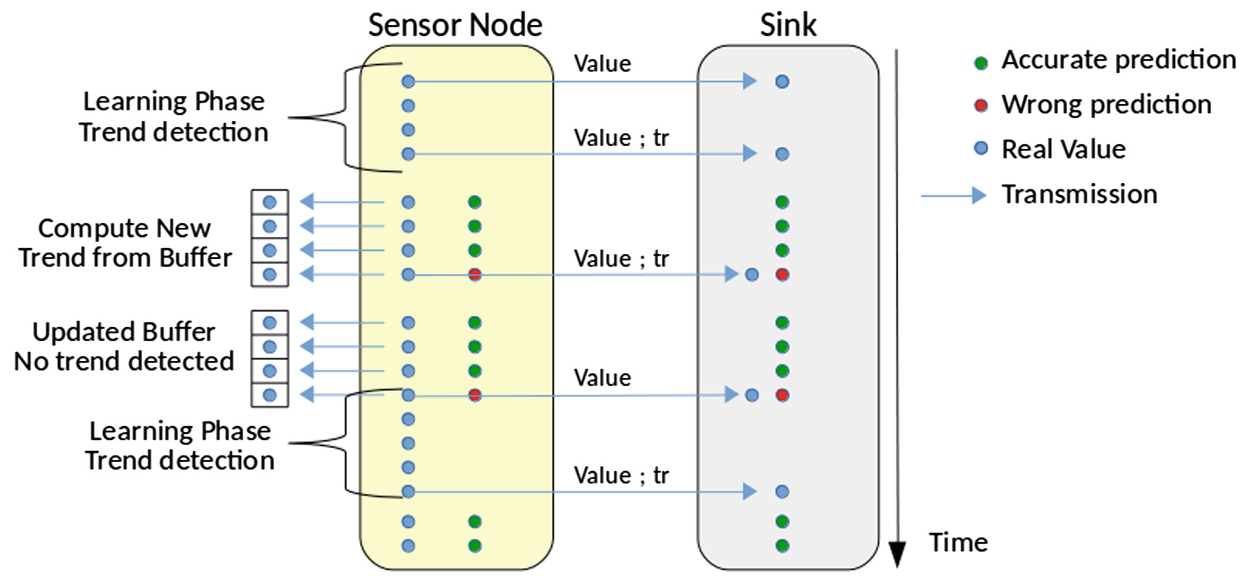 Figure 2: MLDR-H prediction accuracy over time. Note how the predicted values closely track the real-world ground truth while sending significantly fewer updates.
The "Critical Threshold" () ensures that even if the prediction model is in a learning phase, any sudden spike in temperature is transmitted immediately to prevent crop damage—a vital feature for agriculture.
Critical Analysis & Conclusion
MLDR's strength lies in its simplicity and physical basis. Unlike heavy Deep Learning models, kinematic equations require negligible CPU cycles, making them perfect for low-power microcontrollers.
Limitations:
- Unstable Evolution: If environmental changes are highly stochastic (non-uniform acceleration), the node stays in the learning phase, and the reduction benefits diminish.
- Univariate Focus: The current model handles one feature at a time. In reality, temperature and humidity are highly correlated ( is high).
Future Outlook: The logical next step is Multivariate MLDR, where a change in Humidity could "prime" the Temperature prediction model, further reducing the need for the "Learning Phase" and pushing data reduction toward the 90%+ theoretical limit.