
Beyond Simple Averages: Using Machine Learning to Rescue Non-Probability Online Surveys
Evaluating Machine Learning methods for estimation in online surveys with superpopulation modeling
This paper evaluates the efficacy of Machine Learning (ML) algorithms within a superpopulation modeling framework to mitigate selection bias in non-probability online surveys. By comparing various ML techniques across three distinct populations, it identifies Ridge regression and Neural Networks as superior alternatives to traditional linear models for population-level estimation.
TL;DR
Non-probability online surveys are plagued by selection bias because they rely on volunteers rather than random selection. This paper demonstrates that Superpopulation Modeling—specifically using Ridge Regression and Bayesian-regularized Neural Networks—can significantly reduce this bias (RMSE reduction of over 60% in some cases), outperforming traditional linear adjustments.
Background Positioning: This work bridges the gap between traditional survey statistics and modern predictive analytics, establishing a SOTA benchmark for identifying which ML algorithms are best suited for "cleaning" biased survey data.
The "Volunteering" Trap: Why Your Survey Data is Lying
In an ideal world, every member of a population has a known probability of being selected. In the real world of online panels, we deal with "volunteering bias": certain demographics (younger, more tech-savvy, or highly motivated individuals) over-represent themselves. Traditional weights fail when the underlying relationship between your covariates (like age or income) and your target variable ( like health status) is complex or non-linear.
The authors' insight is simple yet powerful: treat the survey adjustment as a prediction problem. If we can build a robust model of how (target) relates to (demographics) using the sample we do have, we can project those findings onto the census data we know exists to "fill in the blanks."
Methodology: The Superpopulation Modeling Framework
The core of the approach is the superpopulation model . The paper explores three ways to use this predicted value :
- Model-Based: Summing the observed sample values and the predicted values for the rest of the population.
- Model-Assisted: Using predictions to create a "difference estimator" that corrects for model errors.
- Model-Calibrated: Adjusting weights so that the sample totals of predicted values match the population totals.
The ML Contenders
The researchers tested a diverse arsenal:
- Penalized Models: Ridge, LASSO, and Elastic Net (to handle multicollinearity).
- Ensemble Methods: Random Forests (Bagged Trees) and Gradient Boosting (GBM).
- Neural Networks: Specifically with Bayesian regularization to prevent overfitting on small samples.
- Prototype Models: k-Nearest Neighbors (k-NN).
 Figure 1: The fundamental superpopulation assumption where represents the ML model's prediction.
Experiments: Ridge vs. The World
The authors tested these methods across three real-world datasets: a Spanish Life Conditions Survey (P1), a financial dataset (P2), and bank marketing data (P3).
Key Findings:
- Ridge Regression is the MVP: In populations with high multicollinearity among covariates, Ridge outperformed others, achieving a median efficiency of 64.3%.
- Neural Network Resilience: Bayesian-regularized Neural Networks (BRNN) were highly effective when sample sizes reached 5,000, suggesting they represent the best "high-ceiling" option.
- The Ensemble Disappointment: Surprisingly, Bagged Trees and GBM underperformed. The authors suggest that without intensive hyperparameter tuning, these "black box" models may struggle with the specific structure of survey bias.
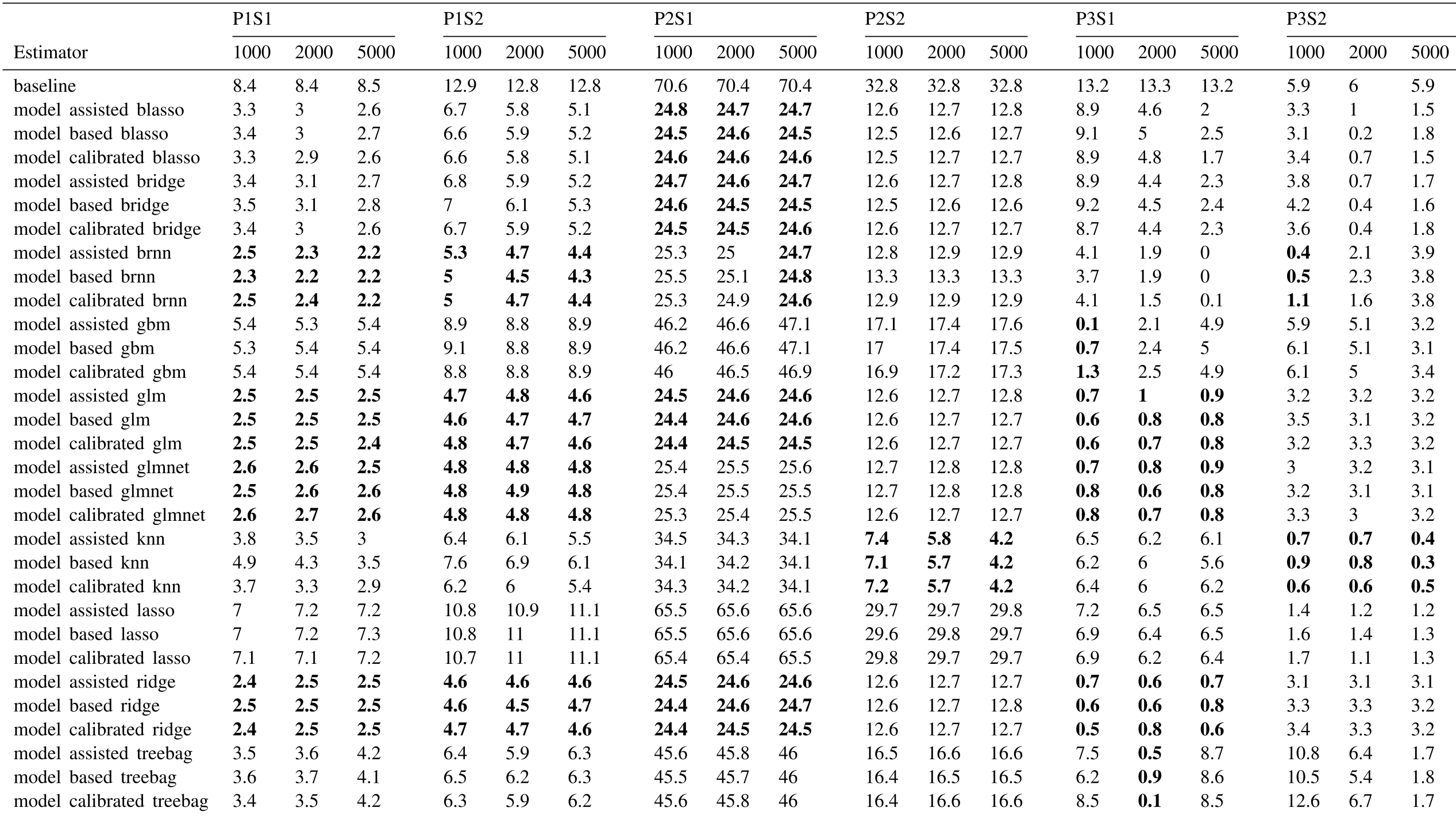 Table 1: Detailed Bias and RMSE across scenarios. Note how Ridge (bridge/ridge) and GLM consistently maintain lower error rates compared to the 'baseline'.
Critical Analysis & Conclusion
Takeaway
The most striking conclusion is that the choice of the ML algorithm matters far more than the specific statistical framework (Model-based vs. Model-assisted). If your model is weak, no amount of statistical weighting will save your estimate.
Limitations
- Hyperparameter Sensitivity: The paper used default parameters for most models. In practice, the performance gap between GBM/Trees and Ridge might close if GBM were tuned via cross-validation.
- Data Requirements: Superpopulation modeling requires access to population-level auxiliary information (censuses), which isn't always available in all countries or industries.
Future Outlook
As we move into an era where "Big Data" is ubiquitous but "Random Data" is rare, this paper provides a roadmap. Future research should look into Automated ML (AutoML) pipelines specifically designed for survey calibration, ensuring the best algorithm is selected dynamically based on the dataset's unique bias profile.