
The Imbalance Trap: Why Linguistic Phenomena Alone Don't Solve Textual Inference
Machine Learning for Imbalanced Datasets of Recognizing Inference in Text with Linguistic Phenomena
This paper presents a comprehensive empirical study on Recognizing Inference in Text (RITE) by analyzing the impact of imbalanced datasets across 28 distinct linguistic phenomena. Using the NTCIR-11 RITE-VAL benchmark, the researchers utilize a Support Vector Machine (SVM) classifier to demonstrate how skewed class distributions significantly alter classification performance.
TL;DR
Recognizing Inference in Text (RITE) is the backbone of modern Question Answering. However, most models struggle not because of linguistic complexity, but because of Data Imbalance. This study evaluates how 28 different linguistic phenomena (like negation and hypernymy) behave under skewed class distributions, revealing that traditional SVMs are dangerously biased toward majority labels in semantic tasks.
Background: The Hidden Skeleton of RITE
In a typical RITE task, a system determines if a Hypothesis can be inferred from a Text. While modern NLP has moved toward deep learning, the fundamental "logical units" of inference remain linguistic phenomena. The NTCIR-11 RITE-VAL task broke these down into 28 categories, such as:
- Lexical Relations: Antonyms, Synonyms, Hypernyms.
- Logic/Structural: Negation, Scrambling, Coreference.
- Exclusions: Spatial, Temporal, and Common Sense contradictions.
The problem? In real-world datasets, these aren't distributed equally.
The Core Challenge: Classification Bias
The authors argue that when one class (e.g., "Entailment") significantly outnumbers the other, standard classifiers like SVM maximize global accuracy by simply ignoring the minority class. This is particularly problematic in linguistic inference where "Non-entailment" (N) is often triggered by specific, rare phenomena like exclusion:modality.
Methodology: Stress-Testing Imbalance
The researchers didn't just train a model; they performed a "ratio-based stress test." They organized the NTCIR-11 RITE-VAL dataset into 20 different groups, ranging from perfectly balanced (50/50) to highly imbalanced (e.g., 6:1 ratio).
Model Architecture & Features
- Classifier: Support Vector Machine (SVM).
- Features: 28 Linguistic Phenomenon Categories.
- Dataset Source: NTCIR-11 RITE-VAL Gold Standard (1200 pairs) and Development Set (581 pairs).
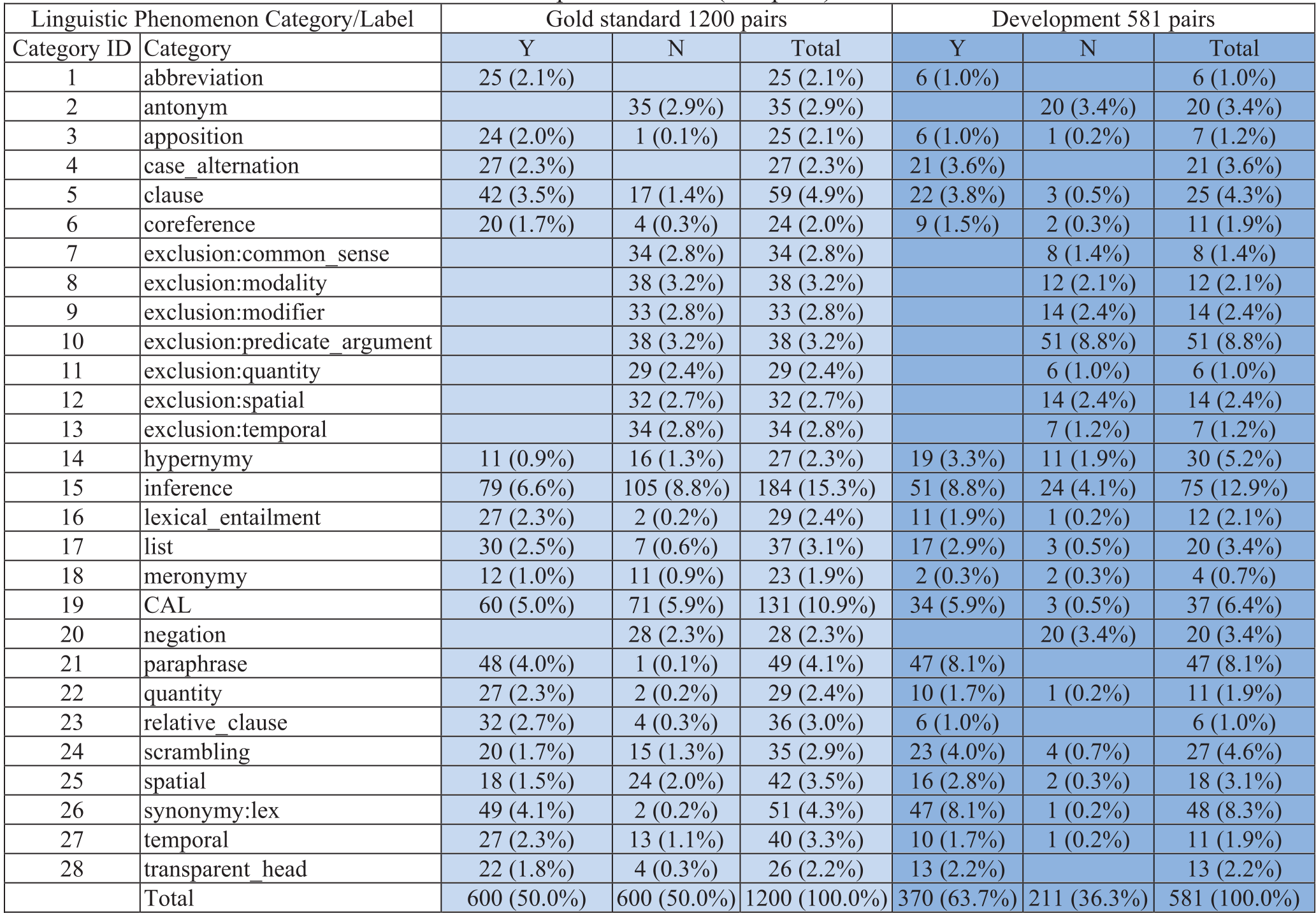 Table: The distribution of labels (Y/N) across the 28 linguistic categories.
Experimental Insights: Accuracy is a Deceptive Metric
The findings were striking. As the imbalance increased, the "accuracy" of the model appeared to improve, but this was a mirage of the majority class dominance.
Key Results:
- Imbalance Inflates Performance: The highest accuracy (93.29%) was found in the most imbalanced set (
D700 - Y600 N100). - Balanced Reality: When forced to predict on a balanced set (
D1200 - Y600 N600), the accuracy dropped significantly to 78.83%. - The "Inference" Dominance: The "Inference" category (General semantic reasoning) was the most frequent phenomenon, accounting for ~15% of all cases, effectively "drowning out" rarer phenomena like
AbbreviationorMeronymy.
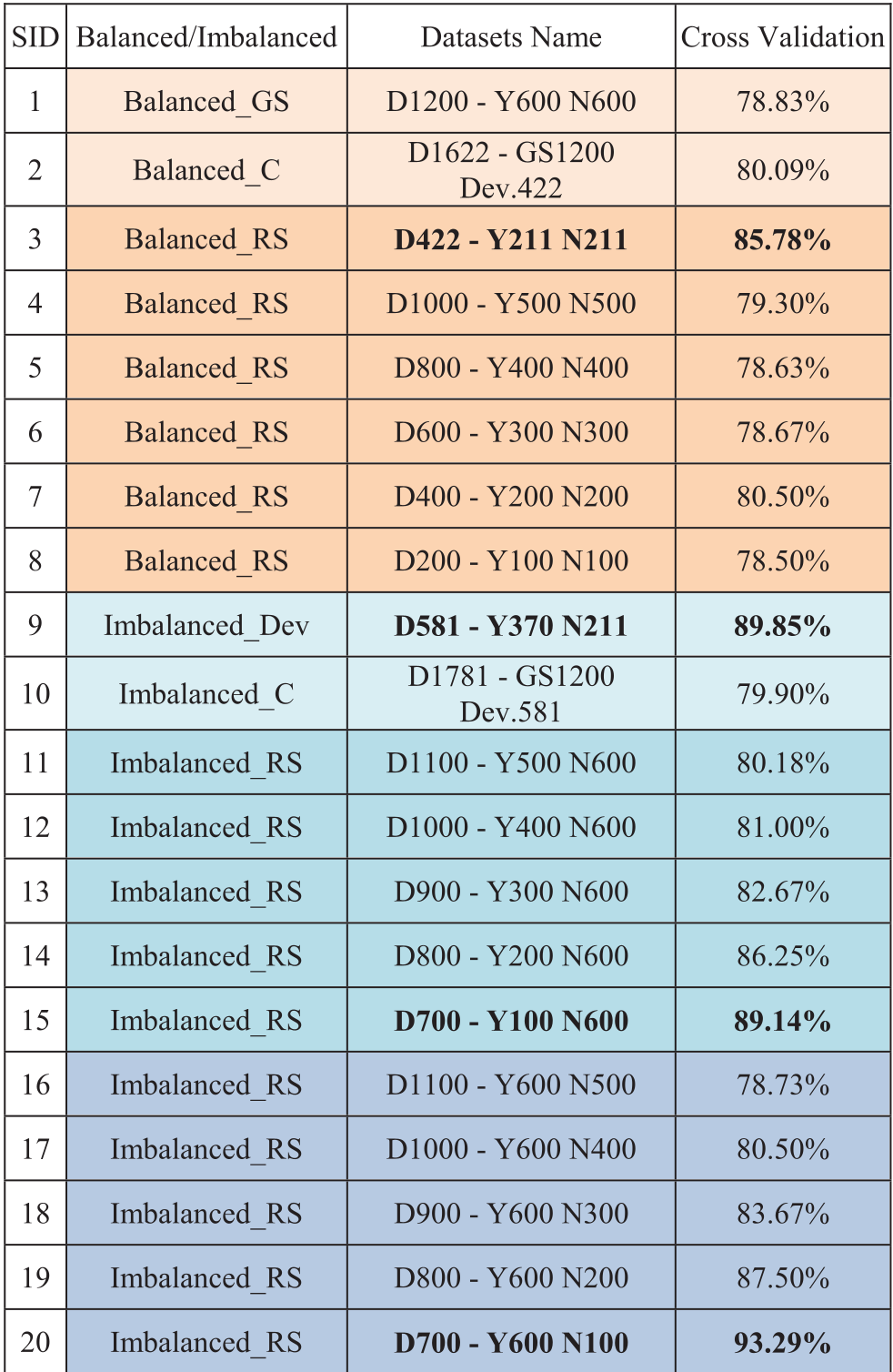 Table: Comparison of CV Accuracy across 20 groups of balanced and imbalanced configurations.
Critical Analysis & The Path Forward
The study concludes that Accuracy is a poor metric for RITE systems. If a system is 90% accurate but fails to detect every instance of Negation (because negation is rare in the training set), it is essentially useless for robust QA.
Limitations:
- Feature Simplicity: The study uses Category IDs as features. In modern contexts, these should be integrated as "Inductive Biases" in Transformer models rather than raw SVM features.
- SVM Constraints: While SVMs are good for high-dimensional small data, they lack the ability to capture the nuance of the linguistic phenomena themselves—they only see the labels.
Future Outlook:
For developers of QA and Validation systems, this paper acts as a warning: Don't trust a high F1 score on a skewed dataset. To build truly "intelligent" RITE systems, we must use techniques like SMOTE (Synthetic Minority Over-sampling Technique) or cost-sensitive loss functions to ensure that even the rarest linguistic "Exclusion" is treated with the same weight as common "Inference."
Final Takeaway
The performance of a machine learning classifier in textual inference is as much a function of data distribution as it is of algorithmic sophistication. Linguistic phenomena are the "what," but class balance is the "how" of successful model training.