
ML-BATC: Optimizing Semiconductor Batch Scheduling via Parameter Learning
Machine learning techniques for scheduling jobs with incompatible families and unequal ready times on parallel batch machines
The paper introduces a machine learning-enhanced scheduling approach for parallel batch machines with incompatible job families and unequal ready times. It utilizes Inductive Decision Trees (IDT) and Multi-layer Perceptrons (MLP) to dynamically estimate the optimal look-ahead parameter for the Batched Apparent Tardiness Cost (BATC) dispatching rule, targeting SOTA performance in minimizing Total Weighted Tardiness (TWT).
TL;DR
Scheduling parallel batch machines in semiconductor fabrication is an NP-hard challenge exacerbated by incompatible job families and dynamic arrivals. This paper presents a hybrid methodology that keeps the speed of the Batched Apparent Tardiness Cost (BATC) dispatching rule but uses Neural Networks and Decision Trees to intelligently "tune" its sensitive look-ahead parameter (). The result? Schedules nearly as good as brute-force optimization but generated in real-time.
Problem & Motivation: The "Waiting" Paradox
In the diffusion and oxidation areas of a wafer fab, machines process "batches" of jobs. However, two constraints make this difficult:
- Incompatibility: Only jobs from the same family can be processed together.
- Unequal Ready Times: Jobs arrive at different times.
The core dilemma is the Waiting Paradox: Should a machine start a half-empty batch now to save time, or wait for a future arrival to increase efficiency? The classic ATC (Apparent Tardiness Cost) rule handles this using a look-ahead parameter (). If is too small, the system becomes too focused on processing times; if too large, it focuses solely on due-date slack. Finding the "Goldilocks" value of usually requires expensive manual simulation or exhaustive search.
Methodology: The Machine Learning Strategy
The authors treat the parameter setting as a regression/classification problem.
1. Feature Engineering (The System State)
Instead of raw data, they define five high-level descriptors of the factory's current state:
- & : Tightness of due dates and ready times.
- & : Range/variance of due dates and ready times.
- : The batch-machine factor (an indicator of system load).
2. Architecture
They compared two primary ML models to predict :
- Multi-layer Perceptron (MLP): A feed-forward neural network with 3 to 7 hidden nodes.
- Inductive Decision Trees (ID3): Which partitions the attribute space into hypercubes to assign the best class.
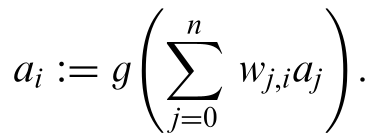 Note: The model uses the system features as inputs to minimize the weighted sum of tardiness.
Experiments & Results
The researchers tested the models against a "Near-Optimal" baseline (calculating every possible value).
Key Findings:
- Near-Optimal Performance: The IDT approach with 25 classes achieved a Mean Square Error of only 0.0259 against the theoretical optimum.
- Generalization: Even when tested on scenarios with different batch sizes or 12 job families (vs. the 3 used in training), the models remained robust.
- Efficiency: Training takes minutes, but inference (deciding ) takes milliseconds, making it suitable for high-velocity manufacturing environments.
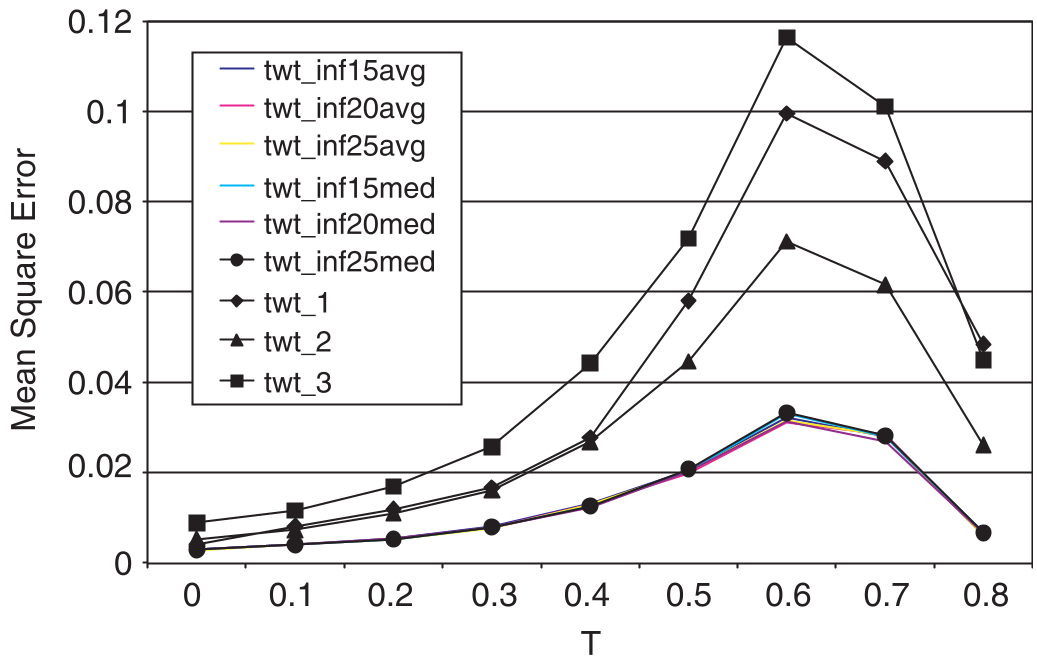 Graph: Impact of Due Date Tightness (T) on performance. The ML-predicted curves (twt_inf) closely track the optimal patterns.
Critical Analysis & Conclusion
Takeaway
The genius of this work isn't in a new complex algorithm, but in improving a simple one. By using ML to "supervise" a dispatching rule, we get the best of both worlds: the reliability of industry-standard rules and the adaptive "intelligence" of modern AI.
Limitations & Future Work
- Static vs. Incremental: The current ID3 setup is static. In a real fab, data is a stream. The authors suggest moving to ID5R (Incremental Induction) in the future.
- Setups: The study assumes incompatible families, but future models need to handle sequence-dependent setup times, where the "cost" of switching between families isn't constant.
This paper serves as an early but foundational proof that machine learning can act as a high-level "tuner" for classical industrial engineering heuristics.