
Signal Compression & Classification: Taming the Curse of Dimensionality in Paralinguistics
Comparative studies on machine learning for paralinguistic signal compression and classification
The paper investigates various signal compression (PCA, LDA, AE) and classification algorithms (SVM, MLP, CNN, etc.) for paralinguistic tasks. It identifies that combining acoustic feature compression with a Multilayer Perceptron (MLP) achieves State-of-the-Art (SOTA) performance on heartbeat anomaly detection and speech emotion recognition.
TL;DR
Paralinguistic signals—like the subtle rhythm of a heartbeat or the nuanced tone of a disabled speaker—are notoriously hard to classify due to data scarcity and high-dimensional feature noise. This paper demonstrates that compressing features via Autoencoders or PCA and utilizing a Multilayer Perceptron (MLP) is more effective than using original high-dimensional features or complex CNN architectures, effectively outperforming prior attention-based SOTA models on the IEMOCAP dataset.
Context: The Paralinguistic Data Bottleneck
In the world of AI, we are spoiled by the abundance of image and text data. However, paralinguistic data (non-verbal vocalizations) is expensive and rare. Collecting heartbeat sounds from patients or spontaneous emotional outbursts from individuals with disabilities requires specialized environments.
When researchers extract features like prosody, energy, and MFCCs using tools like openSMILE, they often end up with over 6,000 dimensions. For a dataset with only a few hundred samples, this is a classic "Curse of Dimensionality" scenario.
Methodology: Compression as a Regularizer
The authors argue that many dimensions in acoustic feature sets are redundant. They propose a two-step pipeline:
- Compression: Reducing dimensions using Principal Component Analysis (PCA), Linear Discriminant Analysis (LDA), or Deep Autoencoders (AE).
- Classification: Testing the "compressed intelligence" across Logistic Regression, SVMs, XGBoost, CNNs, and MLPs.
The Architecture
The Autoencoder approach specifically uses dense layers with SELU (Scaled Exponential Linear Unit) activations and Batch Normalization to stabilize the latent space embedding.
 Figure 1: High-level overview of the feature extraction and classification pipeline.
Experimental Insights
The study analyzed three distinct corpora: Heartbeat classification (HSS), Atypical Affect (EmotAsS), and Speech Emotion Recognition (IEMOCAP).
1. Heartbeat Sounds: PCA-200 + MLP wins
In the heartbeat task, reducing the 1,582-dimensional Emobase features to just 200 via PCA actually improved performance when paired with an MLP, reaching 57.67% accuracy. This suggests that noise in the high-dimensional space was actively hindering the classifier.
2. Emotion Recognition: The MLP Superiority
A key finding was the failure of CNNs in this specific domain. Because the input consists of statistical "summaries" (mean, max, kurtosis) rather than temporal raw signals, the local feature-sharing bias of CNNs is actually a disadvantage.
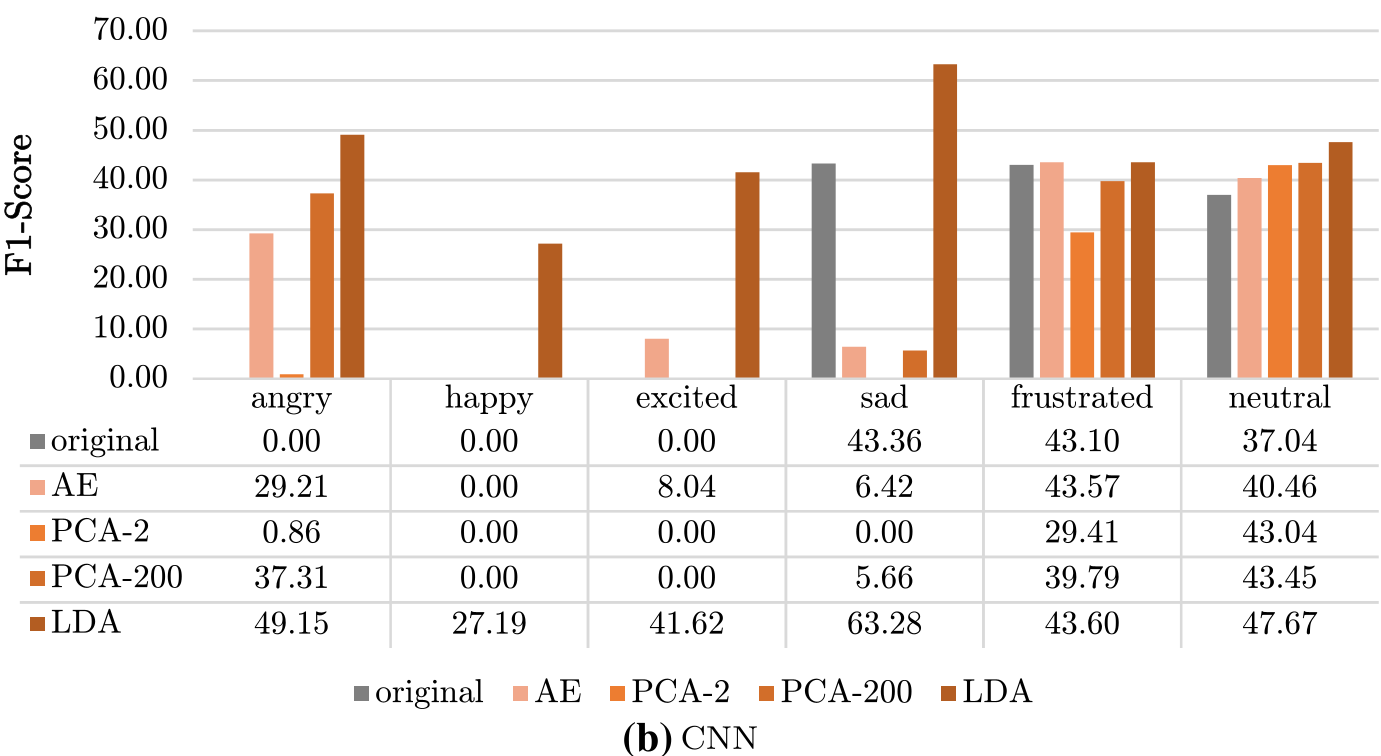 Figure 2: F1-scores comparing MLP and CNN. Note how the MLP maintains a much more stable distribution across emotions.
3. Outperforming Attention Models
Perhaps the most striking result is found in the comparison with Local-attention BLSTM and Audio-BRE models on the IEMOCAP dataset. Despite not using complex recurrence or attention mechanisms, the authors' compression-MLP approach better distinguished "Excited" from "Happy" classes—a notoriously difficult boundary in affective computing.
Critical Analysis & Takeaways
- Simplicity is Robust: In low-data regimes, a well-tuned MLP on compressed features often beats sophisticated attention-based architectures.
- Inductive Bias Matters: Don't use CNNs on statistical feature vectors. CNNs assume spatial/temporal locality, which is destroyed once you calculate the "standard deviation of the pitch" over an entire utterance.
- Limitations: The study relies on hand-crafted LLD (Low-Level Descriptors). Future work should bridge this with modern Self-Supervised (SSL) acoustic embeddings to see if the need for explicit compression persists.
Conclusion
This paper serves as a vital reminder for practitioners in medical and niche audio domains: when your data is small, feature engineering and dimensionality reduction are your best defenses against overfitting.
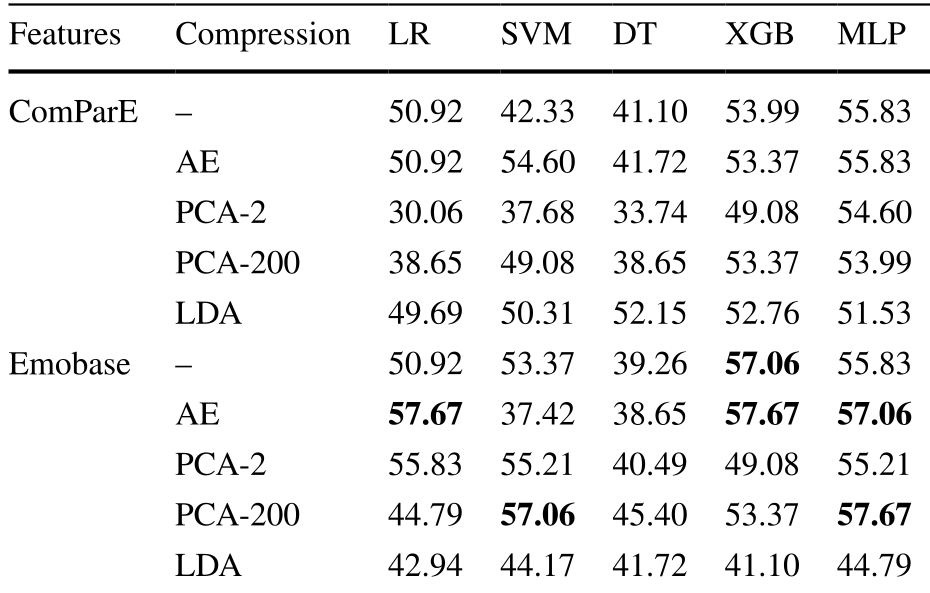 Table 1: Heartbeat classification results showing the dominance of MLPs and XGBoost on compressed sets.