
Predicting Online Banking Satisfaction: A Machine Learning Perspective in Bangladesh
Predicting Satisfaction of Online Banking System in Bangladesh by Machine Learning
This study evaluates customer satisfaction with online banking systems in Bangladesh using machine learning. By benchmarking seven classification algorithms on survey-acquired data, the researchers identified Random Forest and KNN as top performers, achieving a peak accuracy of 96% in predicting user sentiment.
TL;DR
As Bangladesh transitions towards a "Digital Bangladesh," online banking has become a lifeline. This study employs machine learning to predict whether customers are satisfied with these services. By analyzing survey data from various demographics, the researchers found that Random Forest and KNN can predict satisfaction with an impressive 96% accuracy, highlighting service reliability and ease of use as the most critical factors.
Background & Motivation
The COVID-19 pandemic acted as a catalyst for digital banking in Bangladesh, pushing services like bKash, Rocket, and Nagad into the mainstream. However, this rapid shift brought challenges: fear of third-party money laundering and inconsistent service quality. The authors set out to move beyond simple surveys by building a predictive model that helps banks understand why customers are happy or frustrated, providing a data-driven roadmap for service improvement.
Methodology: The Seven-Model Showdown
The authors didn't just pick one algorithm; they conducted an exhaustive comparison across seven traditional machine learning classifications to find the most robust "delimiter":
- Logistic Regression & SVM: For linear decision boundaries.
- Random Forest & Decision Trees: To handle complex, non-linear interactions between features like age, occupation, and transaction frequency.
- KNN: Using proximity to classify user behavior patterns.
- Neural Networks & Naïve Bayes: For probabilistic and deep-seated pattern recognition.
Feature Engineering: What Matters Most?
Using Recursive Feature Elimination (RFE) and Information Gain, the study narrowed down the variables that actually move the needle on satisfaction.
- Information Gain Winner: Attributes like "rely answer" (user dependency) and "find out" (accessibility) showed the highest entropy reduction.
 Fig 1: Correlation Analysis showing the relationship between different user attributes.
Experimental Results & Performance
The results were remarkably competitive. While several models hit the 96% accuracy mark, the Random Forest algorithm emerged as the winner. Why? Because in classification tasks involving human behavior, the "ensemble" nature of Random Forest prevents overfitting—a common trap where a model memorizes survey noise instead of learning general trends.
| Algorithm | Accuracy | Precision | Recall | F1-Score |
|---|---|---|---|---|
| Random Forest | 96% | 0.98 | 0.96 | 0.97 |
| KNN | 96% | 0.98 | 0.96 | 0.97 |
| SVM | 93.3% | 0.90 | 0.96 | 0.96 |
| Neural Network | 86% | 0.86 | 1.00 | 0.92 |
The Neural Network achieved a 100% recall (identifying all satisfied users), but its lower precision indicates it likely suffered from false positives. Random Forest provided the most balanced and reliable "Real World" performance.
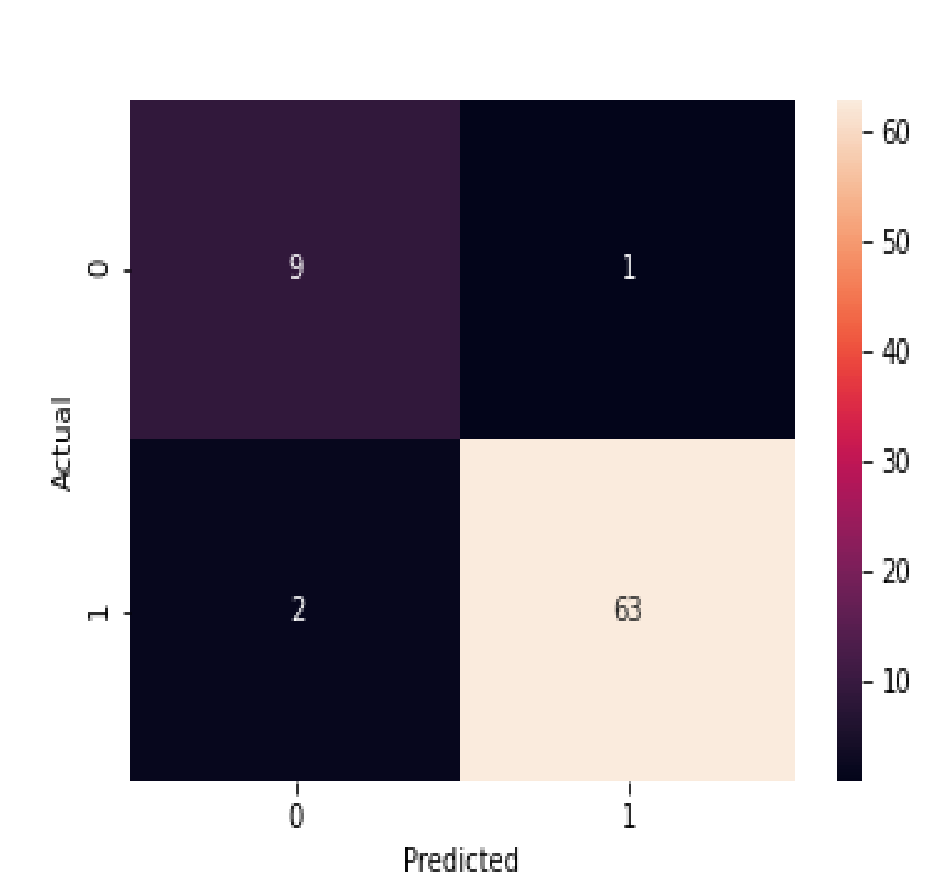 Fig 2: The Confusion Matrix for Random Forest, showing only 1 false negative.
Critical Insight: The "Accessibility" Factor
A fascinating finding in the data analysis phase was the impact of the "Find Out" attribute. Users who found the system easy to navigate had a 96.81% satisfaction rate. Conversely, for those who struggled with the interface, satisfaction dropped to nearly 50%. This quantitative gap proves that in developing markets, UI/UX is not a luxury—it is the primary driver of trust.
Conclusion & Future Work
The study successfully demonstrates that machine learning can accurately quantify the "soft" metric of customer satisfaction. By identifying that 86.6% of the surveyed users are satisfied, the paper paints an optimistic picture for fintech in Bangladesh.
Future Outlook: The authors plan to transition this research into a mobile application—a recommender system that uses these ML weights to suggest the "best" bank based on a user's specific profile and needs. As the dataset grows, moving toward Deep Learning (LSTM) for temporal satisfaction tracking would be a logical and powerful next step.