
Moving Beyond Random Choice: A Comparative Study of ML Strategies for Web Service Recommendation
Evaluation of the Employment of Machine Learning Approaches and Strategies for Service Recommendation
This paper evaluates the performance of classification and regression approaches for Web service recommendation based on non-functional properties (NFPs). It identifies that while classification directly predicts the "best-fit" service, regression algorithms like FIMT-DD offer superior utility optimization in complex scenarios involving cyclic performance variations.
TL;DR
Choosing the "best" web service in a crowded market is no longer a matter of static lookup. This paper dives into the mechanics of Classification vs. Regression for service recommendation. Using real-world data and advanced simulations, the researchers found that while classification is great for straightforward "winner" detection, regression-based approaches (like FIMT-DD) are much better at understanding the nuanced cycles of service performance, leading to more resilient 97% optimization achievements.
Context: The Volatile Market of Services
In the world of Service-Oriented Computing (SOC), multiple providers often offer identical functionality. The differentiator is the Non-Functional Property (NFP)—primarily response time and availability. Because these properties change based on "call context" (time, location, day), a static recommendation is useless.
The core challenge identified by Kirchner et al. is that the service environment is in a state of perpetual change. New providers enter, performance drifts, and consumer preferences vary. Most existing Collaborative Filtering (CF) models fail to account for this context-specific drift.
Methodology: Two Paths to Optimization
The study explores two distinct Machine Learning (ML) philosophies:
- Classification (The direct "Winner" approach): Services are categorized as "best-fit" or "non-best-fit." It’s computationally faster at the recommendation stage but loses information about the relative quality of the runners-up.
- Regression (The "Performance Predictor" approach): This predicts the actual numerical NFP value (e.g., response time in ms) for each service. While it requires more calculation, it enables a ranked list of candidates.
Architectural Framework
The authors utilized a broker component that collects measurement data, pre-processes it with statistical attributes (like moving averages), and updates a "Background Model."
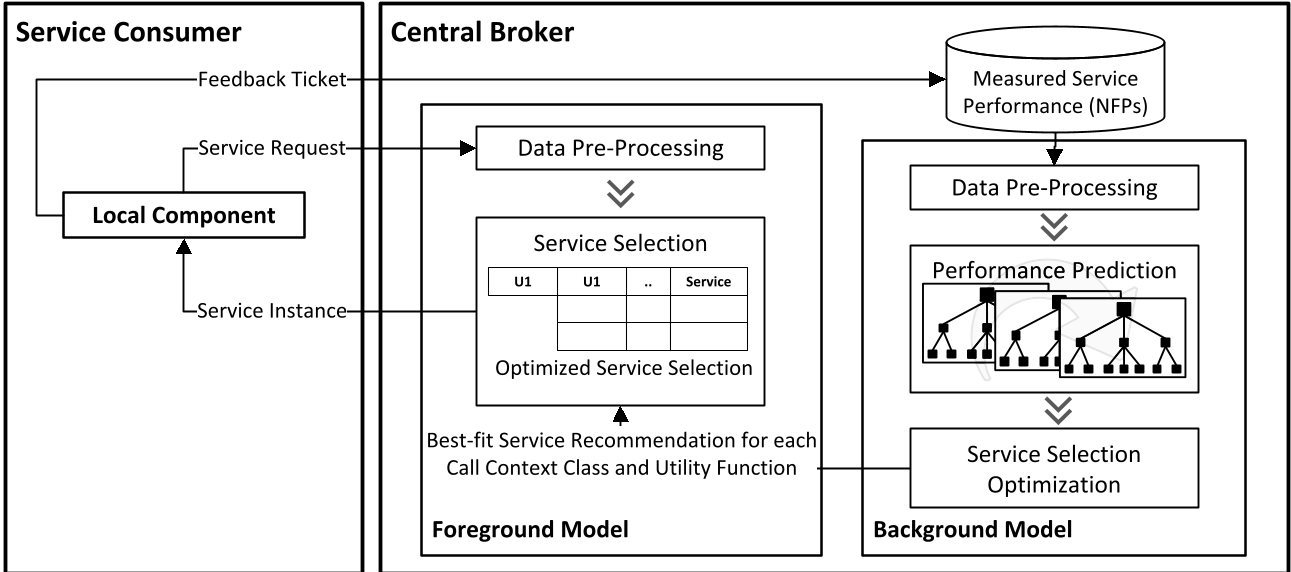 Figure 1: The Broker framework showing the integration of ML learning for NFP prediction.
Key Performance Indicators (KPIs)
To judge the models, the researchers didn't just look at accuracy. They defined two critical metrics:
- Best Choice: Did we pick the actual #1 service? (Accuracy)
- Overall Achievement: On a scale from the worst to the best service, how much of the performance gap did our recommendation close? (Optimization Utility)
Experimental Insights: Real vs. Simulated
1. Real-World Success
Using data from four stock quote Web services over 185 days, the team found that sliding window learning outperformed incremental updates.
- Classification (DecisionStump): Hit a higher "Best Choice" peak (82.26%).
- Regression (FIMT-DD): Offered more steady results across longer prediction windows.
2. The Stress Test: Profile-Guided Simulation
The most interesting part of the research is the simulation of "Spikes." Real-world service profiles are often too distinct to challenge a model. The authors created scenarios where service profiles overlapped, adding Cyclic Spikes (regular performance drops/gains) and Acyclic Spikes (random fluctuations).
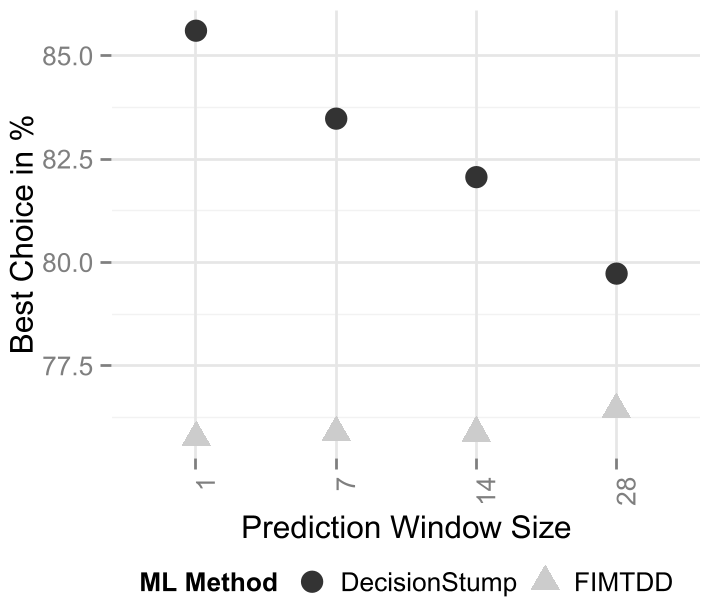 Figure 2: Performance metrics across different training window sizes.
The Verdict on Spikes: Regression proved superior in cyclic environments. Because FIMT-DD models the performance profile of each service individually, it "understands" when a service is likely to recover from a spike. Classification, which only sees who won previously, often gets confused when the "champion" changes rapidly.
Critical Analysis & Conclusion
This paper provides a sobering look at a common trade-off in ML: simplicity vs. insight.
- The Strength of Regression: Its ability to rank "second-best" services is vital. In production environments, the #1 service might be overloaded; having a high-confidence #2 predicted by regression is better than a "non-best" label from a classifier.
- The Problem of Acyclic Spikes: Neither model handles random, aperiodic spikes well. In these cases, the models performed barely better than random selection.
Future Outlook
The authors suggest that future systems must account for over-consumption. If a recommender sends everyone to the "best" service, that service's performance will naturally degrade due to load. This creates a feedback loop that requires more advanced, perhaps Reinforcement Learning (RL) based, load-aware strategies to solve.
For architects building service brokers today: Use a sliding window of 40-60 days with a regression model. It strikes the best balance between accuracy and the ability to capture performance trends.