
From GMMs to i-vectors: Modernizing Speech Emotion Recognition
Machine Learning Approaches for Speech Emotion Recognition: Classic and Novel Advances
2018-01-01
Summary
Problem
Method
Results
Takeaways
Abstract
The paper explores Speech Emotion Recognition (SER) by benchmarking classical Gaussian Mixture Models (GMM) against modern i-vector and Probabilistic Linear Discriminant Analysis (PLDA) frameworks. Utilizing simulated Japanese and German emotional speech databases, the authors achieve a State-of-the-Art (SOTA) 91.4% recognition rate using the i-vector/PLDA approach across four emotions.
## TL;DR
This research provides a comprehensive bridge between classic acoustic modeling and modern factor analysis for Speech Emotion Recognition (SER). By adapting the **i-vector + PLDA** framework—originally the gold standard for speaker identification—the authors achieved a **91.4% accuracy** in speaker-independent emotion detection, significantly outperforming both standard GMMs and human listeners.
## The Core Challenge: Emotional Variability
Recognizing emotion in speech is notoriously difficult due to the "speaker variability" problem. An angry voice for one person might sound like the neutral voice of another. Traditional Hidden Markov Models (HMM) and Gaussian Mixture Models (GMM) often treat features in a vacuum, failing to extract the underlying "latent factors" that define an emotion regardless of who is speaking.
## Methodology: The i-vector Revolution
The breakthrough in this paper lies in the adaptation of the **i-vector paradigm**. Instead of using high-dimensional supervectors that are cumbersome and noisy, the authors use **Total Variability Modeling**.
### 1. The i-vector Equation
The model represents a speech supervector $M$ as:
$$M = m + Tw$$
Here, $m$ is the emotion-neutral mean, $T$ is a low-rank matrix capturing variability, and $w$ is the **i-vector**—a compact, low-dimensional representation of the emotional state.
### 2. PLDA (Probabilistic Linear Discriminant Analysis)
After extracting the i-vectors, the authors apply **PLDA** to maximize the distance between different emotion classes while minimizing the distance between different speakers expressing the same emotion.
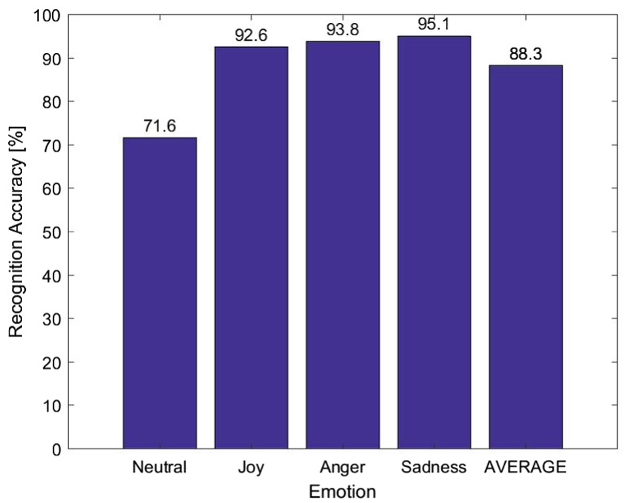
*Figure: Comparative recognition rates highlighting the superiority of PLDA and UBM-GMM approaches.*
## Multi-Feature Late Fusion
Beyond i-vectors, the study introduces a "Late Fusion" technique for GMMs. Instead of picking the "best" feature, it combines the scores from multiple classifiers trained on:
* **MFCC**: Spectral envelope.
* **PLP**: Perceptually motivated features.
* **PARCOR**: Linear prediction-based coefficients.
The authors discovered that **PLP and PARCOR** actually outperform the industry-standard MFCCs in emotional tasks, particularly for identifying "Anger" and "Sadness."
## Results & Experimental Evidence
The results demonstrate a clear hierarchy of performance:
1. **i-vector + PLDA**: 91.4% (Highest Accuracy)
2. **Late Fusion GMM**: 90.9%
3. **Standard GMM (MFCC)**: 80.9%
4. **Human Evaluation**: 68.1%
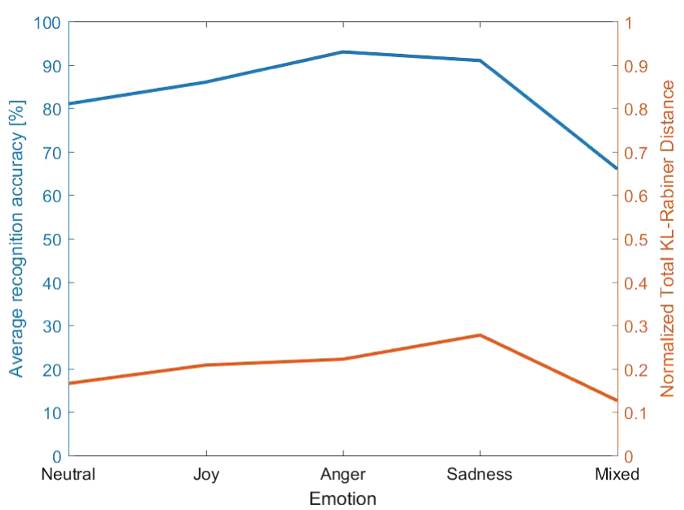
*Figure: (a) Normalized Juang-Rabiner distances showing how distinct emotions are in the vector space; (b) Comparison across different feature sets.*
Interestingly, the study found that **Anger** is the most easily recognized emotion across both Japanese and German datasets, likely due to its unique spectral energy and intensity profile.
## Critical Analysis & Conclusion
### Takeaway
The shift from raw acoustic modeling to latent factor modeling (i-vectors) is essential for SER. This paper proves that techniques developed for identifying *who* is speaking are equally powerful for identifying *how* they are feeling.
### Limitations
The primary caveat is the use of **simulated data** (actors). While professional actors provide clear "prototypical" emotions, real-world data is often more ambiguous and "noisy." Future work must validate these i-vector gains on spontaneous, real-world conversations (e.g., call center recordings).
### Future Outlook
As we move into the era of Transformers and Wav2Vec 2.0, the "feature fusion" and "latent modeling" insights from this paper remain relevant. Modern SSL (Self-Supervised Learning) models essentially perform a more complex version of the latent extraction described here, proving that the authors' intuition was ahead of the curve.