
High-Flying Intelligence: Transforming Brazilian Agriculture and Forestry via Specialized UAVs
Machine Learning Applied to Uav Imagery in Precision Agriculture and Forest Monitoring in Brazililian Savanah
This paper presents an end-to-end monitoring system using custom-built UAVs and Deep Learning to address pest management in soybean crops and forest conservation in the Brazilian Savannah. By combining superpixel segmentation with SOTA CNN architectures (Inception-V3, VGG-16), the authors achieved a peak classification accuracy of 99.04% for soybean disease identification.
TL;DR
Researchers have developed a dual-purpose UAV system designed to tackle two of Brazil's biggest environmental and economic challenges: soybean pest control and Savannah (Cerrado) deforestation. By utilizing custom 3D-printed gimbal mounts and fine-tuned Deep Learning models, the system identifies soybean diseases with an impressive 99.04% accuracy, effectively replacing imprecise manual sampling methods.
Background & Motivation: The "Beat Cloth" Bottleneck
Brazil stands as a global titan in soybean production, yet it faces constant threats from aggressive pests like caterpillars and stinkbugs. The status quo for pest management is the beat cloth—a manual process where workers shake plants over a white canvas and count the fallen insects. This is not only slow but often misses pests residing on the underside of leaves. Simultaneously, the Brazilian Savannah (Cerrado) has lost over 75% of its original vegetation. There is a desperate need for a "eye in the sky" that can provide granular data for both industry and conservation.
Methodology: Custom Hardware Meets Deep Learning
The authors didn't just buy off-the-shelf drones; they engineered two distinct platforms:
- Agriculture UAV: Focused on stability and low-altitude leaf inspection.
- Forestry UAV: Designed for longer endurance and stereo imaging to monitor protected species like the Cumbaru.
The Abaxial Challenge
Pests hide under leaves. To solve this, the team designed a custom 3D-printed gimbal system. This allows the camera to capture the abaxial face (the underside) of the foliage, a perspective rarely captured by traditional aerial surveys.
 Figure: The specialized UAV setup and the custom-designed 3D-printed camera mounts.
The Software Pipeline: Superpixels and CNNs
The raw imagery is processed using SLIC (Simple Linear Iterative Clustering) to generate "superpixels." This reduces the complexity from 12 million pixels down to 2,000 meaningful regions. These regions are then fed into heavy-weight Convolutional Neural Networks (CNNs).
Experimental Results: The Power of Fine-Tuning
The study compared several SOTA models, including VGG-16, VGG-19, ResNet-50, Inception-V3, and Xception. A critical finding was the necessity of Transfer Learning. For instance, a VGG-19 model trained from scratch achieved only ~70% accuracy, but with 100% fine-tuning, it soared to over 99%.
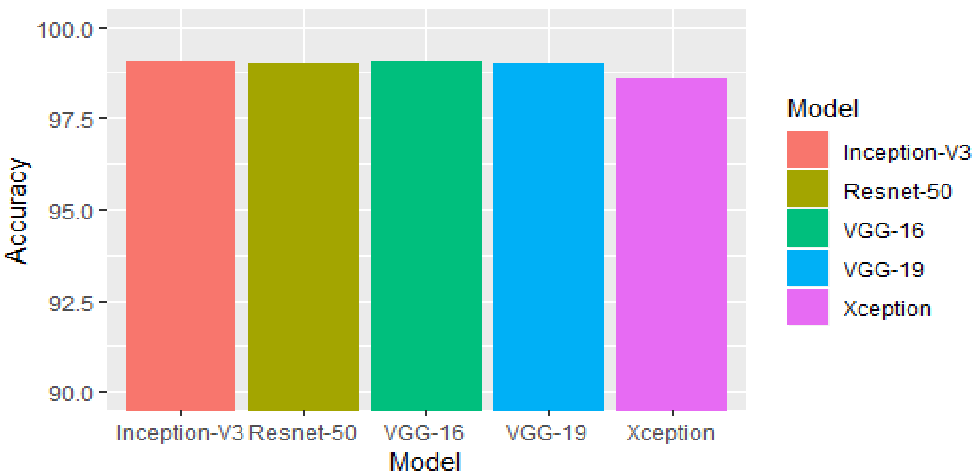 Figure: Comparison of accuracy across different Deep Learning architectures.
The boxplot analysis below highlights the stability of these models. While Inception-V3 and VGG-16 hit the peak of 99.04%, the ANOVA test (p=0.412) suggested that the choice of architecture is less critical than the quality of data and the use of fine-tuning strategies.
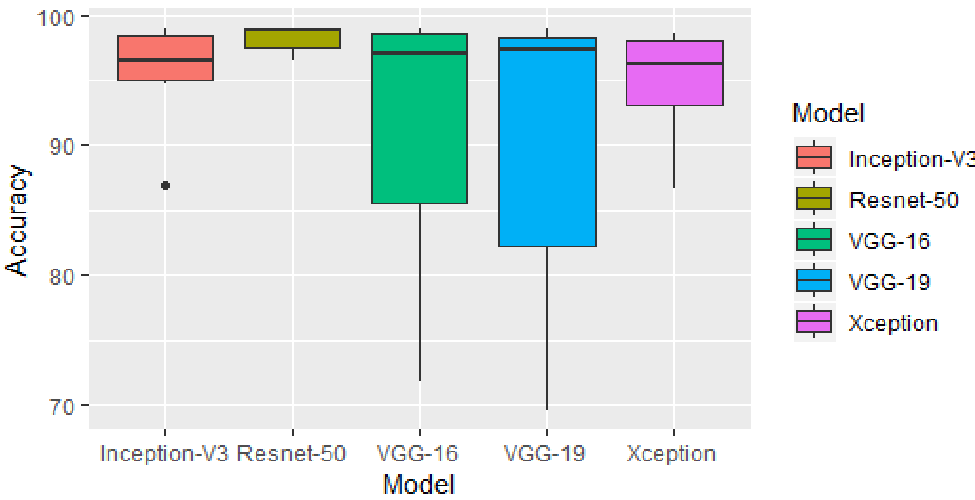 Figure: Boxplot showing the performance ranges of the evaluated models.
Critical Insights & Future Outlook
The success of this project lies in the hardware-software co-design. By mounting cameras to see where pests actually live (under the leaf), the researchers provided the AI with the right data, not just more data.
Takeaways:
- Transfer Learning is Mandatory: In domain-specific tasks like agriculture, pre-trained weights on ImageNet provide a crucial "head start" that prevents models from getting lost in the noise of field imagery.
- Hybrid Approach: The use of superpixels (computer vision) before feeding data into CNNs (deep learning) remains a highly efficient way to handle high-resolution remote sensing data.
- Next Frontiers: The authors are moving toward real-time classification via mobile apps and Edge AI, allowing farmers to get instant feedback while the drone is still in the air.
While the current results are based on preliminary manioc and soybean field tests, the framework provides a robust template for AI-driven ecological and agricultural sovereignty.