
Deciphering the Pulse of Twitter: From Macro Spikes to Micro Influencers
On macro and micro exploration of hashtag diffusion in Twitter
This exploratory study investigates hashtag diffusion on Twitter through a dual-lens framework: a macro-analysis of temporal dynamics and a micro-analysis of individual user roles. Using a dataset of 12 million tweets, it classifies hashtags into "single spike," "multi-spikes," and "fluctuation" patterns while identifying four key user roles—Idea Starters, Amplifiers, Adapters, and Commentators—based on Edelman’s Topology of Influence theory.
Executive Summary
TL;DR: This paper provides a comprehensive autopsy of how hashtags spread on Twitter by analyzing 12 million tweets. It categorizes hashtags into three temporal patterns (Single Spike, Multi-Spikes, and Fluctuation) and maps the "social DNA" of four distinct user roles—Idea Starters, Amplifiers, Adapters, and Commentators—revealing how community structure and topic semantics drive the lifecycle of information.
Background: Positioned between sociological theory and data science, this work moves beyond simple "influence" tracking to show that information diffusion is a collaborative symphony rather than a solo performance by a few celebrities.
Problem & Motivation: Why One Size Doesn't Fit All
Most prior research treats information diffusion as a uniform process. However, the authors argue that a hashtag like #London2012 (event-specific) behaves fundamentally differently from #fashion (general interest). Previous works often oversimplified this by focusing only on "influencers" who trigger large cascades, ignoring the "middlemen" who refine and bridge these ideas across different social clusters.
Methodology: The Macro-Micro Framework
1. Macro Dynamics: The Three Tempos
The authors categorize hashtags based on their daily frequency patterns:
- Single Spike: Drastic rise and fall, typical of specific events (e.g.,
#HappyAnniveSHINee4th). - Multi-Spikes: Recurrent peaks, often seen in serialized events like sports or elections.
- Fluctuation: Sustained, moderate frequency typical of evergreen topics (e.g.,
#beauty,#travel).
2. Micro Roles: Defining the Key Players
Adopting Edelman’s Topology of Influence (TOI), the authors created quantitative scores to identify:
- Idea Starters (IS): Sources of high-quality, highly retweeted original content.
- Amplifiers (Amp): The "first responders" who propagate news quickly.
- Adapters (Ad): Community bridges who retweet from diverse sources.
- Commentators (Com): Active participators who contribute without necessarily being retweeted.
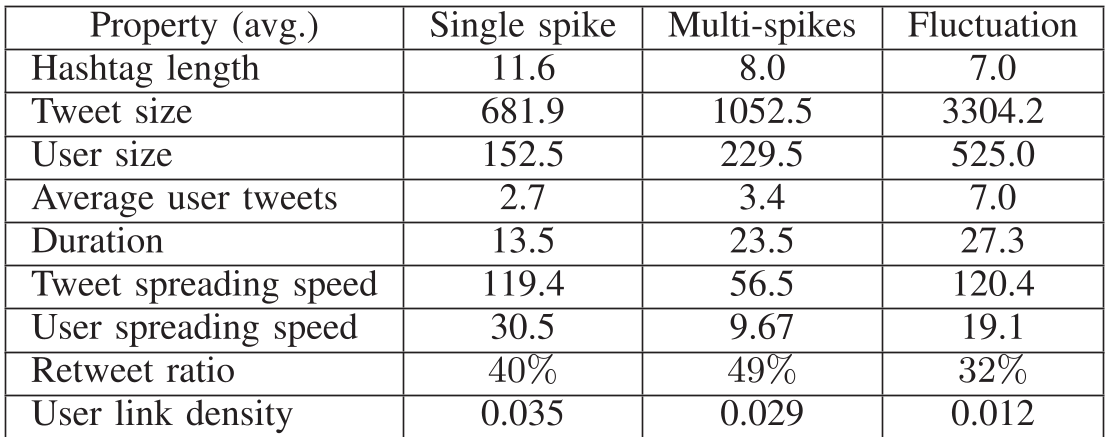 Figure 1: Average properties across different hashtag classes, showing clear distinctions in duration and user engagement.
Experiments & Results: Who Really Drives the Conversation?
The study reveals a counter-intuitive finding: Adapters, not Idea Starters, are the busiest. While Idea Starters have a high reputation (In-degree), Adapters act as "Boundary Spanners," linking disparate clusters and actually producing the highest number of daily tweets (Activity = 38.4).
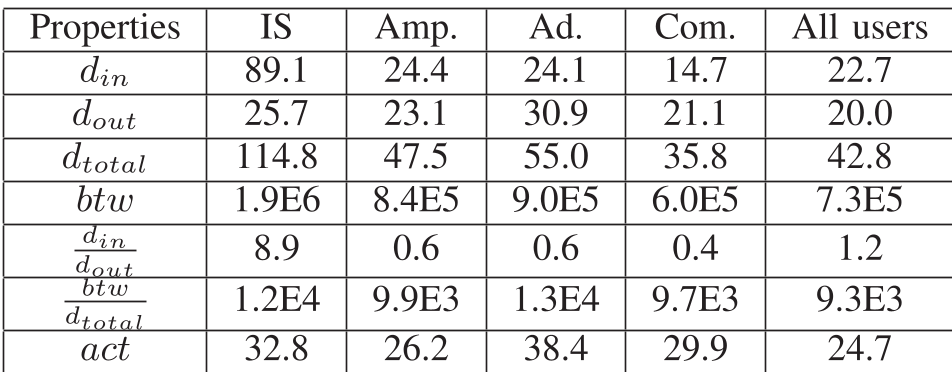 Figure 2: Comparison of structural network properties across user roles. Note the massive in-degree of Idea Starters vs. the high activity and out-degree of Adapters.
Key Insights:
- Event-Specific (Spiky) Topics: Densely connected users, high retweet ratios, and heavy influence from Idea Starters.
- General-Interest (Fluctuating) Topics: Distributed across local communities, longer lifespan, and more genuine, non-retweeted input from Commentators.
Critical Analysis & Conclusion
Takeaway
The paper shifts the focus from "reaching the most people" to "understanding the role of the person reached." For marketers or researchers, this means that for event-driven campaigns, one should target Idea Starters; for long-term brand building, targeting Adapters who bridge communities is more effective.
Limitations & Future Work
The study is localized to a Singapore-based dataset from 2012. Given how algorithmic feeds (like X’s "For You") have evolved since then, the manual classification of spikes might be automated today using deep learning. However, the fundamental role definitions remain a cornerstone for understanding social dynamics in any networked environment.