
Macroeconomic Factor-Based Sector Rotation: Bridging Financial Intuition with Explainable AI
Utilizing Macroeconomic Factors for Sector Rotation based on Interpretable Machine Learning and Explainable AI
This paper introduces a sector rotation strategy for the Chinese stock market by utilizing Explainable AI (XAI) models like Random Forest and Ridge Regression powered by macroeconomic factors. The authors successfully bridge the gap between complex machine learning "black boxes" and financial interpretability by incorporating feature selection, return discretization, and market crowdedness indicators to achieve superior risk-adjusted returns.
Executive Summary
TL;DR: This paper proposes an interpretable framework for industry sector rotation in the Chinese market. By synthesizing macroeconomic factors—Growth, Inflation, Rates, Credit, and Exchange—and processing them through Explainable AI (XAI) models like Random Forest, the authors developed a strategy that significantly outperforms standard benchmarks. The core innovation lies in the combination of lagging macro features, return discretization, and crowdedness filtering.
Context: Positioned at the intersection of Econometrics and Machine Learning, this work acts as a bridge, transforming traditional "black-box" predictions into actionable, transparent financial insights. It effectively updates the classic "Investment Clock" for the Big Data era.
The "Black Box" Problem in Finance
In asset management, a model that predicts correctly but cannot explain why is often useless. Analysts need to know if a prediction is based on a temporary glitch or a fundamental shift in GDP or interest rates. The authors identify two primary pain points:
- Interpretability Deficit: Standard deep learning models provide no intuition for "why" a specific sector is chosen.
- Noise in Returns: Directly predicting the exact percentage of stock returns is highly unstable.
Methodology: The Synthesis of Macro-Intuition
The authors don't just feed raw data into a model; they curate it based on economic theory.
1. Factor Engineering
They synthesized five core pillars of the economy using higher-frequency proxies:
- Growth: PMI and industrial profit growth (proxies for GDP).
- Inflation: Oil, pork, and thread prices (proxies for CPI/PPI).
- Rate/Credit: Treasury yields and credit spreads.
- Exchange: RMB/USD middle price.
2. Model Architecture
The paper compares Multiple Linear Regression (MLR), Ridge Regression (RR), and Random Forest (RF). The breakthrough occurs when they shift from Regression (predicting the exact return) to Classification (predicting the probability of a positive return).
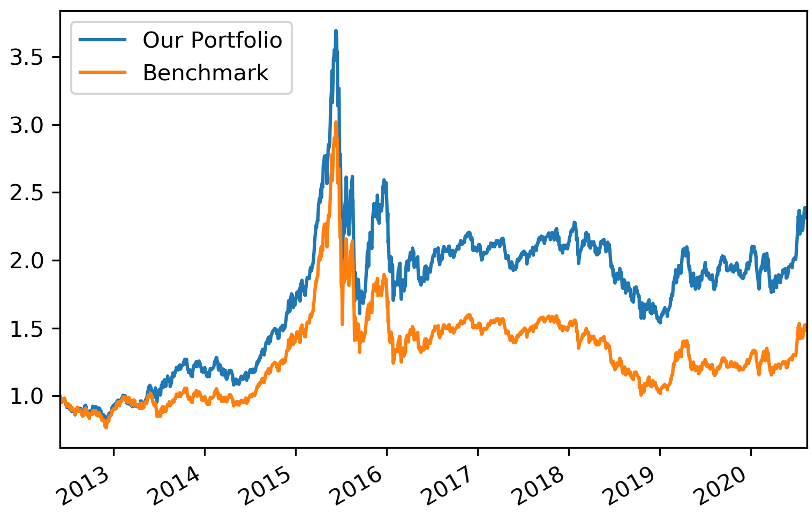 Fig 1. The net value trend shows the significant Alpha generated by the XAI-driven portfolio over the benchmark.
Key Performance Drivers
Feature Selection & Lagging
Macroeconomic effects are not instantaneous. The authors found that including 6-month and 12-month lags significantly reduced overfitting and improved the Sharpe ratio. PCA was utilized to handle the resulting multi-collinearity, ensuring the model focused on the most impactful variance components.
The Crowdedness Filter (Signal Timing)
A unique contribution is the Crowdedness Indicator. The model assumes that even if a sector is fundamentally strong, it may be "overbought." They calculate:
- CTC/CVC: Correlations between turnover/volume and price.
- Kurtosis: Measuring the distribution of returns to spot bubbles.
When these indicators cross a historical threshold, the strategy exits the position to hold cash, effectively mitigating drawdowns during market overheating.
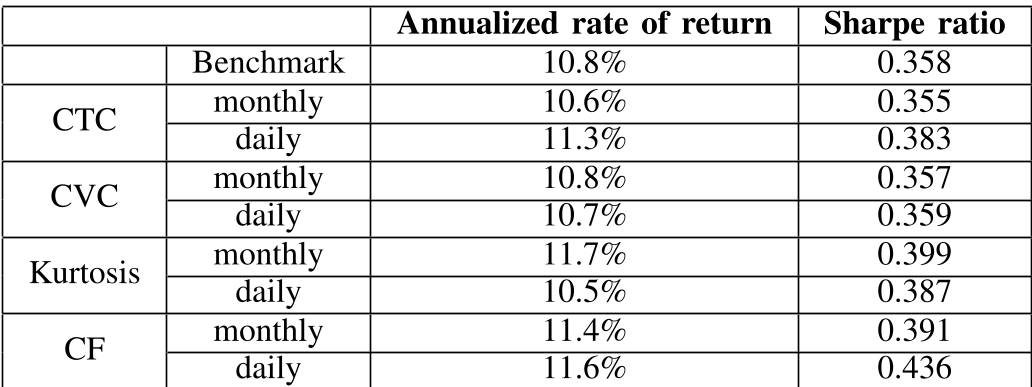 Table 1. Comparing Monthly and Daily optimization strategies. Daily monitoring of crowdedness signals yields the highest Sharpe Ratio (0.436 - 0.495).
Critical Analysis & Conclusion
Takeaway
The research proves that Random Forest Classifiers are superior to linear models for sector rotation because they capture the non-linear interaction between macro variables (e.g., how high inflation impacts Growth differently than low inflation).
Limitations & Future Work
While robust, the strategy relies heavily on the WIND database and Chinese market dynamics. A future extension would be to test this framework in developed markets (US/EU) to see if the same macro-lags hold true. Additionally, incorporating NLP-based sentiment analysis from central bank speeches could further sharpen the "Rate" and "Credit" factors.
Final Thought: This work demonstrates that in the world of AI finance, "knowing yourself" (transparency) is indeed the beginning of all wisdom—and profit.