
Community Clouds: Overcoming the Barriers of Voluntary Resource Sharing
Exploring the Role of Macroeconomic Mechanisms in Voluntary Resource Provisioning in Community Network Clouds
This paper explores the integration of cloud computing into community wireless mesh networks by proposing "Community Clouds." It investigates macroeconomic mechanisms and cost-value propositions to encourage voluntary resource provisioning among members, aiming to move beyond simple bandwidth sharing toward collective storage and processing.
TL;DR
While we have successfully built community-owned internet (Wireless Mesh Networks), we have failed to build a community-owned "AWS." This paper analyzes why users share bandwidth but hesitate to share storage or CPU, and proposes a macroeconomic toolkit—ranging from social capital to automated Linux distros—to transform small-scale voluntary efforts into sustainable, federated community clouds.
Background: The Infrastructure Gap
Community networks like Guifi.net have proven that volunteers can build massive IP networks (20,000+ nodes) using off-the-shelf hardware. However, these networks remain "dumb pipes." The vast amount of latent computing power and disk space sitting at the edges of these networks remains untapped. The gap exists because sharing a hard drive feels "riskier" or "costlier" than sharing an internet connection.
The Problem: The Cost-Value Chasm
The authors identify a classic economic hurdle: The Inception Barrier.
- High Startup Costs: Setting up a cloud node requires hardware, electricity, and technical expertise.
- Low Initial Value: Until a "critical mass" of members provides resources, the cloud has no useful applications.
- The Tragedy of the Commons: Without incentives, users prefer to consume (free-ride) rather than provide.
Methodology: Macroeconomic Mechanisms for Sustainability
The paper argues that we cannot rely on "altruism" alone. Instead, they propose a multi-layered macroeconomic strategy:
1. The Evolutionary Model
The authors map the relationship between cost and utility. To survive the "nascent stage," the system relies on Early Adopters—highly motivated individuals who ignore the high relative cost because they value the community's success.
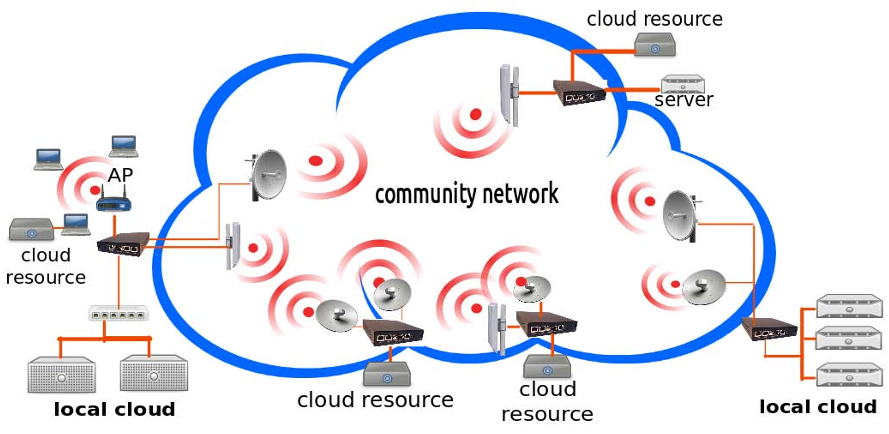
2. Local vs. Federated Clouds
- Local Community Clouds: High "Bonding Social Capital." Users share resources with neighbors they know, increasing trust.
- Federated Community Clouds: Managed via "Peering Agreements" between different zones, allowing for scale while maintaining local autonomy.
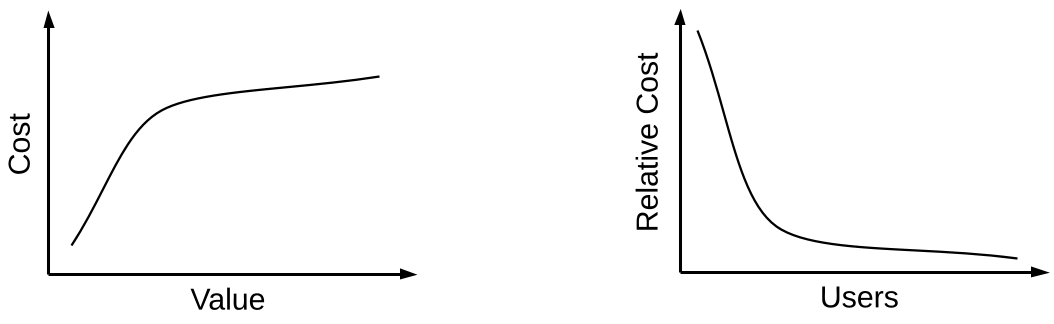
3. Reducing Transaction Costs
The "Ease of Use" policy is critical. The authors developed a custom Linux distribution to automate the "joining" process. By making cloud provisioning invisible—similar to how Skype or Spotify used P2P resources in their early days—technical barriers are removed for the average user.
Critical Insight: Social Capital > Financial Capital
The most profound takeaway is that community clouds should not try to compete with Amazon or Google on price. Instead, they should compete on:
- Privacy: Keeping data within the physical community.
- Locality: Lower latency for local services.
- Social Capital: Strengthening the "sense of belonging" which commercial providers cannot replicate.
Experiments and Results
By analyzing the topology of Guifi.net, the authors show that community networks follow a scale-free small-world pattern. This is ideal for a cloud because it allows for localized clusters of high-performance (Super Nodes) while maintaining global connectivity.
The transition to a sustainable "permanent operation" occurs when the "Value Proposition" (access to local SaaS like ownCloud or FreedomBox) significantly outweighs the "Maintenance Cost" of keeping a small plug-computer running.
Conclusion and Future Outlook
This work shifts the focus from purely technical challenges (how to distribute data) to the incentive challenges (why should I share?). As we move toward a more decentralized web, the "Macroeconomic Policies" outlined here—Commons Licenses, Peering Agreements, and Social Capital—provide the blueprint for building infrastructures that are truly "by the people, for the people."
Limitations: The paper acknowledges that a strong central coordination (or effective decentralization) is needed to manage "Entry Barriers" and prevent low-quality nodes from degrading the experience for others.
Future Work: The next step is the real-world deployment of these policies within the Guifi.net prototype to measure how social incentives change user behavior in real-time.