
MAI-Thinking-1: The Architecture of a Hill-Climbing Machine
MAI-Thinking-1: Building a Hill-Climbing Machine
The paper introduces MAI-Thinking-1, a 35B active / 1T total parameter Mixture-of-Experts (MoE) reasoning model developed from scratch by Microsoft AI. It utilizes a "hill-climbing machine" system-level optimization approach and achieves SOTA-level results on STEM and coding tasks, including 97.0% on AIME 2025 and 52.8% on SWE-Bench Pro.
TL;DR
Microsoft AI has unveiled MAI-Thinking-1, a massive 1-trillion parameter MoE (35B active) that redefines how we build reasoning models. Eschewing the common shortcut of distillation, this model was trained from scratch to become a "Hill-Climbing Machine"—a system designed for stable, continuous improvement through a rigorous feedback loop of data curation, architectural co-design, and stabilized Reinforcement Learning (RL).
The Core Philosophy: Capability Should Be Learned, Not Inherited
In the race for SOTA, many labs resort to distillation (training on outputs from GPT-4 or Claude). The MAI team argues this creates a ceiling: imitated intelligence lacks the robustness needed for "long, enduring climbs." Instead, they treat model development as a system-level optimization problem, where every component—from the custom "YOLO" training framework to the "Rocket" RL infrastructure—is tuned to ensure the performance curve never plateaus.
Methodology: The Anatomy of the Machine
1. Architectural Co-Design (The Sparse Body)
MAI-Base-1 utilizes a decoder-only Transformer with a unique interleaved structure. Instead of making every layer a Mixture-of-Experts (MoE), they alternate between high-sparsity MoE layers and dense Feed-Forward Networks (FFN).
- Latent MoE: They use a shared down-projection before dispatching tokens to 8 out of 512 experts, significantly reducing communication overhead.
- Periodic Attention: 5 local attention layers (sliding window) followed by 1 global attention layer optimize the KV cache for its massive 256K context window.
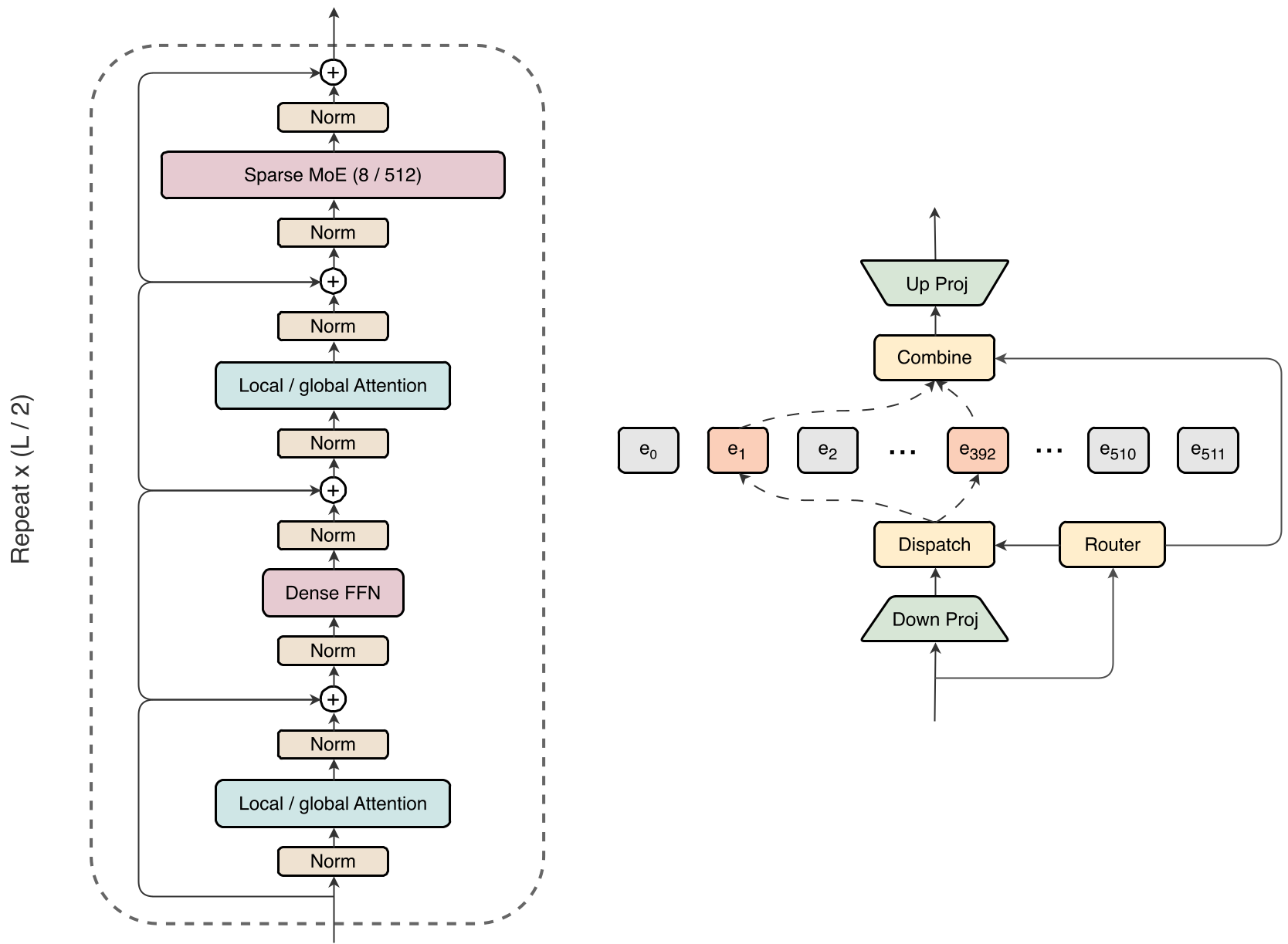 Figure: The MAI-Base-1 architecture interleaving MoE and Dense FFNs.
2. Stabilizing the RL Climb
The most impressive feat is the STEM, Agentic, and Safety climbs. To stop the model from "collapsing" or "reward hacking" (generating gibberish to get rewards), they introduced:
- Adaptive Entropy Control: A controller that dynamically adjusts clipping bounds to prevent the model from becoming too overconfident or too random.
- Outer Ratio Clip: Prevents catastrophic gradient spikes during off-policy training.
- Self-Distillation: When a training run crashes or a new base model is ready, they "distill" the best traces from the previous run into the new one, ensuring progress is never lost.
Experiments & Results: Brute Force Meets Elegance
MAI-Thinking-1 was trained on 30 Trillion tokens on a cluster of 8,192 Blackwell (GB200) GPUs.
- STEM Reasoning: 97.0% on AIME 2025.
- Coding: 52.8% on SWE-Bench Pro, approaching the performance of much larger "frontier" models.
- Infrastructure Efficiency: Despite the complexity of MoE, the "YOLO" framework achieved 20% MFU and 90% goodput, meaning the GPUs spent very little time idling or recovering from failures.
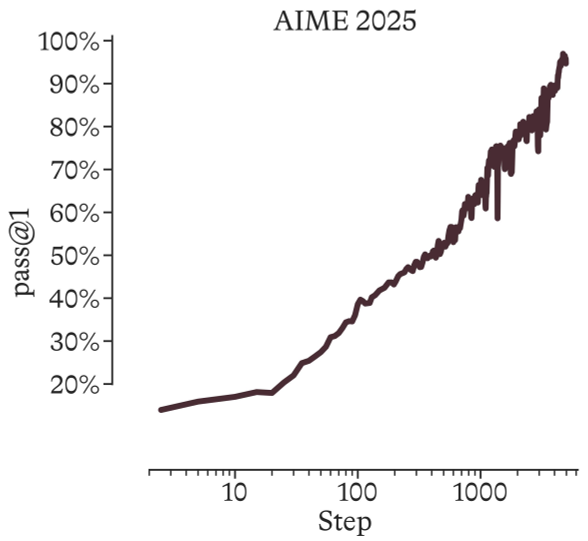 Figure: The performance of MAI-Thinking-1 showing sustained log-linear improvement during RL.
Deep Insight: Why This Matters
The most striking takeaway is the Rank Invariance Challenge. The authors discovered that a data mixture that looks great on a 1B parameter model might actually perform worse than others when scaled to 35B. This proves that "Scaling Laws" aren't just about compute; they are about data diversity matching model capacity. By focusing on "clean, enterprise-grade data" and avoiding synthetic "junk," Microsoft has built a model that isn't just a parrot—it's a reasoner.
Conclusion & Future Look
MAI-Thinking-1 is a statement of intent. It proves that with the right "machine" (infrastructure + data + RL), a mid-sized model can punch far above its weight class. As the team extends this to multi-modal data and even larger scales, the "Hill-Climbing Machine" may become the blueprint for the next generation of AGI.