
A Majority of Wrongs Doesn’t Make It Right: Defeating Strategic Spammers in Skewed Domains
A Majority of Wrongs Doesn’t Make It Right - On Crowdsourcing Quality for Skewed Domain Tasks
This paper introduces the "Double/Triple Testing" model, a task-agnostic quality assurance framework designed to combat strategic spammers in binary crowdsourcing tasks with skewed answer distributions. By mathematically leveraging principles from medical test theory, the method outperforms traditional Majority Voting in both cost-efficiency and label accuracy.
TL;DR
When crowdsourcing labels for imbalanced datasets (e.g., "Is there a rare bird in this photo?"), standard Majority Voting is both expensive and easy to cheat. This paper introduces Double and Triple Testing, a method derived from medical diagnostics that selectively requests redundant opinions only when a worker submits the "common" answer. This approach increases accuracy from 86.5% to 92.5% in high-spam environments while significantly cutting costs.
Context: The "Lazy Spammer" Paradox
In many Web-scale tasks—like identifying adult content or sentiment analysis—data is naturally skewed. A classic study on Amazon Mechanical Turk found that 85% of websites are "General Audience." A "strategic spammer" who realizes this can simply answer "G" for every single task, achieving an 85% accuracy rate with zero effort.
The paradox? They look more reliable than honest workers who make occasional human errors. Because they agree with the majority (the skew), they are rarely flagged by standard consensus algorithms or gold questions.
Motivation: Why Sensitivity Matters Less Than Specificity
The authors argue that we should treat a crowd worker like a medical diagnostic test. In medical theory, the reliability of a test for a rare disease depends on:
- Sensitivity (): Ability to find the rare case (True Positive).
- Specificity (): Ability to correctly ignore the common case (True Negative).
Through a sensitivity analysis of the Positive Predictive Value (PPV), the authors prove a counter-intuitive point: In skewed domains, improving specificity is exponentially more valuable than improving sensitivity.
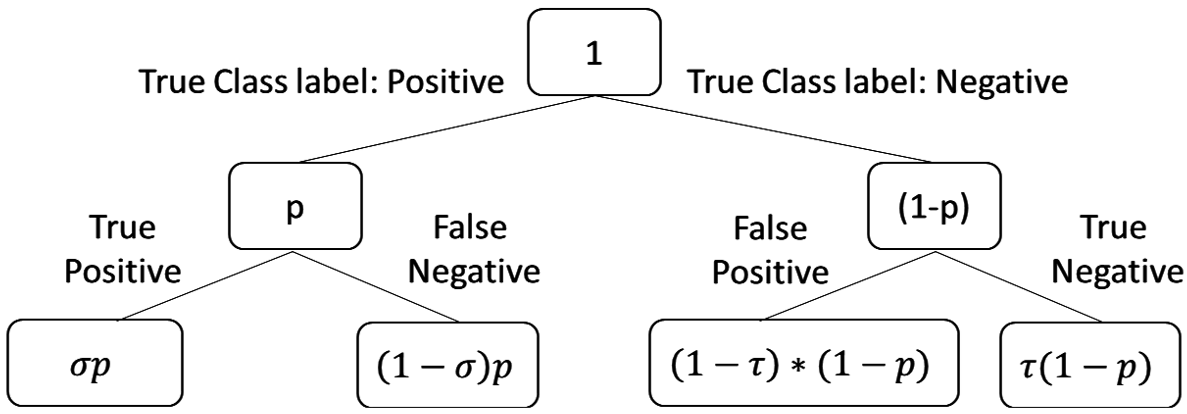
If a condition is rare (Prevalence is low), even a near-perfect sensitivity won't stop the results from being flooded by false positives. To get "clean" data, you must focus on the workers who say "Yes" (the rare class) only when they are absolutely sure.
The Solution: Selective Redundancy (Double/Triple Testing)
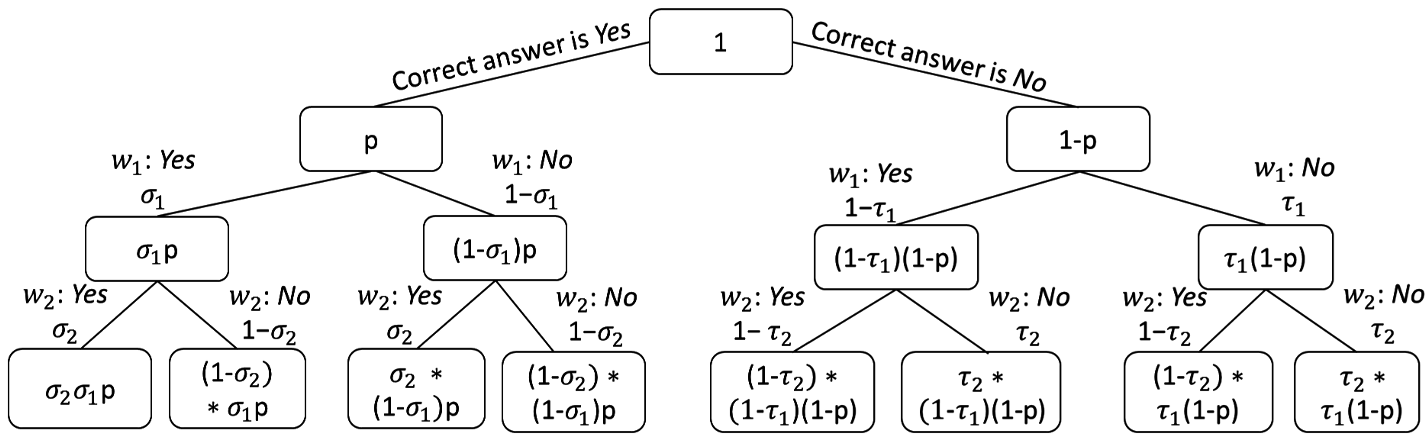
Instead of asking 3 people for every task (Symmetric Redundancy), the Double Testing Model uses a conditional logic:
- Step 1: Ask Worker A.
- Step 2: If Worker A gives the Rare label, accept it.
- Step 3: If Worker A gives the Frequent label, ask Worker B.
- Step 4: If Worker B gives the Rare label, accept it. Only if both say "Frequent" do we accept the majority label.
This "asymmetric" approach assumes that spammers will hide in the frequent class. By forcing a second (or third) check only on majority answers, the model creates a "hurdle" that spammers struggle to jump.
Experimental Battle: Triple Testing vs. Majority Voting
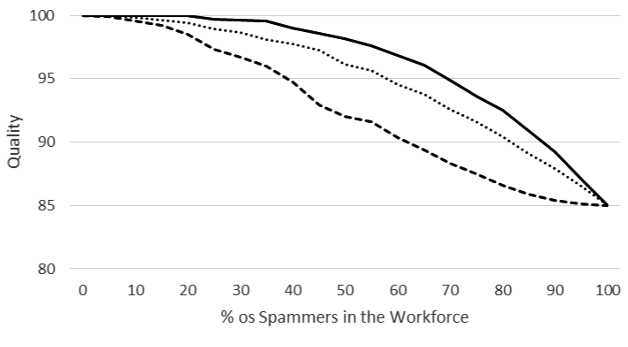
The authors tested their model against Majority Voting under varying degrees of "spam pressure."
1. Accuracy vs. Spammer Ratio
As the workforce becomes more corrupted (up to 80% spammers), Majority Voting collapses because the "majority" is now composed of spammers. However, Double and Triple Testing actually maintain or even improve their relative performance because they are specifically designed to filter the "frequent-answer" noise.
2. The Cost Factor
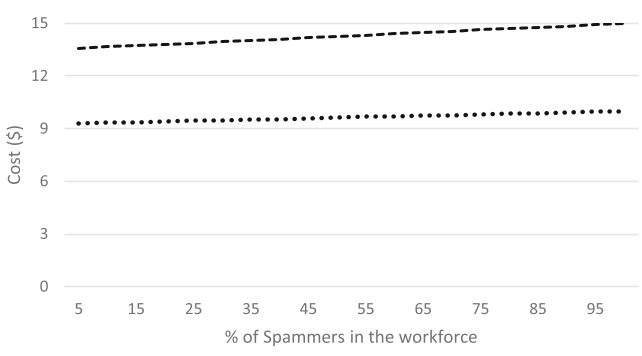
Perhaps the most striking result is the cost. Majority Voting of 3 workers costs a fixed 15 and 15$, depending on the spam ratio. In a typical scenario, Triple Testing delivers higher quality for 33% less cost.
Critical Insight: Task Difficulty & Dependencies
The model's Achilles' heel is the Statistical Independence Assumption. If a task is "objectively hard" (not just skewed), Worker A and Worker B might both generate the same false positive because the data is confusing, not because they are spammers. The authors suggest integrating the Rasch Model (from psychometrics) to calibrate for question difficulty, ensuring that the "second opinion" comes from a worker with a higher skill level.
Conclusion
This paper serves as a vital reminder for ML practitioners: Data distribution dictates the efficacy of your quality control. In the "long-tail" world of the Web, democratic consensus (Majority Voting) is an expensive way to get wrong answers. By shifting focus to Specificity, we can build crowdsourcing pipelines that are both cheaper and more resilient to fraud.