
Make Hay While the Crowd Shines: Re-engineering Efficient Crowdsourcing
Make Hay While the Crowd Shines: Towards Efficient Crowdsourcing on the Web
This paper presents a comprehensive research framework for enhancing crowdsourcing efficiency through a novel two-level microtask taxonomy and a detailed worker behavior typology. By analyzing data from 1,000 workers on CrowdFlower, the author establishes a systematic approach to identifying malicious activities and optimizing task design.
TL;DR
Crowdsourcing is a "gold mine" for human intelligence, but it is often plagued by "fools gold" provided by malicious workers. This research proposes a robust structural framework—a two-level microtask taxonomy and a behavioral typology—to help task designers identify and mitigate malicious behaviors like "Smart Deceiving." By introducing the concept of the Tipping Point, the paper provides a mathematical way to predict when a worker will stop providing quality data.
Background: The Wild West of Web Microtasks
While platforms like Amazon Mechanical Turk (MTurk) and CrowdFlower have democratized access to human labor, the lack of standardized task design has created a "dark forest" for researchers. Existing work often focuses on simple demographics or static "gold standards" (test questions). However, as rewards fluctuate and tasks become more complex, workers adapt, often finding clever ways to maximize pay while minimizing effort—frequently at the expense of data quality.
Problem & Motivation: Why Current Checks Fail
The author identifies a critical gap: Context-agnostic quality control.
- Taxonomy Void: Without knowing what kind of task is being performed (is it simple verification or complex sentiment analysis?), we cannot set the right incentives.
- Sophisticated Malice: "Spammers" aren't just lazy anymore; they are evolving. "Smart Deceivers" can bypass basic validations by providing "just good enough" answers that don't trigger automatic filters.
Methodology: Mapping the Crowd's Mind
The paper's core contribution is twofold: understanding the Task and understanding the Worker.
1. The Microtask Taxonomy
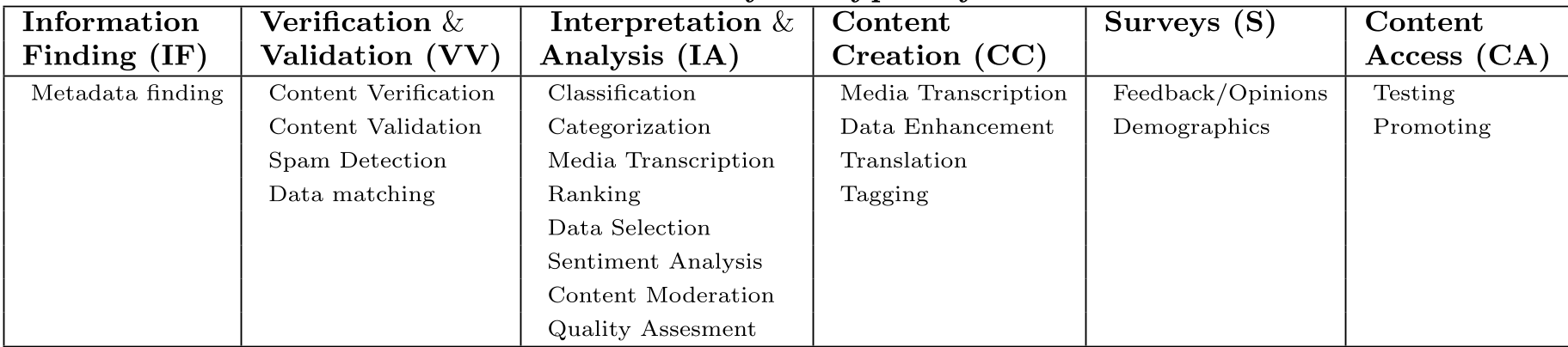
Instead of viewing all tasks as a monolithic block of "work," the author proposes a two-level hierarchy:
- Level 1 (Goal-Oriented): The "Why" (e.g., Information Finding, Surveys, Content Creation).
- Level 2 (Workflow-Oriented): The "How" (e.g., Classification, Tagging, Transcription).
2. The Behavioral Spectrum
The study moves beyond the binary "Good vs. Bad" worker model, identifying five specific personas:
- Fast Deceivers (FD): The copy-pasters.
- Smart Deceivers (SD): The rule-followers who mask their lack of effort.
- Rule Breakers (RB): Those who ignore instructions.
- Gold Standard Preys (GSP): Honest workers who fail checks due to fatigue/boredom.
- Ineligible Workers (IE): Those who don't meet the target demographic.
3. Measuring Maliciousness and the "Tipping Point"
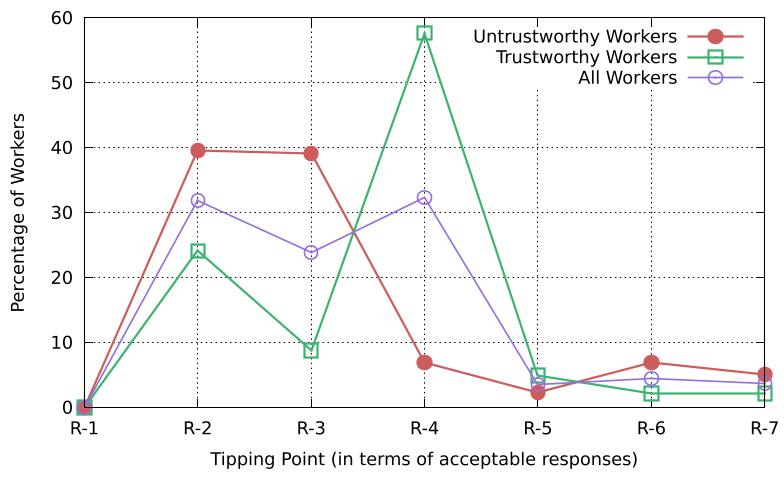
The research introduces a formal metric for maliciousness: Where represents the acceptability of responses. More importantly, it identifies the Tipping Point—the specific moment in a multi-step task where a worker's quality drops significantly.
Experiments & Results: Identifying the Point of No Return
Through an extensive study of 1,000 workers, the author found that task affinity (how much a worker likes a task) is directly correlated with reward and effort.
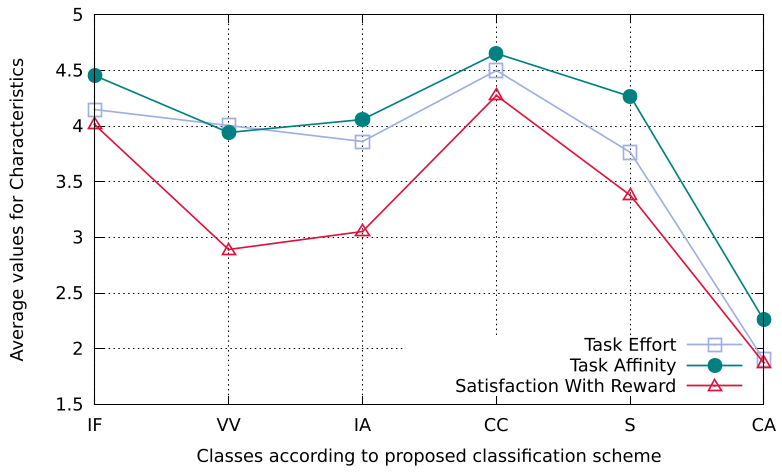
Key findings include:
- Early Detection: A large percentage of malicious workers "tip" (start cheating) very early in the survey.
- The Incentive Myth: Higher pay attracts more people but doesn't necessarily improve the quality of the individual responses; it only increases the speed of completion.
Critical Insight & Conclusion
Takeaways for Researchers
- Don't just use Gold Standards: Smart Deceivers will pass them. Use Psychometric approaches (rephrasing the same question later) to catch inconsistencies.
- Monitor the Tipping Point: If a worker's quality drops at Question 5, the rest of their data is likely compromised.
- Screen for Eligibility: Explicitly filter out workers before they even start to save costs.
Limitations
The current study focuses heavily on Surveys. While the taxonomy covers a wide range of tasks, the behavioral metrics (like the Tipping Point) may manifest differently in high-intensity tasks like real-time video annotation or creative writing.
Future Outlook
As we move toward "Hybrid Intelligence" and using crowds to train LLMs, this work sets the foundation for Automated Worker Modeling. Future systems could dynamically adjust task difficulty and rewards in real-time based on a worker's detected "Maliciousness" score.