
Beyond Exclusion: Re-appropriating Gender Recognition for Transgender Support
Exploring a Makeup Support System for Transgender Passing based on Automatic Gender Recognition
This paper introduces "Flying Colors," a virtual makeup support system designed for the transgender community in Japan to assist in "passing"—the ability to be perceived as one's identified gender. Leveraging Automatic Gender Recognition (AGR) and 3D facial modeling, the system provides makeup recommendations and quantitative feedback to optimize gender presentation in a private, safe environment.
TL;DR
Researchers from the University of Tokyo and the University of Strasbourg have developed Flying Colors, a virtual makeup system that turns Automatic Gender Recognition (AGR)—conventionally a tool of exclusion for the trans community—into a supportive feedback mechanism. By focusing on the Japanese context where "passing" is a critical safety strategy, the system allows users to privately experiment with makeup styles that optimize their gender presentation based on machine learning feedback.
The "Passing" Paradox in Japan
In many Western LGBTQ+ discourses, "passing" (being perceived as a cisgender person) is sometimes debated as a form of conformity. However, in Japan, the researchers found that passing is often a fundamental survival and career requirement. 13 out of 15 participants in their study highlighted the avoidance of workplace discrimination as a primary motivation.
Existing technologies fail this community twice:
- AGR Systems: Usually function as "Misgendering Machines" that provide binary labels and low accuracy for trans individuals.
- Commercial Beauty Apps: Designed for cisgender women to "enhance" features, whereas trans women often need to "hide" or "recontour" biological male facial structures.
Methodology: Turning the Classifier into a Coach
The core innovation of Flying Colors is its shift in perspective. Instead of using AGR to "label" a person, it uses it to calculate a Makeup Feedback score.
1. The Feedback Loop
The system processes a front-facing image and calculates the probability of being classified as the target gender before and after the virtual makeup. The "score" is the delta.
- Formula:
- By starting the score at 0, the system focuses on the effectiveness of the makeup rather than the person's inherent features.
2. High-Fidelity Virtual Application
To ensure the makeup felt realistic and functional, the system employed two technical approaches:
- Segmentation: For hair, lips, and eyebrows using pixel-level maps.
- 3D Morphable Models (3DMM): Reconstructing a 3D mesh of the face to apply contouring, highlights, and shadows that respect the user's specific bone structure.
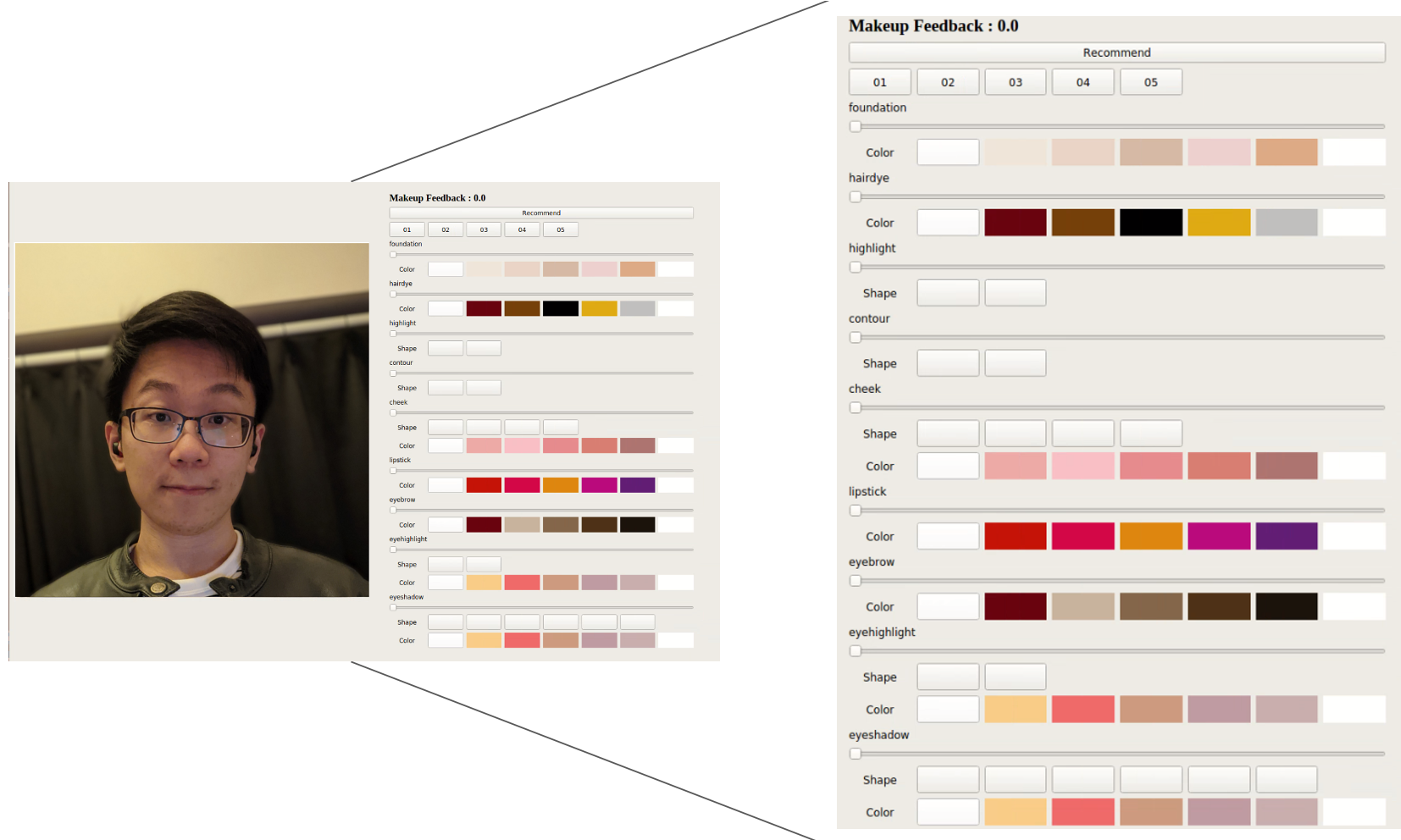 Figure 1: The Flying Colors Interface showing the makeup feedback score and recommendation pipeline.
Key Findings: The "Blameability" of AI
The study discovered a fascinating psychological advantage of AI over human feedback: Blameability. Participants noted that if a machine gives a low passing score, they can choose to ignore it or "blame the algorithm" for being a "stupid machine." In contrast, being misgendered by a human in public is a "stone in the heart" that triggers immediate social trauma.
- Confidentiality: A machine doesn't "out" you in a safe, offline environment.
- Consistency: Human judgment is fickle; an AI provides a consistent metric to track progress over months of transition.
- Validation: High scores from the system provided a genuine sense of gender affirmation and confidence.
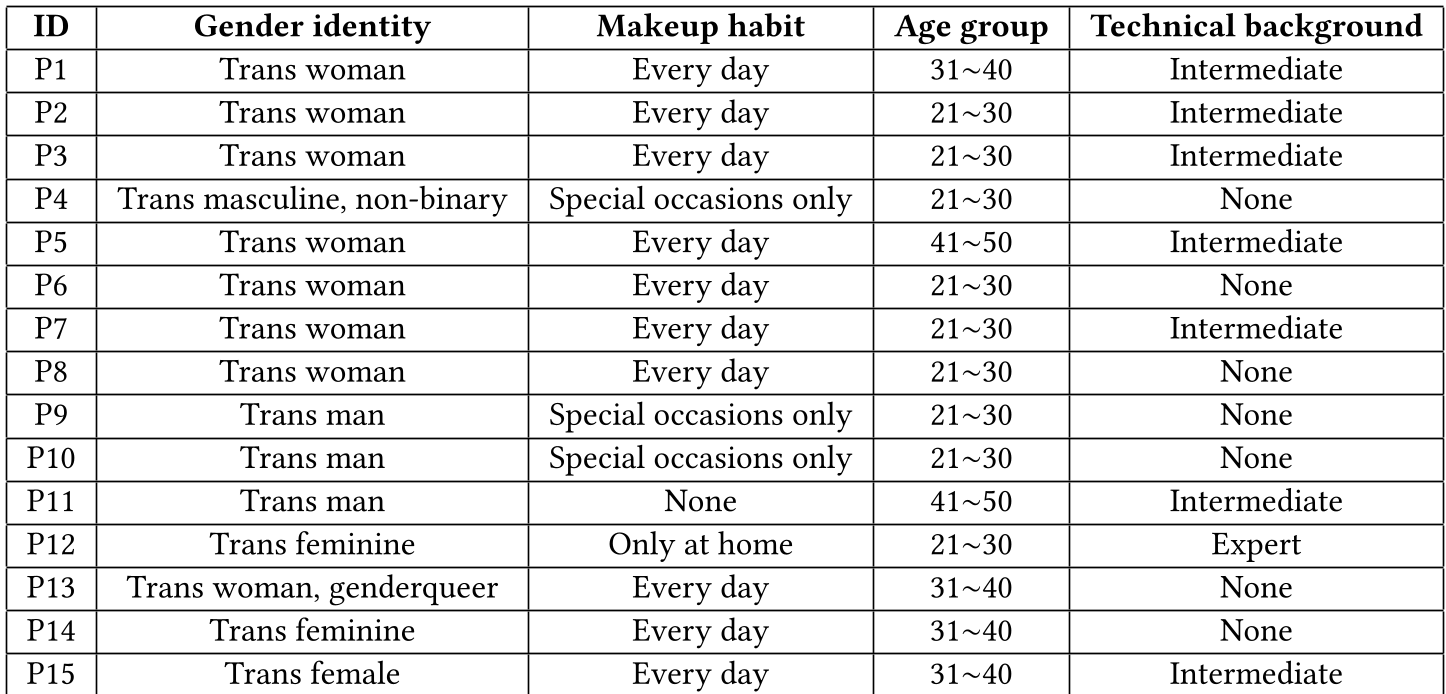 Figure 2: Diversity of the 15 participants involved in the Tokyo study.
Critical Insight: AGR as a Potential Ally?
The authors argue that the harm of AGR is not intrinsic to the math, but the context of power.
- Involuntary AGR (Vending machines, surveillance): Is a threat that risks outing individuals.
- Voluntary AGR (Self-targeted tools): Becomes a tool for autonomy.
However, they warn of the "slippery slope" where employers might use such scores to demand a certain "passing standard." True inclusivity requires the right to opt-out and strict data privacy, ensuring the user is the one holding the "virtual mirror."
Conclusion and Future Work
Flying Colors proves that the same algorithms used for surveillance can be subverted for empowerment. Future iterations aim to include heatmaps to show users which parts of their face (e.g., jawline vs. eyes) are influencing the classifier most, moving from "black-box" scores to "explainable" makeup artistry.
Takeaway: In the quest for inclusive AI, sometimes the solution isn't to ban the technology, but to put the controls in the hands of those it traditionally marginalized.