
Digital Puppetry: How Social Bots Distorted the 2016 State of Mind
The Impact of Malicious Accounts on Political Tweet Sentiment
This study investigates the influence of social bots on public opinion during the 2016 U.S. Presidential Election by analyzing a dataset of over 700,000 unique Twitter accounts. Using a Convolutional Neural Network (CNN) for sentiment analysis and the Botometer API for detection, the researchers successfully quantified how malicious accounts artificially inflate tweet volume and skew sentiment metrics for candidates.
TL;DR
Researchers at Florida Atlantic University analyzed ~3 million tweets from the 2016 U.S. Election to uncover the "Bot Effect." By deploying a character-level CNN and the Botometer detection system, they discovered that social bots and now-deleted accounts significantly inflated Donald Trump's perceived popularity and positive sentiment, masking a demographic reality that leaned toward Hillary Clinton.
The Illusion of Consensus
In the digital age, we often use Twitter volume and sentiment as a barometer for the "national mood." However, this barometer is easily gamed. The authors argue that while social media has become a staple of political campaigns, it is plagued by Social Bots—automated accounts designed to spread misinformation, sway neutral voters, and create an illusion of overwhelming support for specific candidates.
The core challenge lies in the sophistication of these bots. They don't just spam; they mimic human retweeting patterns and form dense networks to bypass simple detection. If we don't filter them, our "data-driven" insights into public opinion are effectively hallucinated.
Methodology: The Character-Level Approach
To tackle a dataset of this scale (705,381 unique accounts), the team moved beyond simple keyword matching.
1. Convolutional Neural Networks (CNNs) for Sentiment
The researchers utilized a CNN based on the AlexNet architecture, adapted for text. Instead of traditional word embeddings, they used a log(m) character-level embedding. This allows the model to understand the "visual" structure of text, making it more resilient to typos and the slang common in political bickering.
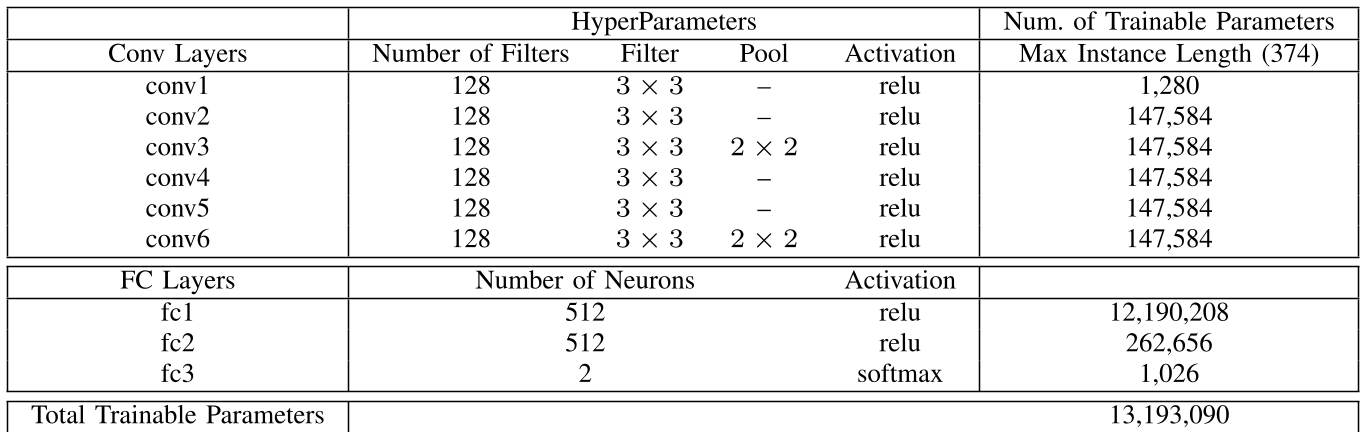 Table 1: The CNN architecture used for sentiment classification, featuring over 13 million trainable parameters.
2. The Botometer Filter
Using the Botometer API, the authors tested six different thresholds (0.50 to 0.75). A critical finding was the "Deleted Cohort": 134,849 accounts that existed during the election but were banned by the time of analysis. These accounts are "ghosts" in the data—highly suspicious but technically unclassifiable by standard APIs.
Key Findings: The Great Sentiment Shift
The results provide a stark look at how bots can flip a narrative.
- Volume Distortion: In the raw "single-tweet" dataset, Trump dominated with 58.58% of volume. Once the deleted cohort was removed, his share dropped to 42.28%.
- The Positive Sentiment Flip: Trump’s "vote" metric (the ratio of positive sentiment) fell from 55.07% to just 37.17% after cleaning.
- The "Deleted" Secret: The deleted cohort was overwhelmingly pro-Trump (56.3% positive). This confirms that Twitter’s subsequent Purge specifically targeted accounts that were aggressively boosting one candidate.
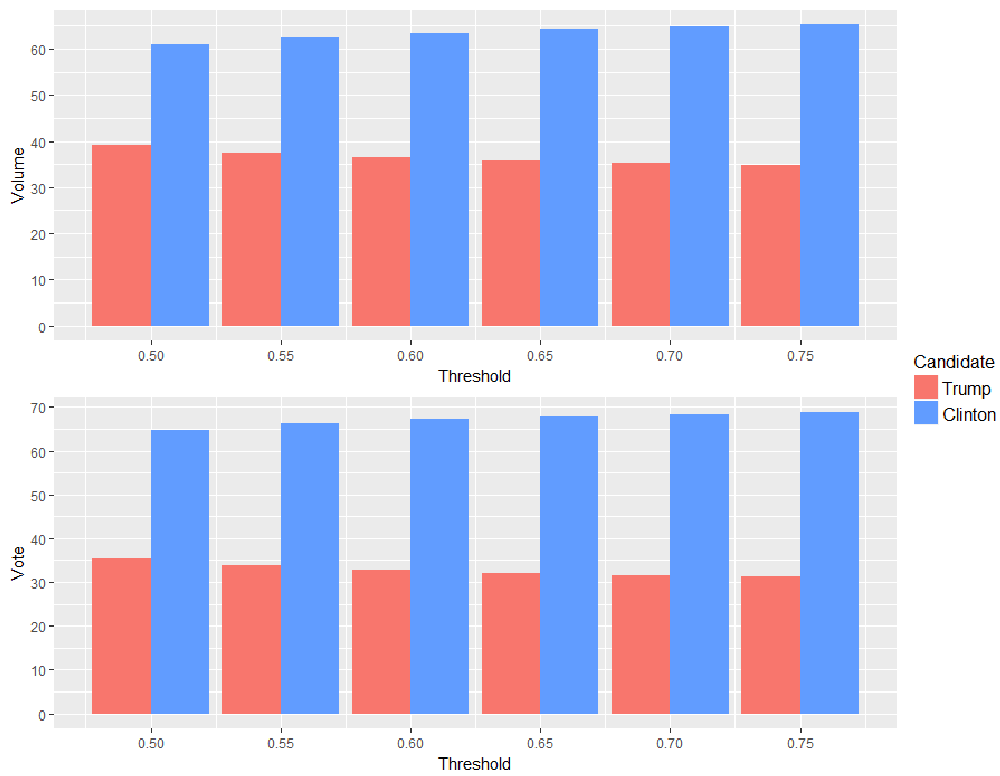 Figure 1: Comparison of Volume and Sentiment (Vote) ratios across different bot detection thresholds.
Critical Insight: Why This Matters
The most profound takeaway is that after removing bots, the Twitter data actually aligned better with real-world exit polls for the under-50 demographic. This suggests that Twitter is a valid polling tool, but only if you have the surgical precision to remove the automated noise.
Limitations & Future Work
The study relies on the Botometer as a "source of truth," yet bot developers are constantly evolving. Furthermore, the "Deleted Cohort" remains a black box—while we know they were pro-Trump, we can't definitively prove why they were deleted (though the 2018 Russian bot purge offers a strong clue).
Conclusion
This research serves as a cautionary tale for data scientists and political analysts. Sentiment analysis is a powerful tool, but without a robust strategy for Bot De-noising, it risks becoming a megaphone for artificial influence rather than a mirror of the public mind.