
Unmasking the Hijacker: Advanced Anomaly Detection in Social Media Streams
Malicious Behaviour Identification in Online Social Networks
The paper introduces an automated framework for detecting compromised accounts in Online Social Networks (OSNs), specifically Twitter, by identifying anomalous "prodigious" segments in tweet streams. It utilizes a novel aggregate of 21 features across lexical, syntactic, and engagement categories, achieving significant performance gains (up to 13% for Perceptron) using an interactive machine learning approach.
TL;DR
Social media account hijacking is a silent threat where attackers exploit the established trust of legitimate profiles. This paper presents an automated system that identifies compromised Twitter accounts by analyzing a "signature" of 21 unique features—ranging from writing style (stylometry) to follower engagement patterns. Using an iterative machine learning approach, the authors demonstrate that even short tweets contain enough signal to distinguish a real user from an intruder.
The "Trust Gap": Why Content Analysis Matters
The core problem in OSN security is the shift from fake accounts (bots) to compromised accounts. A compromised account is a "wolf in sheep's clothing"—it bypassers initial security filters because its history is legitimate.
Previous works like COMPA relied heavily on metadata (IP addresses, timestamps). However, this paper argues that the essence of the user—their writing style and how their audience reacts to them—is the most reliable signal for long-term detection. The challenge lies in the "short-text" nature of tweets, where traditional linguistic analysis often fails due to the lack of data per post.
Methodology: The Behavioral Fingerprint
The authors break down the user's digital identity into three distinct feature categories:
- Text-Specific Features: Beyond just words, this includes ASCII ratios, punctuation frequency, and sentence structure.
- N-Grams: Capturing the subconscious patterns in character and word sequences.
- Post-Specific Features: Tracking the social "gravity" of a user—how many likes and shares does a typical post generate?
The Iterative Training Algorithm
The system doesn't just train once. It uses an Incremental Interactive Learning approach. It starts with a "safe" anchor (the first 100 tweets) and builds a model. As it processes the timeline, it groups tweets into batches. If a batch is deemed legitimate, it's folded into the training set to refine the model. If suspicious, it's flagged for review.
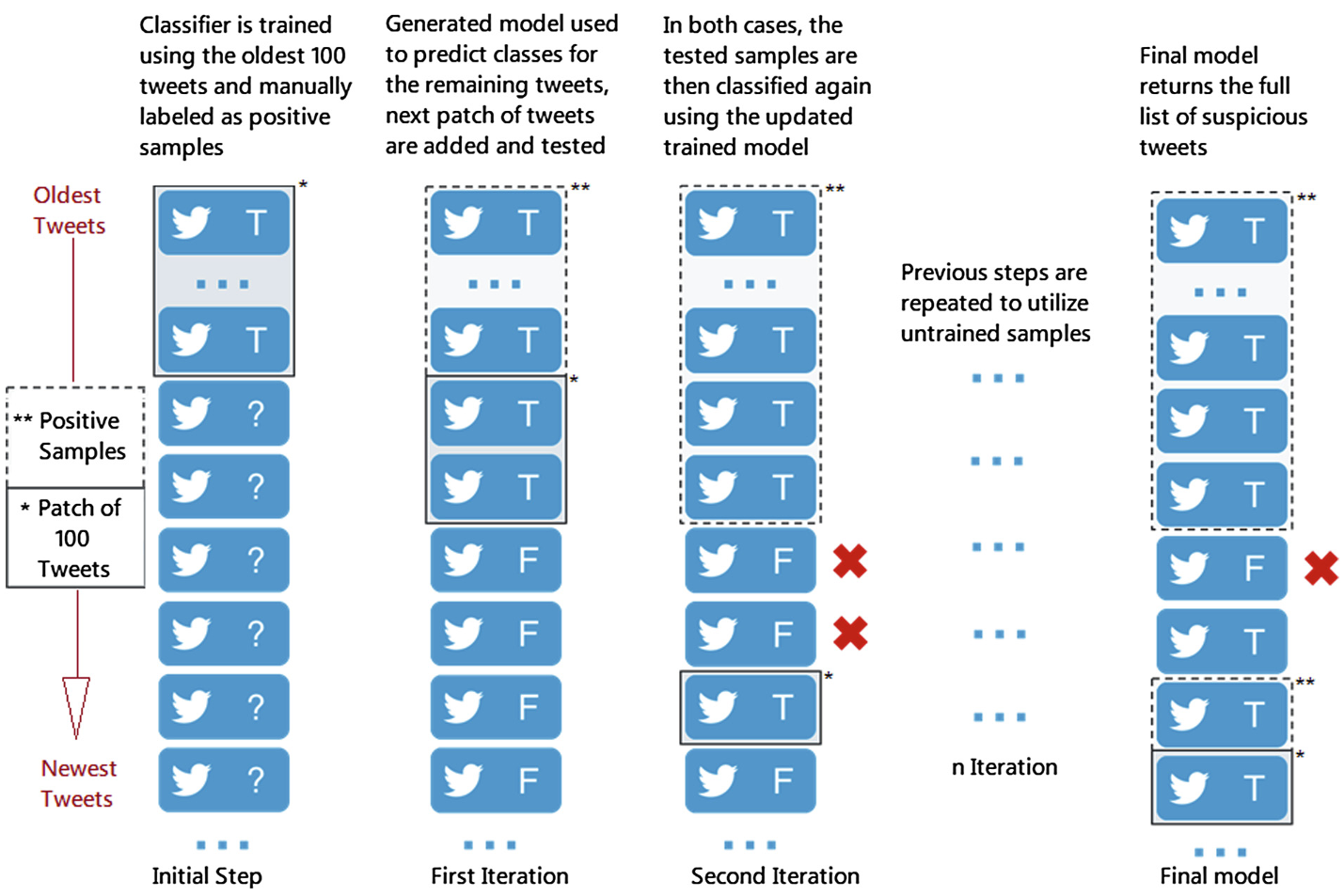 Figure 1: The incremental training process where the model evolves as it consumes the user's timeline.
Performance Benchmarks
The researchers tested four primary classifiers: Perceptron, Decision Tree, One-Class SVM, and Isolation Forest.
| Classifier | Precision (All Features) | F-measure |
|---|---|---|
| One-Class SVM | 0.85 | 0.61 |
| Perceptron | 0.83 | 0.70 |
| Decision Tree | 0.73 | 0.76 |
The One-Class SVM emerged as the precision leader, suggesting it is highly effective at defining the "boundary" of a user's normal behavior. Interestingly, the study found that while increasing the initial training set size improves recall (the ability to find all bad tweets), it can slightly hurt precision because the likelihood of including "already-compromised" tweets in the training data increases.
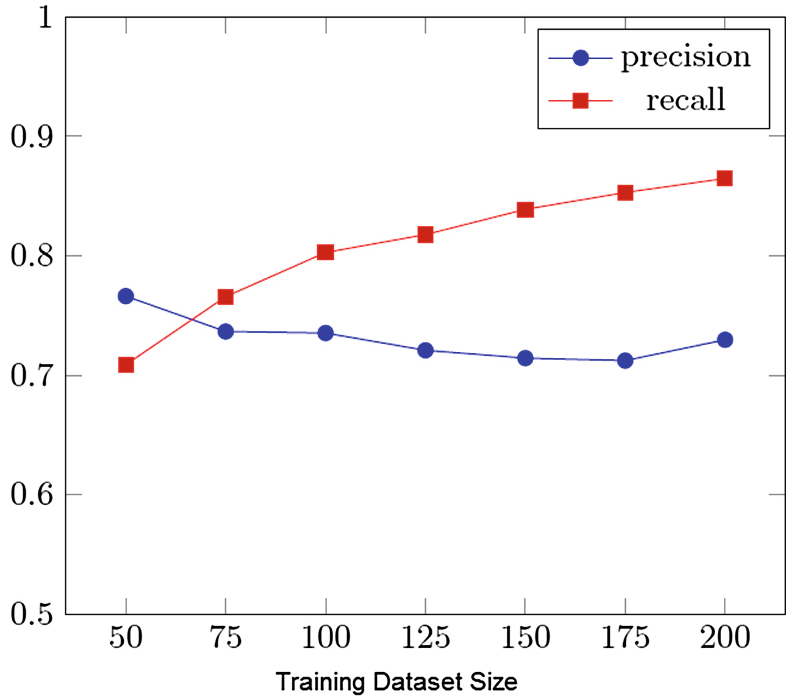 Figure 2: The impact of training set size on model performance. A 100-tweet window provides the optimal balance for initial training.
Critical Insight & Conclusion
The true value of this work lies in its holistic feature aggregation. By combining stylometric data with engagement metrics, the system creates a multi-dimensional defense.
Limitations: The system relies on a clean "starting period" of 100 tweets. If an account is compromised from its inception or very early on, the baseline will be skewed. Furthermore, the current model lacks geolocation data, which the authors acknowledge would significantly boost accuracy.
Future Outlook: As LLMs make it easier for attackers to mimic writing styles, the "Post-specific" features (engagement patterns) will likely become the most critical battleground for identifying malicious behavior in OSNs.