
Privacy-Aware Anomaly Detection: Identifying Malicious Workers via Sparse Group Queries
Malicious Crowdsourcing Worker Detection using Privacy-Aware Group Queries
This paper introduces a privacy-aware framework for detecting malicious crowdsourcing workers by utilizing group queries and sparse signal processing. The core methods, Approx. MAP and a low-complexity GLRT, leverage compressed sensing to identify "spamming" patterns without exposing individual worker identities, achieving superior detection performance over standard energy detectors.
Executive Summary
TL;DR: This paper tackles the conflict between data integrity and worker privacy in crowdsourcing. By treating malicious worker detection as a sparse signal recovery problem, the authors propose a system where "Group Queries" aggregate results to hide individual identities while providing enough statistical evidence to root out bad actors using Approximate MAP and GLRT detectors.
Context: In the landscape of crowdsourcing research, this work acts as a bridge between Privacy-preserving Data Management and Anomaly Detection. It transitions from simply "filtering bad data" to "statistically identifying bad sources" under strict privacy constraints.
Problem & Motivation: The Privacy-Utility Tradeoff
In platforms like Amazon MTurk or Figure Eight, ensuring data quality usually means looking at every single worker's history and specific answers. This creates a privacy nightmare. If a requester knows exactly who provided which "wrong" answer (which might be a subjective medical opinion), workers' anonymity is shattered.
The authors identify a key Insight: In a healthy crowdsourcing ecosystem, malicious workers are sparse (the "Sparsity Assumption"). If we only see aggregated results of group queries—modeled as —can we still find the "support" (the specific indices) of the malicious workers?
Methodology: Levering Sparse Encoding
The system model treats the responses from workers as a vector. Malicious workers add a "spamming" term to the ground truth.
1. The Group Query Mechanism
Instead of seeing individual , the user receives , an aggregate defined by a sparse encoding vector .

2. Approximate MAP (Maximum A Posteriori)
The optimal detector would be a MAP detector, but calculating the joint PDF of all workers is complex. Because the encoding vectors are sparse, they are "approximately orthogonal." This allows the authors to decouple the joint probability into a product of marginal probabilities, significantly simplifying the math.
3. Low-Complexity GLRT
To scale to thousands of workers, the authors propose a two-step process:
- Step I (Support Estimation): Calculate the posterior probability that a specific worker is malicious based on the subset of queries they participated in ().
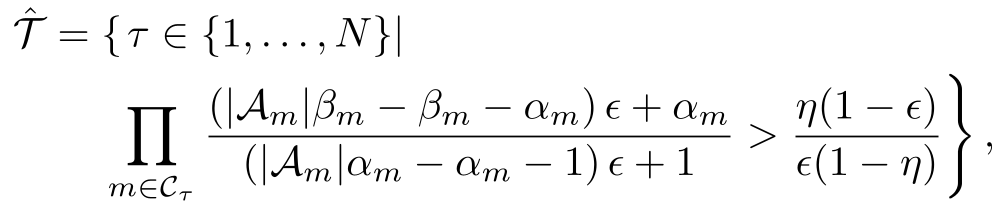
- Step II (Decision Fusion): Use a Generalized Likelihood Ratio Test (GLRT) to make a global binary decision (Malice Present vs. Not Present).
Experiments & Results: Precision under Noise
The authors tested their methods against a standard Energy Detector.
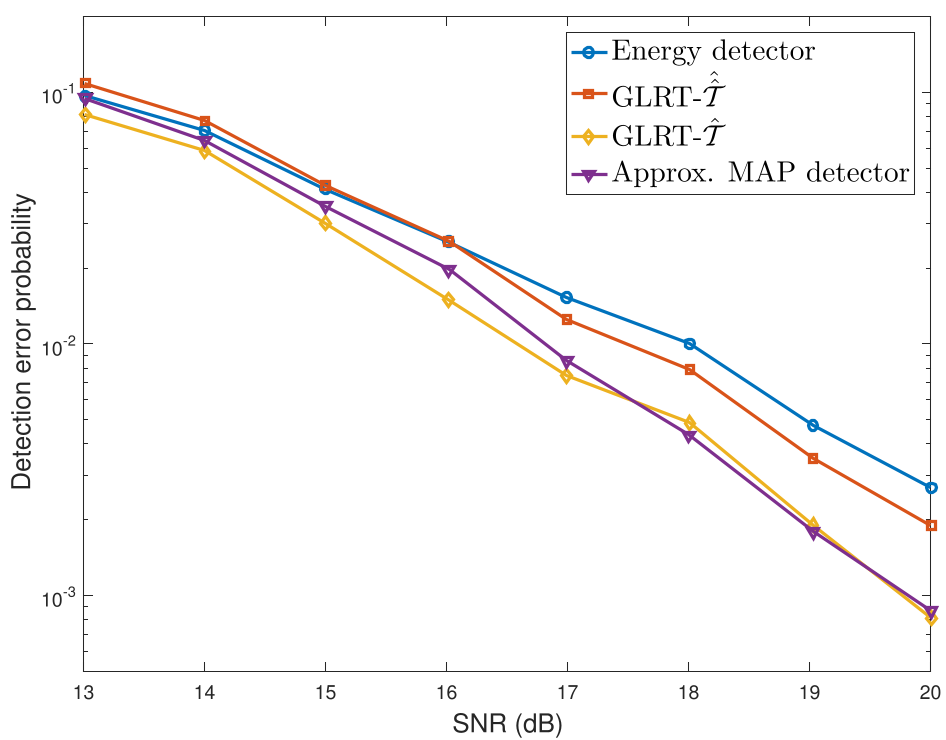
- SNR Performance: In high-SNR environments, the support estimation becomes remarkably accurate. Even at lower SNRs, the Approx. MAP maintains a significant lead over the baseline.
- Scaling with Tasks: As the number of standard tasks () increases, the detection error probability drops exponentially, proving that more queries lead to better worker profiling without compromising privacy.
Critical Analysis & Conclusion
Takeaway
The genius of this work lies in using Compressed Sensing not for signal reconstruction, but for source evaluation. It proves that you don't need to know "who said what" to know "who is lying."
Limitations
The model assumes the "maliciousness" remains constant across tasks (Joint Sparsity). If a worker is "smart-malicious"—alternating between honest and dishonest answers—the sparsity pattern would shift, potentially requiring a dynamic support tracking model.
Future Outlook
This framework is highly applicable to Edge Computing and Federated Learning, where central servers must detect poisoned gradients from edge devices without inspecting the private local data of those devices.