
Fingerprinting the Digital Enemy: Behavioral API Analysis for Malware Classification
Malware Family Fingerprinting Through Behavioral Analysis
This paper presents a behavioral fingerprinting method for malware family classification using the frequency of Windows API system function calls. By leveraging dynamic analysis data from over 65,000 samples and a stacked ensemble machine learning model (KNN, Logistic Regression, and Decision Trees), the authors achieve a family classification accuracy of 96.5%.
TL;DR
In the escalating arms race between malware authors and security researchers, static signatures are losing ground to polymorphism. This paper introduces a method to identify malware families by their "behavioral fingerprints"—specifically the frequency of Windows API calls. By analyzing over 65,000 samples through a stacked ensemble machine learning model, the authors reached a staggering 96.5% accuracy, proving that what malware does is far more revealing than how it looks.
Problem & Motivation: The Failure of Static Signatures
Traditional Anti-Virus (AV) software relies on signatures—specific strings or code patterns. However, malware authors use polymorphism to restructure code while maintaining the same malicious functionality.
The authors identify a critical gap: while AV labels (like those from Microsoft Defender) are useful for grouping malware, they often rely on simple string matching which doesn't explain the underlying behavior. The researchers' intuition was that any malicious action must eventually interface with the Operating System via API calls. Therefore, the relative frequency of these calls provides a stable, "functional" signature that obfuscation cannot easily hide.
Methodology: The Stacked Ensemble Approach
The research pipeline used the Cuckoo Malware Sandbox to generate dynamic analysis reports in JSON format. The core feature set was derived from the count of each unique Windows API function invoked during execution.
Architecture Overview
To handle the classification, the authors employed a Stacked Ensemble model using scikit-learn. This architecture combines:
- K-Nearest Neighbors (KNN)
- Logistic Regression
- Decision Trees
By "stacking" these classifiers, the model can capture different nuances in the API frequency data—varying from local clusters to linear relationships and hierarchical splits.
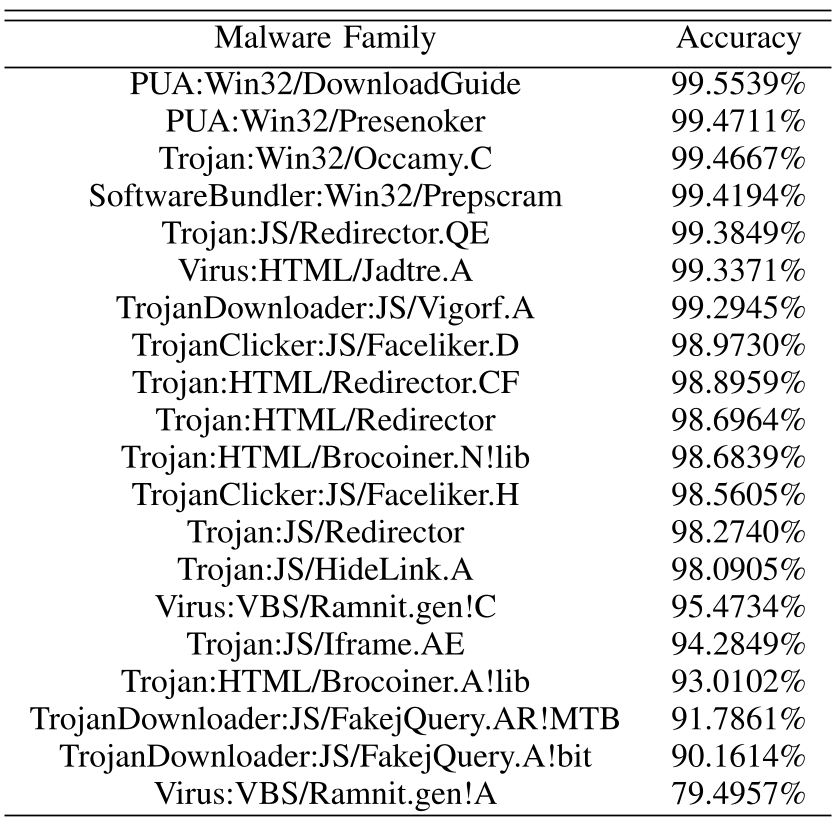 Table 1: Classification Accuracy across various prevalent malware families.
Experiments & Visual Evidence
The study compared the API profiles of different families. A key finding was that the relative proportions of calls (the "fingerprint") mattered more than the total number of unique APIs used.
For example, the "DownloadGuide" family utilized 152 unique APIs, while "Redirector.QE" used only 24. Despite this difference, the frequency patterns within each family were consistent enough for the model to achieve >99% accuracy for both.
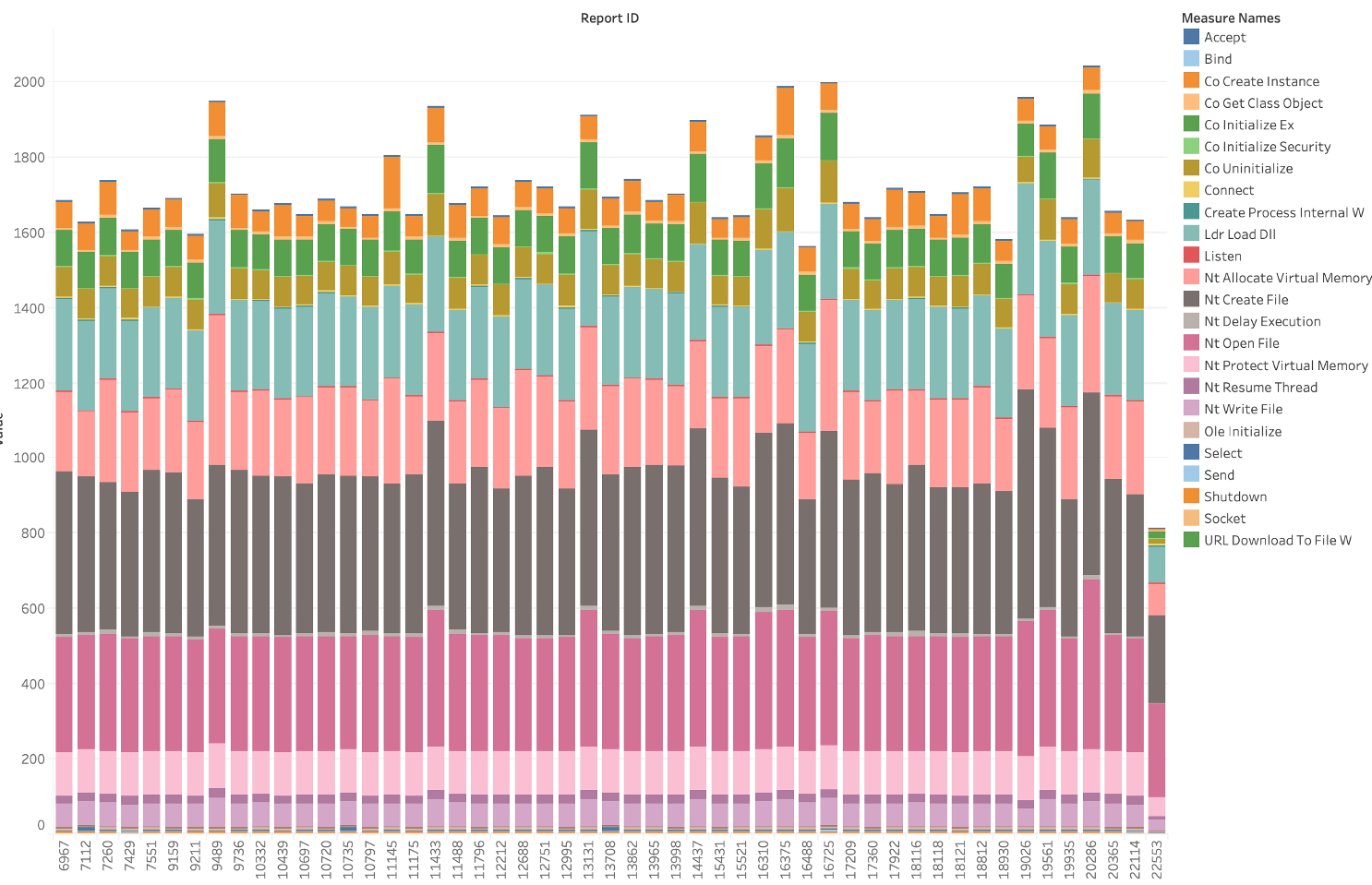 Fig 2: API Frequency for Trojan:JS/Redirector.QE, visualizing the behavioral signature.
The "Ramnit" Case Study: Why Logic Sometimes Fails
The most intriguing result was the performance gap between Ramnit.gen!A (79.49%) and Ramnit.gen!C (95.47%).
- Finding:
Ramnit.gen!Ahad a significantly higher variety of API calls (287 vs 123) and lacked a uniform pattern. - Insight: This suggests the AV signature for
Ramnit.gen!Ais likely an "over-broad" label used by Microsoft to catch multiple, distinct generations of the malware, whereasgen!Cis more behaviorally specific.
Critical Analysis & Conclusion
Takeaway
The paper successfully demonstrates that Behavioral Fingerprinting via API frequency is a powerful tool for reverse-engineering the logic behind AV labels and identifying the true "identity" of polymorphic threats.
Limitations
- Label Dependency: The method relies on the accuracy of the initial ground-truth labels provided by AV vendors (e.g., Microsoft). If the label is "over-broad" (as seen in Ramnit), the model accuracy drops.
- Environment Awareness: Sophisticated malware can detect sandbox environments (like Cuckoo) and alter its behavior to hide its true API fingerprint.
Future Work
The authors suggest that by analyzing how these API frequencies evolve over time, we can model the "natural selection" of malware. This could lead to predictive systems that anticipate the behavioral traits of the next generation of a malware family before it even hits the wild.