
BIRCH: Scaling Malware Family Identification without Sacrificing Precision
Malware family identification with BIRCH clustering
The paper introduces a novel malware family identification framework leveraging the BIRCH clustering algorithm combined with hybrid (static and dynamic) feature extraction. It achieves high-accuracy malware grouping while significantly outperforming traditional algorithms in execution speed, particularly for large-scale datasets.
TL;DR
Researchers from the University of Rome have addressed the bottleneck in automated malware analysis by introducing a BIRCH-based clustering framework. By utilizing a hybrid feature set and an incrementally scalable tree-based algorithm, they achieved near-SOTA grouping accuracy while maintaining execution speeds that far surpass traditional hierarchical methods.
Background: The Ground Truth Dilemma
In the world of cybersecurity, the term "malware family" is surprisingly ill-defined. One vendor might label a sample based on its delivery mechanism, while another labels it by its payload. This lack of a "Gold Standard" ground truth makes it difficult to evaluate automated tools.
The authors tackle this by comparing two distinct ground truths:
- AVclass-based: Synthesized from multiple commercial antivirus labels via majority voting.
- Malheur-based: Derived from sophisticated behavioral clustering.
Their discovery? The Malheur-based ground truth actually provides higher internal consistency (measured by Silhouette Coefficient), yet standard algorithms often struggle to process its complex feature space efficiently.
Methodology: High-Fidelity Features & BIRCH
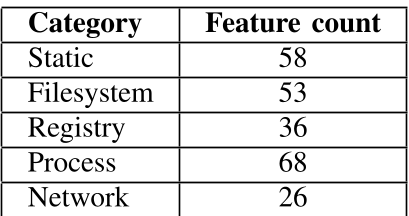
The system workflow begins with Hybrid Analysis. Unlike static analysis (which can be bypassed by obfuscation) or dynamic analysis (which is resource-heavy), the authors use both. They extract 241 numeric features from Cuckoo Sandbox reports, covering:
- Static Metadata: Readable strings inside the binary.
- Dynamic Operations: Filesystem modifications, registry changes, and network packets.
Why BIRCH?
Most high-accuracy clustering (like Hierarchical Clustering) has a high computational cost (), making it unsuitable for the thousands of new malware samples discovered daily. BIRCH (Balanced Iterative Reducing and Clustering using Hierarchies) changes the game by:
- Summarizing Data: It stores data in "Clustering Feature" (CF) vectors.
- O(n) Complexity: It builds a height-balanced CF Tree, requiring only a single pass over the dataset.
- Incremental Nature: It can process new samples without re-clustering the entire history.
Experimental Results: Speed Meets Accuracy
The evaluation compared BIRCH against a suite of algorithms, including DBSCAN, K-Means, and various Hierarchical Linkages.
1. Accuracy (FMI/ARI/AMI)
Across both ground truths, BIRCH consistently ranked at the top. While certain Hierarchical Linkage methods (like Single Linkage) occasionally matched it, they did so at a massive performance cost.
2. Execution Time
The performance gap was stark. As shown in the figures below, BIRCH outperformed almost every competitor. Only Mini-Batch K-Means was faster, but its accuracy was significantly lower, making it unreliable for security-critical family identification.
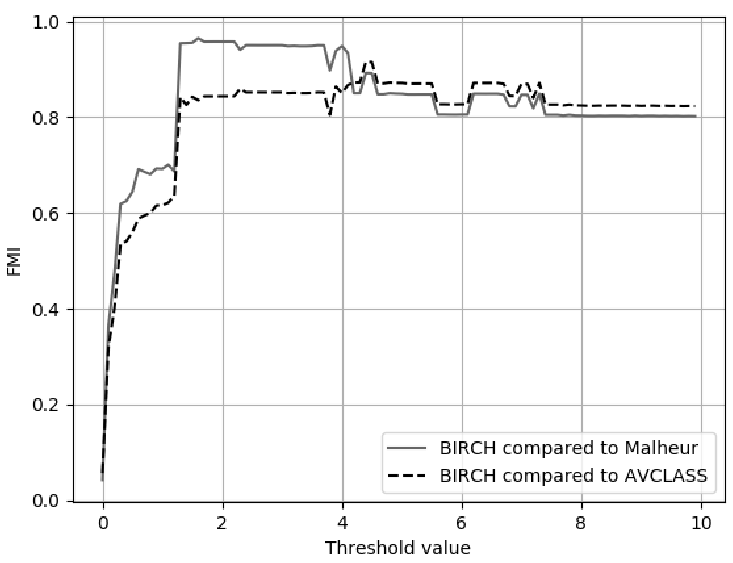 Figure: FMI achieved by clustering algorithms across different ground truths.
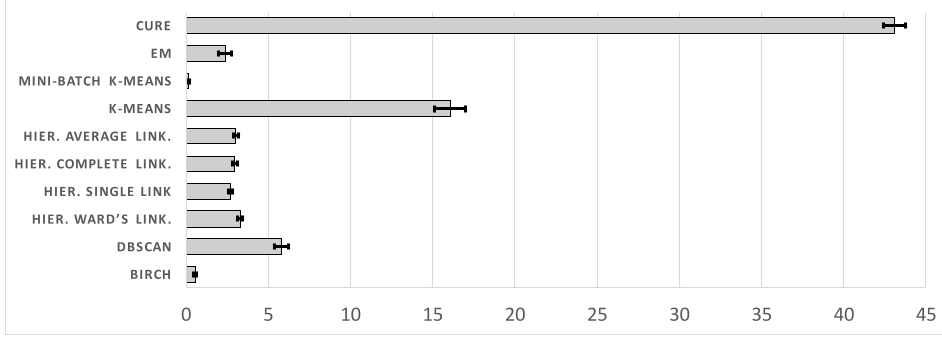 Figure: Execution times in seconds showing BIRCH's superior efficiency.
Critical Insight: The Future of Triage
The real value of this research lies in Automated Triage. By grouping similar malware into families efficiently, analysts can ignore "known" variants and focus their limited manual effort on truly novel threats.
However, the authors acknowledge a limitation: the reliance on sandbox reports means the system is only as good as the dynamic analysis it consumes. If a malware detects the sandbox and remains dormant, the feature vector will be hollow.
Conclusion
The BIRCH algorithm provides the "Holy Grail" for malware family identification—the ability to cluster at scale without the quadratic time complexity that usually haunts hierarchical methods. For future security architectures, moving toward BIRCH for online, incremental clustering will likely be the standard for handling the "Malware Deluge."