
Beyond Equilibrium: Scaling Social Diffusion Simulations via Centrality-Based Abstraction
Managing the Complexity of Large-Scale Agent-based Social Diffusion Models with Different Network Topologies
The paper introduces three novel model abstraction methods (M1, M2, M3) designed to manage the computational complexity of large-scale agent-based social diffusion simulations across different network topologies. By utilizing node centrality measures, the proposed M3 method achieves superior approximation accuracy specifically on scale-free networks, while attaining up to 40x speedup in regular networks.
TL;DR
Simulating how opinions or viruses spread across millions of agents is computationally grueling. While previous "shortcuts" assumed groups of agents eventually reach the same state (equilibrium), this paper proves that assumption fails in Scale-Free networks (like the real world). The authors propose three new abstraction methods—M1, M2, and M3—that use Social Network Centrality to simplify complex simulations, achieving up to a 40x speedup without sacrificing accuracy.
The "Equilibrium" Trap in Scale-Free Networks
In traditional social diffusion research, the standard trick for scaling up is to group similar agents into "super-agents." This works if everyone in a group eventually thinks the same way (Reaching Equilibrium).
However, the author reveals a critical flaw:
- Topology Matters: Random and regular networks converge fast, but Scale-Free networks (where a few "hubs" have massive influence) converge much slower.
- External Noise: In the real world, media and information sources constantly "poke" the system. If the network is disturbed faster than it can converge, the "equilibrium shortcut" becomes a source of massive error.
Methodology: Ranking the Influencers
To solve this, the paper shifts the focus from where the system ends up to who matters most. They propose approximating the group's average opinion by weighting each agent's contribution based on their Significance Value (sv).
The Three Tiers of Abstraction:
- M1 (Local Influence): Based on simple degree centrality—how many people does an agent talk to?
- M2 (Relative Influence): A more nuanced version of M1 that accounts for the relative weight of an agent’s voice compared to their neighbors.
- M3 (Propagated Influence): The "Gold Standard" of the paper. It iteratively propagates influence throughout the network (similar to PageRank). If you influence an influential person, your "significance" increases.
 The core math: Defining how opinion change () is driven by weighted interpersonal influence.
Experiments: Speed vs. Accuracy
The authors tested these methods against 1,000 agents in three network types: Scale-free, Regular, and Random.
Key Insights:
- The Scale-Free Breakthrough: In parallel simulations, the new M3 method significantly reduced Root-Mean-Square Error (RMSE) compared to the previous Invariant-based (INV) baseline.
- Efficiency: The computation time for the "Original Model" exploded as agent counts increased, but the abstracted models remained nearly flat in complexity.
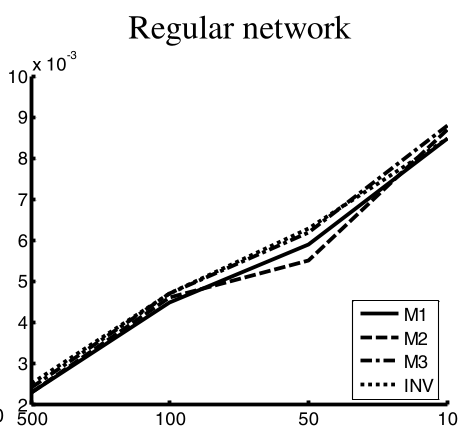 Performance Analysis: As shown in Fig 7, method M3 consistently tracks the global dynamics more accurately than the INV method in Scale-Free networks.
Computational Speedup (Table 1 Summary):
| Network Type | Original Model (1k Agents) | M1/M2 Abstraction | Speedup |
|---|---|---|---|
| Regular | 54.2s | ~4.4s | 12x - 40x |
| Scale-free | 41.0s | ~2.7s | 15x - 25x |
Critical Analysis & Takeaways
The brilliance of this work lies in its recognition that not all agents are created equal. By identifying "influencers" via social network metrics, we can ignore the microscopic interactions of thousands of "follower" agents while still capturing the macro-level movement of the population.
Limitations:
- The methodology assumes a somewhat static network topology. If the network structure evolves as fast as the opinions (dynamic topology), the significance values would need constant recalculation, potentially eating into the computational gains.
- Method M3 is the most accurate but also the most complex to pre-calculate, requiring multiple iterations for the nodes.
Future Outlook: This approach provides a blueprint for simulating massive social phenomena—from "fake news" propagation to vaccine hesitancy—on consumer-grade hardware by replacing brute-force agent simulation with intelligent, centrality-aware aggregation.