
Steering the Collective Mind: Managing Consensus via Social Leadership
Managing consensus based on leadership in opinion dynamics
The paper proposes a leadership-based consensus management framework in opinion dynamics, utilizing the DeGroot model and social network analysis. It introduces an optimal "Adding Edge" strategy to achieve group consensus and generalized rules to guide opinions toward a specific target interval.
TL;DR
In the age of social media, opinions don't just form—they are shaped. This paper moves beyond simply modeling how people disagree to proposing a rigorous engineering framework for how to make them agree. By identifying "Opinion Leaders" within the topology of a social network, the authors provide an algorithmic way to achieve group consensus—or even drive the group toward a specific target value—by adding the minimum number of social interactions.
Problem & Motivation: The Gap in Opinion Dynamics
For decades, models like DeGroot or Hegselmann-Krause have focused on the What: "What happens to opinions over time?" They describe convergence or polarization as passive phenomena. However, policymakers and firms are interested in the How: "How can we intervene to resolve dissent?"
The challenge is twofold:
- Topology matters: You cannot force consensus if the network graph is disconnected or lacks a central influencer.
- Efficiency: Intervening in a network is "expensive." You want to achieve maximum influence with minimum structural changes.
Methodology: The Power of Leadership
The core insight of the paper is the mathematical formalization of Leadership.
1. Identifying the Leaders
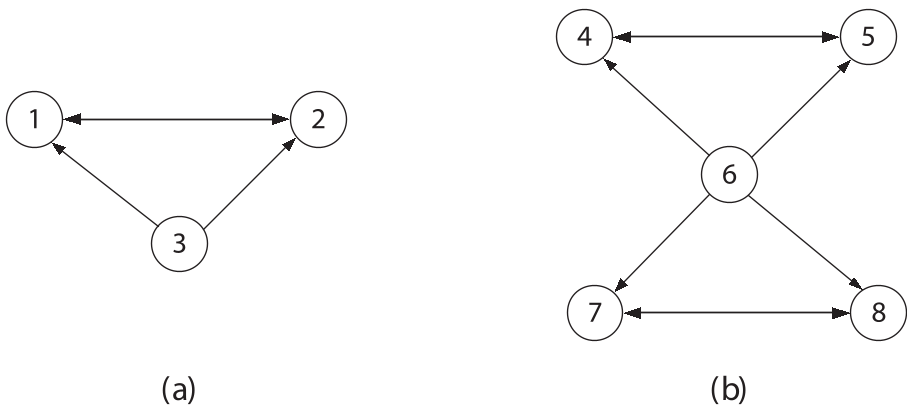
The authors prove that for a consensus to form, there must be at least one "Opinion Leader"—an agent from whom there is a directed path to every other agent in the network (Theorem 1). Crucially, the final consensus value is purely a linear combination of these leaders' initial opinions.
2. The Minimal Intervention Strategy
If a network is fragmented, the authors propose a two-step optimization:
- Network Partition: Divide the network into sub-networks that each have their own local leaders.
- Adding Edges: Add the minimum number of directed edges (, where is the number of sub-networks) to create a global leadership structure.
3. Guiding Opinions to a Target
What if you don't just want any agreement, but agreement on a specific value? The authors generalize the strategy:
- Phase 1: Adjust the network structure (adding edges) to pick the "right" leaders whose opinions are closest to the target.
- Phase 2: Use "adjusting rules" to slightly nudge those leaders' opinions.
Experiments & Results
The authors validated their model using a 26-agent simulation. Initially, the network was fragmented into three sub-communities, leading to opinion dissent (divergence).
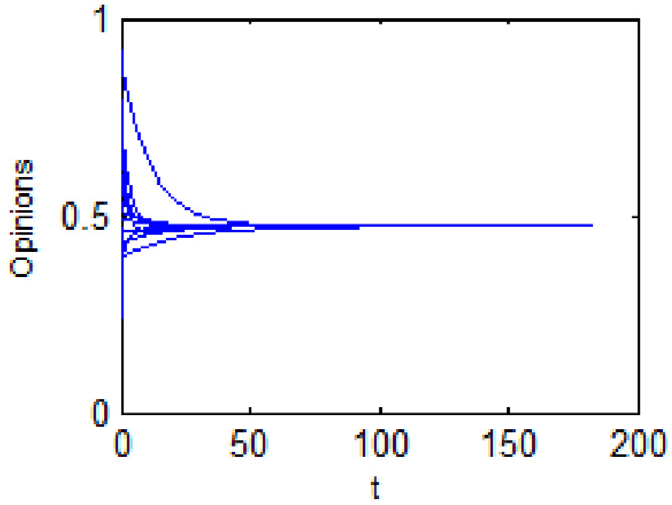
By applying the Adding Edge Algorithm, they demonstrated that adding just two specific links (e.g., from an agent in the second group to a leader in the first) could force the entire 26-agent population to converge to a single value.
| Scheme | Added Edges | Resulting Consensus () |
|---|---|---|
| Scheme 1 | (), () | 0.84 |
| Scheme 2 | (), () | 0.24 |
| Scheme 3 | (), () | 0.47 |
This proves that by strategically choosing which connection to add, an external moderator can effectively "select" the final consensus value from the existing pool of leader opinions.
Critical Insight: Why This Matters
This research provides a "control theory" for social networks. It highlights that social influence is a zero-sum game of accessibility. By ensuring a specific leader is "accessible" to all, you effectively grant them control over the group's collective future.
Limitations & Future Work
- Static Trust: The model assumes trust weights remain constant, whereas in real life, radical intervention might cause agents to lose trust and break edges.
- Rational Agents: It assumes agents follow the linear DeGroot update rule. Incorporating "stubborn agents" or "noise" (bounded confidence) would increase robustness.
Conclusion
This paper is a significant contribution to the management of public opinion. It provides the mathematical proof that consensus is not just a matter of "talking it out"—it is a structural property of the network that can be engineered with surprising precision.