
Blockchain vs. The Fax Machine: A Modern Blueprint for Lifetime Healthcare Data
Managing Lifetime Healthcare Data on the Blockchain
The paper proposes a blockchain-based healthcare data management system that integrates a permissioned blockchain (Multichain) with centralized off-chain storage. It enables instant, universal access to medical records while maintaining a pseudo-anonymous architecture specifically designed to facilitate large-scale machine learning and data mining.
TL;DR
Despite living in the age of fiber-optic internet, the medical industry still crawls along on 1980s fax technology. This paper proposes a hybrid architecture using Multichain and centralized off-chain storage to create a secure, tamper-proof, and instantly accessible medical history. By decoupling identity from data through a "second-layer" blockchain, it solves the paradox of making data private for patients yet accessible for life-saving Machine Learning.
The "Fax Trap": Why Healthcare is Stuck in the 80s
The global Electronic Health Records (EHR) market is booming, yet data remains siloed. If you wanted your records from birth today, you'd face a gauntlet of phone calls, e0.04-per-page photocopying fees, and slow-moving Freedom of Information requests.
The root cause is a lack of a trustless communication protocol. Hospitals use faxes because they are perceived as more secure than email—unmanipulatable and less prone to remote hacks. However, this fragmentation leads to delayed diagnoses and administrative nightmares.
Methodology: The Double-Layer Blockchain
The core innovation of this paper is how it structures patient data to be both anonymous and easily traversable.
1. Pseudo-Anonymous Identifiers
Instead of using a static ID, the system generates a Base Record using a hash (SHA-256) of the patient’s Date of Birth, Social Security Number (SSN), and a secret PIN.
2. The Second-Layer Chain
To prevent the need to scan the entire global blockchain to find one patient's history, the authors propose a logical "user-specific chain." Each new record is linked by hashing the previous record’s identifier with a salt (the SSN).
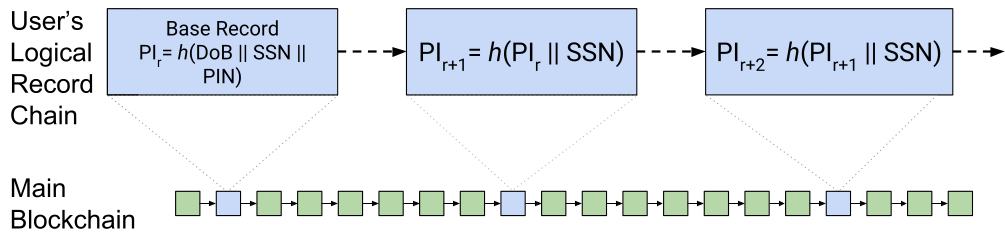 Fig 1: The logical chain produced by linking records on top of the main ledger.
3. Hybrid Storage Strategy
While some systems try to put data directly "on-chain" (bloating the ledger) or use decentralized storage like IPFS (risking data persistence and access control), this system uses a Centralized Database managed by a government health agency.
- On-Chain: Stores the pseudo-anonymous ID, a hashed pointer to the file, and a file integrity hash.
- Off-Chain: Stores the actual medical file, stripped of identifying information.
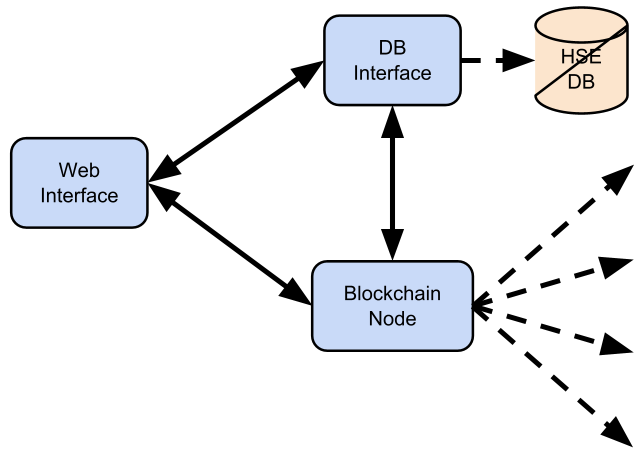 Fig 2: The central database working in tandem with existing hospital systems.
Why Decoupling Works: Security & Analytics
One of the boldest claims in the paper is leaving the off-chain data unencrypted.
The Motivation: Encrypted data is the "graveyard" of Machine Learning. While technologies like Homomorphic Encryption exist, they are currently too slow for complex medical AI. By keeping data unencrypted but strictly anonymous, researchers can apply for temporary access to scrape datasets for trends (e.g., flu outbreaks or hospital stay predictions) without ever knowing the patients' identities.
Handling the "Identity Leak"
What happens if a patient's PIN or SSN is phished? In a traditional blockchain, that data is compromised forever. In this system, because the storage is centralized, the patient can generate a new PIN, create a new Base Record, and the system can migrate the files to new pointers and delete the old records.
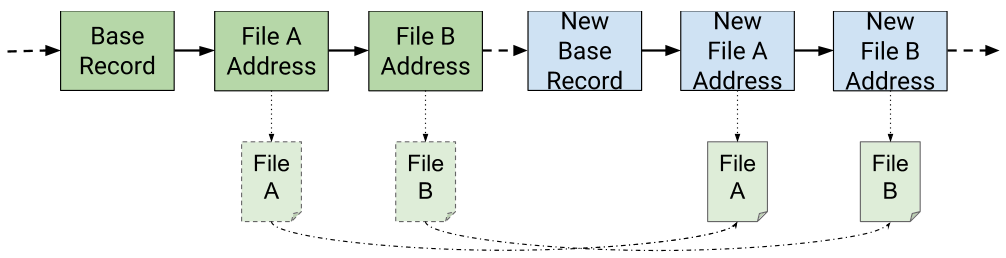 Fig 3: Moving files from a compromised base record to a new, secure chain.
Critical Insight & Conclusion
Most blockchain projects fail in healthcare because they try to "disrupt" everything at once. This paper’s strength lies in its pragmatism:
- It uses a Permissioned Blockchain (Multichain), allowing government oversight.
- It does not rely on volatile tokens or cryptocurrency.
- It acknowledges that hospitals will keep their internal databases, acting as a synchronization layer rather than a replacement.
The Takeaway: The path to modernizing healthcare isn't just about the technology—it's about building a system that balances the patient's right to privacy with the society's need for data-driven medical breakthroughs.
Limitations
The use of SSN as a salt is a noted security risk, given its susceptibility to theft. Future iterations suggest using Smart ID cards with chip readers as a more robust hardware-based salt to ensure that "knowledge" of a number isn't the only barrier to a lifetime of medical secrets.