
Beyond the Straight Line: Why Manifolds are the Secret Blueprint of AI Behavior
Manifold Steering Reveals the Shared Geometry of Neural Network Representation and Behavior
The paper introduces Manifold Steering, a novel activation-based intervention method that respects the intrinsic geometric structure of neural representations and behaviors. By fitting manifolds to activations () and output distributions (), the authors demonstrate a scaled isometry between internal geometry and external behavior, achieving state-of-the-art control across LLMs and visual world models.
TL;DR
Researchers have long assumed that "concepts" in AI are represented as straight lines—if you want to turn "Monday" into "Friday," you just add a vector. This paper proves that assumption is wrong. By treating AI internals as curved manifolds rather than flat spaces, the authors introduce Manifold Steering, a method that produces 2.8x more natural behavior and enables precise control over complex, multi-dimensional logic.
The Problem: The "Teleportation" Trap
Current AI steering methods (like "Inference-time Intervention") usually follow the Linear Representation Hypothesis (LRH). This assumes that if you want to shift a model's state, you can simply draw a straight line between two points in activation space.
However, the authors observe a critical failure: Linear steering often leads to "teleportation." If you steer a model from "Tuesday" to "Thursday" using a straight line, the intermediate outputs aren't "Wednesday"—they are often gibberish or a weird superposition of unrelated tokens. This is because the straight line "cuts through" the empty space where the model has no data, similar to trying to walk through a mountain instead of following the curved path around it.
Methodology: Mapping the AI's "Internal Terrain"
The core insight of this paper is that representation geometry () and behavior geometry () are two sides of the same coin.
1. Fitting the Manifolds
The researchers used cubic splines and Thin Plate Splines (TPS) to map out how models like Llama 3.1 8B store concepts (e.g., circular for weekdays, sequential for ages, and grids for complex logic).
2. The Shared Geometry
They discovered a scaled isometry: the distance between two points on the internal activation manifold is directly proportional to the "Hellinger distance" (a measure of similarity between probability distributions) in the output behavior.
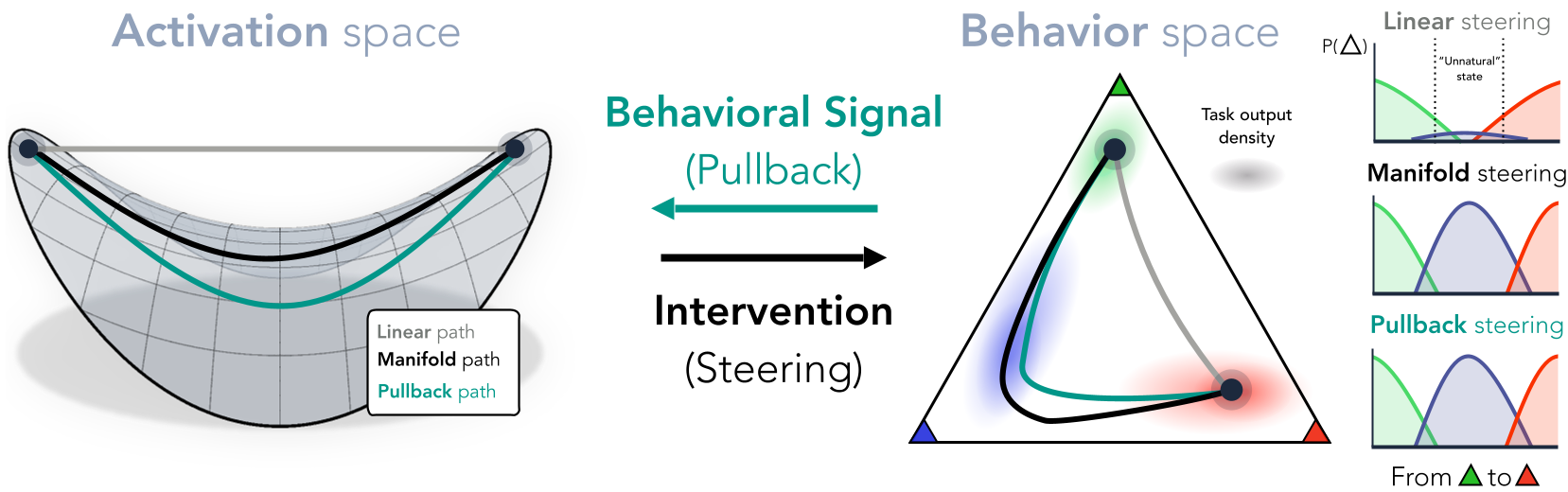 Figure 1: Comparison of Euclidean steering (straight line) vs. Manifold steering (following the curve). The manifold approach stays within the "natural" zones of the model.
Experiments: Results from Language to Physics
The authors tested this theory across diverse domains:
- Reasoning Tasks: Steering through days of the week or months.
- In-Context Learning (ICLR): Controlling a model's "mental map" of a 2D grid learned during a single prompt.
- World Models: Controlling a "Mountain Car" simulation by intervening in the visual encoder of a reinforcement learning agent.
Key Result: Factored Control
In the 2D grid tasks, manifold steering allowed the researchers to move the model's "belief" horizontally without affecting the vertical coordinate. Linear steering failed completely, scrambling the coordinates because it didn't understand the underlying graph structure.
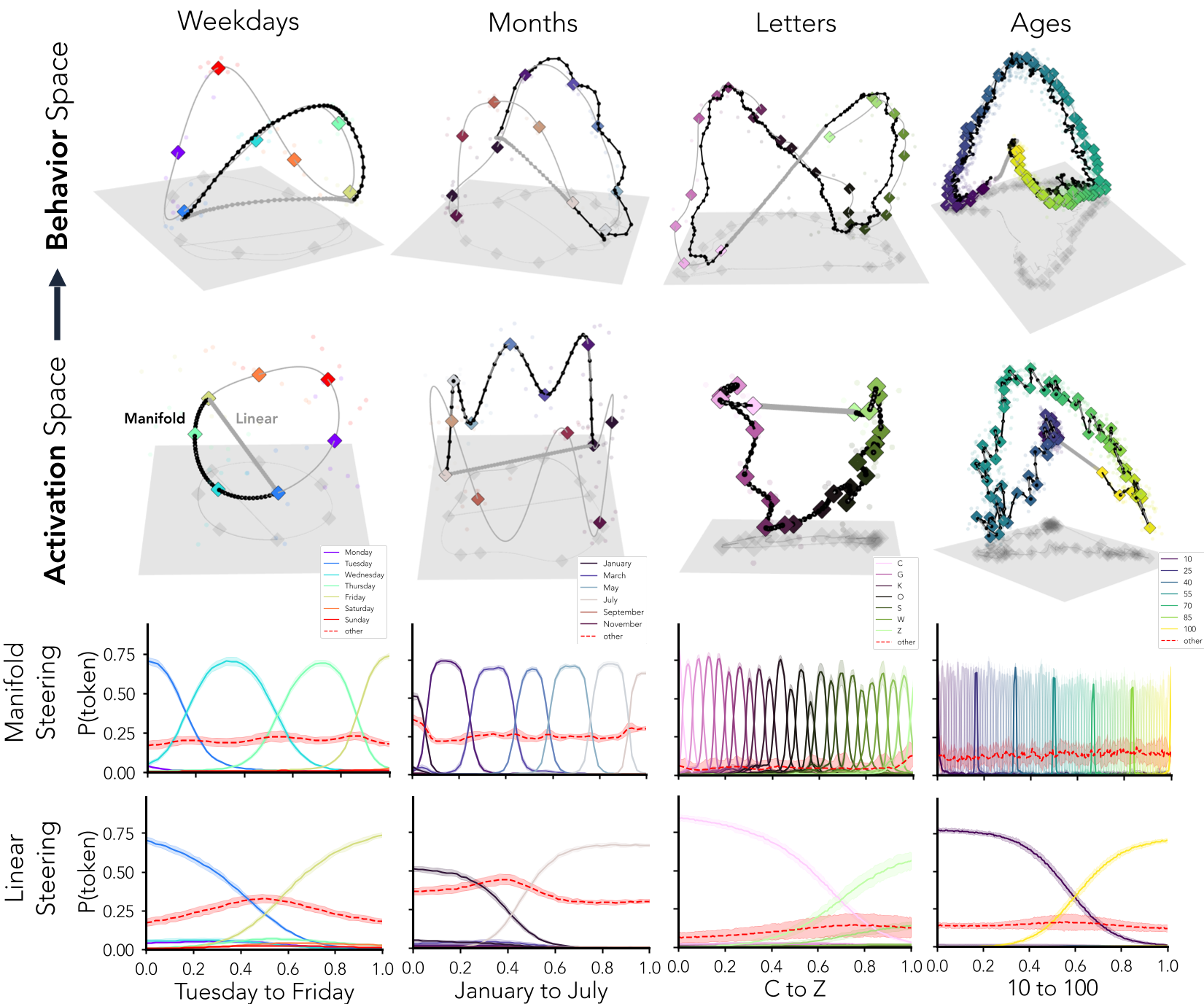 Figure 2: Manifold steering yields smooth, ordered transitions (Monday -> Tuesday -> Wednesday), while linear steering causes mass to jump randomly.
The "Pullback" Insight: Geometry works both ways
One of the most impressive parts of the paper is the Pullback experiment. They asked: "If we optimize an activation path purely to make the output look natural, what path does it take?"
The result? The optimization automatically recovered the curved activation manifold. This confirms that the internal geometry is not just a curiosity; it is the fundamental constraint of how the model processes information.
Critical Analysis & Conclusion
Takeaway
The AI community has been obsessed with finding the "right direction" (vectors). This paper suggests we should be looking for the "right geometry" (manifolds). By respecting the curvature of AI's internal spaces, we can make interventions safer and more predictable.
Limitations
- Complexity: Fitting manifolds to simple concepts like "weekdays" is easy. Doing it for abstract concepts like "sycophancy" or "truthfulness" is much harder and requires better unsupervised tools.
- Multi-step logic: The study focus is mostly on "next-token" distributions. Extending this to long-form sequence generation remains a future challenge.
Final Thought: If neural networks are indeed "conceptual spaces," then Manifold Steering is our first real compass for navigating them without getting lost in the "off-manifold" wilderness.