
Decoding Workplace Silence: The Power of Self-Annotation in Non-Acted Speech Emotion Recognition
Comparing Manual and Machine Annotations of Emotions in Non-acted Speech
This paper investigates Speech Emotion Recognition (SER) in non-acted workplace environments by comparing self-reported and observer-perceived annotations. By utilizing a refined 10-point valence scale and high-agreement datasets, the authors achieved a SOTA speaker-dependent classification accuracy of 80% and a speaker-independent accuracy of 61%.
TL;DR
Recognizing emotions in a workplace setting is notorious for being "too subtle" for traditional AI. This paper tackles the challenge by moving away from exaggerated "actor" data. By comparing how speakers perceive their own voice vs. how others hear them, and focusing on high-agreement samples, researchers boosted emotion classification accuracy to 80%—a significant leap for real-world (non-acted) speech processing.
The "Authenticity" Gap: Why Current AI Fails in the Office
Most Speech Emotion Recognition (SER) systems are trained on actors shouting or crying. In a professional environment, people rarely express emotions so vividly. This creates a domain gap where models struggle with "moderated" expressions.
The authors identify a critical missing link: The Self-Perception. Most databases use third-party observers to label data, but the person speaking actually knows the "truth" of their emotional state. This study asks: If the speaker and the observer can't agree on the emotion, should the machine even try to learn from it?
Methodology: The 6-Month Reunion
To ensure clean data, the researchers performed a unique longitudinal experiment:
- Delayed Self-Annotation: Participants listened to their own recordings 6 months later to avoid "context memory" and focused only on short utterances.
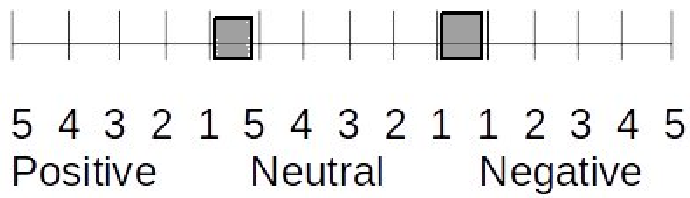
- The Valence Scale: Instead of simple "Happy/Sad" labels, they used a nuanced scale (Fig 1) that maps "Neutral" on a gradient toward Positive or Negative.
- Feature Engineering: Beyond standard MFCCs, they introduced frequency-domain autocorrelation to capture the shifting contours of natural speech.
Key Insight: The Positive Emotion Paradox
One of the most striking findings is that Positive emotions are the hardest to detect. While participants and observers agreed on Neutral (84%) and Negative (74%) clips, they only agreed on Positive clips 38% of the time.
Why? In non-acted speech, "positive" often sounds "neutral." This confirms that psychological shifts in negative emotions (stress, anger) produce much more distinct acoustic signatures than being "content" or "happy" at work.
Experimental Performance
By training only on "Agreement Samples" (where the speaker and researcher agreed), the Random Forest classifier achieved a major performance boost.
- Speaker-Dependent Accuracy: Reached 80%, a 7% increase over prior methods.
- Neutral Recognition: In speaker-independent tests, neutral detection shot up from a dismal 3% to 56%.
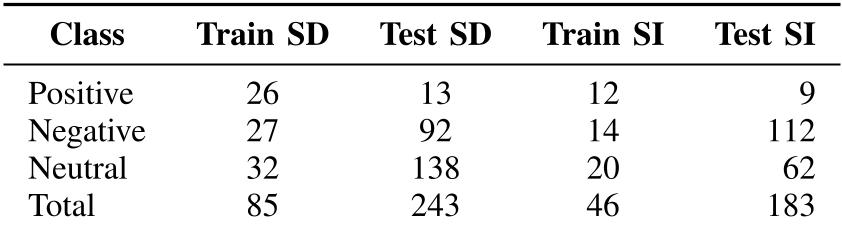
The table above demonstrates that when the model "knows" what an individual sounds like, it becomes remarkably adept at separating negative from neutral states.
Clinical and Occupational Implications
This research isn't just about better accuracy; it's about mental health. Given that mental health issues account for nearly 13% of the global disease burden, using non-obtrusive laptop microphones to detect stress or early signs of depression in employees could be a game-changer for workplace wellness.
Limitations & Future Work
The study admits that the "Positive" class remains a challenge due to low sample agreement. Future models may need to treat "Neutral-leaning-Positive" as its own specific category rather than forcing a binary classification.
Final Verdict
This paper proves that the "internal truth" of the speaker (Self-Annotation) is the most reliable fuel for SER models. By filtering out the noise of human disagreement, we can finally build AI that understands the subtle emotional textures of our daily professional lives.