
Beyond QoS: Unleashing the Synergy Effect in Cloud Manufacturing Service Composition
Manufacturing service composition model based on synergy effect: A social network analysis approach
The paper proposes a manufacturing service composition model based on the "Synergy Effect" within a Service Social Network (SSN). It moves beyond traditional QoS-only selection by integrating five types of social relationships to optimize collaboration in cloud manufacturing, specifically validated in an intelligent automobile manufacturing scenario.
TL;DR
Modern manufacturing is no longer about isolated factories but distributed, cloud-based service chains. This paper introduces a Synergy-aware Service Composition model that treats manufacturing units as "social" entities. By analyzing their hidden social relationships—like past transaction history and resource complementarity—the model builds dynamic alliances that perform better in the real world than those selected purely on speed or cost (QoS).
The "Isolation" Problem in Manufacturing Clouds
In the era of Cloud Manufacturing, when a complex task (like building an electric vehicle) arrives, a platform must pick services for R&D, parts manufacturing, and assembly.
Current SOTA methods focus on Quality of Service (QoS): Who is the cheapest? Who is the fastest? The blind spot: Even if you pick the three "best" individual services, if they use incompatible data formats, are geographically 2,000 miles apart, or have never worked together, the "hand-over" between tasks becomes a nightmare of delays and communication errors.
The Core Insight: Services as Social Entities
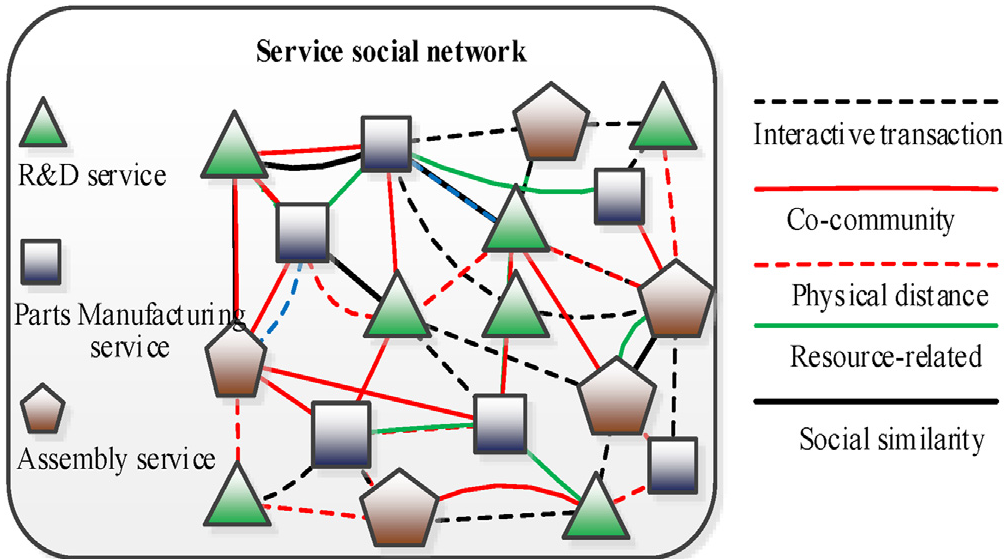
The authors argue that services on a cloud platform naturally form a Service Social Network (SSN). To capture the "synergy effect" (where 1+1 > 2), they identify five critical dimensions of social relationship strength:
- Interactive Transaction: Does service A regularly work with service B? (Collaboration habit).
- Co-community: Do they belong to the same platform or industrial cluster? (Trust & Shared standards).
- Physical Distance: How far must physical parts travel? (Logistics latency).
- Resource-related: Are their machines and skills complementary? (Value surplus).
- Social Similarity: Are the organizations similar in reputation and scale? (Structural alignment).
Methodology: The Weighted Synergy Network (WSN)
The methodology moves through three sophisticated phases:
- Relationship Quantification: Each of the five factors is calculated via specific formulas (e.g., Euclidean distance for similarity, transaction volume decay for history).
- Weighting via Information Entropy: Instead of arbitrary weights, the authors use Rough Set Theory and Information Entropy to determine which relationships matter most. Interestingly, Interactive Transaction was found to be the most critical factor (weight: 0.38).
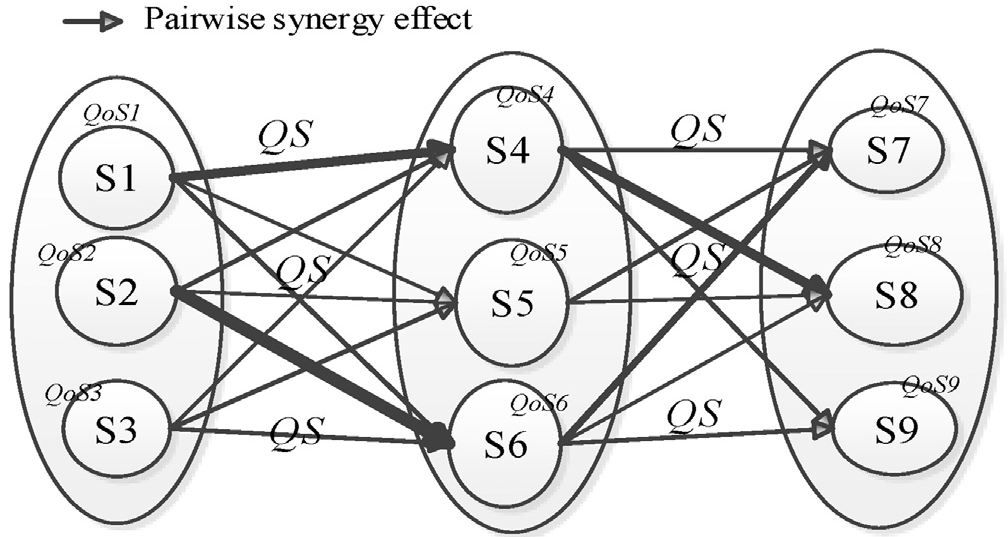
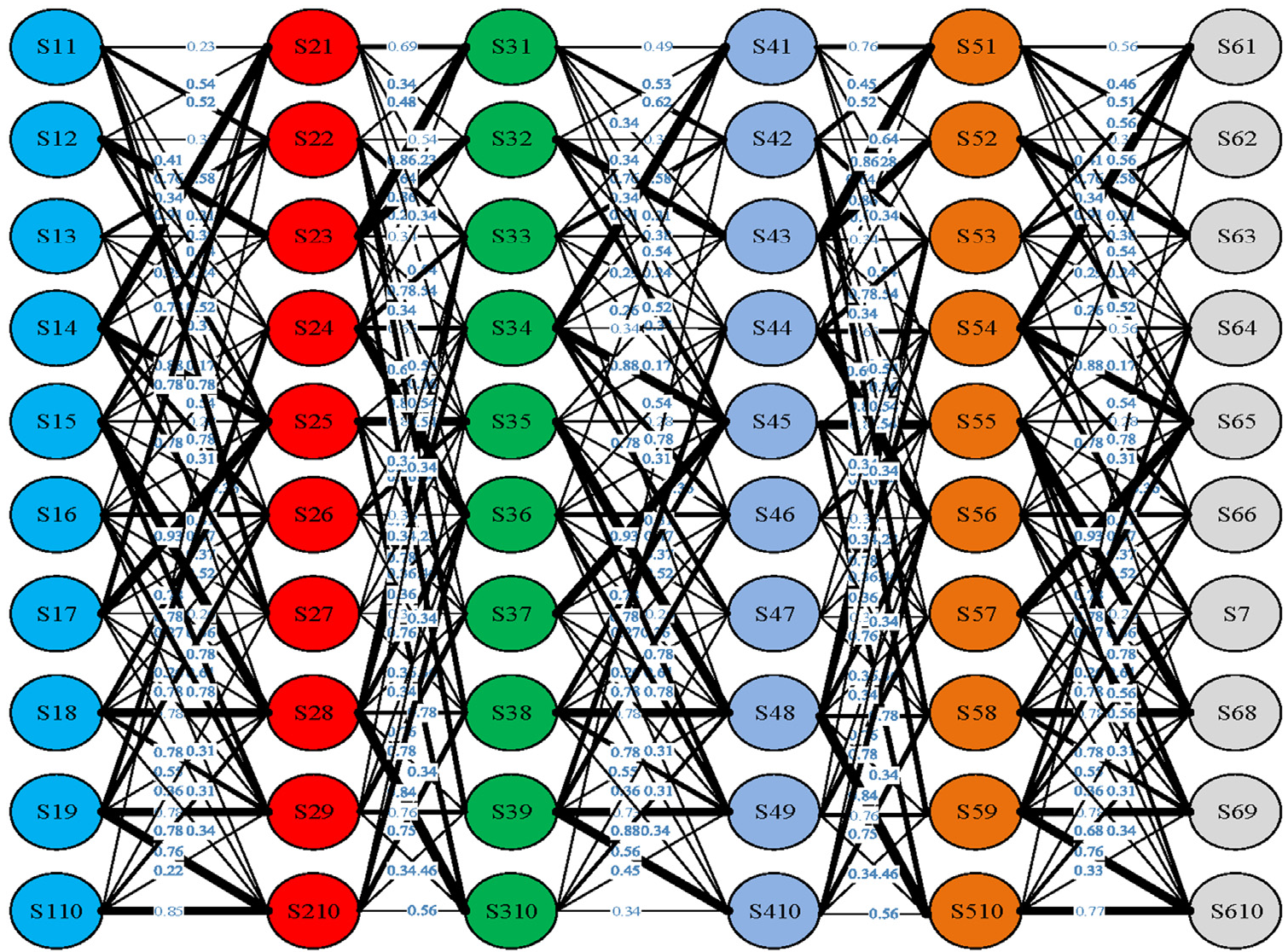
- Optimized Selection: To avoid the "combinatorial explosion" (NP-hard problem), an improved Gravitational Search Algorithm (GSA) is used to find the global optimal path through the synergy network.
Experimental Results
The model was stress-tested in an Intelligent Automobile Cloud Manufacturing simulation involving six sub-tasks.
- The Synergy Advantage: The synergy-aware model achieved a synergy score of 3.58, compared to just 2.68 for traditional QoS-aware models.
- QoS tradeoff?: Surprisingly, the total QoS remained nearly identical. This proves that you can gain massive collaboration benefits without sacrificing raw performance metrics.
- Algorithm Efficiency: The improved GSA algorithm demonstrated superior stability and faster convergence compared to Particle Swarm Optimization (PSO), especially as the number of candidate services scaled toward 1,000.
Critical Analysis & Future Outlook
This work marks a shift from "Service Computing" to "Social Service Computing." It acknowledges that manufacturing is a human-and-resource-centric activity where compatibility is as valuable as capability.
Limitations: The model currently treats synergy as relatively static. In a real-world scenario, a "bad" transaction yesterday should immediately degrade the synergy score today. Future versions would benefit from a real-time "Update-on-Failure" mechanism.
Takeaway for Practitioners: When orchestrating complex supply chains in the cloud, don't just ask "Who is the best?" Ask "Who works best together?"
Conclusion
By quantifying the "Synergy Effect" through a social lens, this research provides a robust mathematical framework for building the next generation of resilient, highly-collaborative manufacturing alliances.