
Distributed Improved Random Forest: Bridging Domain Expertise and Big Data in Education
MapReduce-Based Improved Random Forest Model for Massive Educational Data Processing and Classification
This paper proposes an improved Random Forest (RF) model specifically tailored for massive educational data mining, utilizing a feature weighting system within the ID3 framework. To handle big data scales, the authors implement the model on the MapReduce distributed framework, achieving significant performance gains in classifying college graduates' employment statistics.
TL;DR
In the era of big data, educational data mining (EDM) often struggles with complex, categorical datasets that overwhelm traditional algorithms. This paper introduces an Improved Random Forest (RF) model that incorporates a feature weighting system to prioritize meaningful attributes based on expert experience. By deploying this model on the MapReduce framework, the researchers achieved a 50%+ reduction in processing time for massive datasets (20M+ entries) while significantly boosting classification accuracy over standard ID3 and C4.5 models.
Problem & Motivation: The "Tilted Split" Dilemma
In educational datasets—such as those tracking graduate employment—data is often "tag-type" (categorical). Traditional RF models using Information Gain (ID3) tend to favor attributes with a large number of possible values (e.g., "Home City" with 33 values) over more predictive but simpler attributes (e.g., "Organization Type" with 9 values). This is known as the tilted split problem.
Furthermore, as educational data scales to millions of records, single-node machine learning implementations hit a computational ceiling. There is a dire need for a system that is both analytically "smart" (domain-aware) and computationally "strong" (distributed).
Methodology: Human Intelligence Meets Distributed Power
1. The Improved Feature Weighting System
The core innovation lies in the modification of the information gain formula. Instead of treating all features equally, the authors introduce a weight to the empirical conditional entropy:
By setting smaller for features with higher correlation (based on expert work experience), those features are more likely to be selected as splitting nodes. For instance, teachers observed that "Organization Type" is a stronger predictor of employment success than "Gender," so its weight was adjusted to reflect this hierarchy.
2. MapReduce Architecture for Scalability
To handle 10M+ records, the paper implements a three-stage MapReduce workflow:
- Model Training: Conducted offline on a local node.
- Serialization & Deserialization: The most technical challenge. The trained model is serialized into binary and stored in the Hadoop Distributed File System (HDFS).
- Distributed Prediction: The Map tasks distribute prediction work across nodes, while the Reduce tasks aggregate the final classification results.
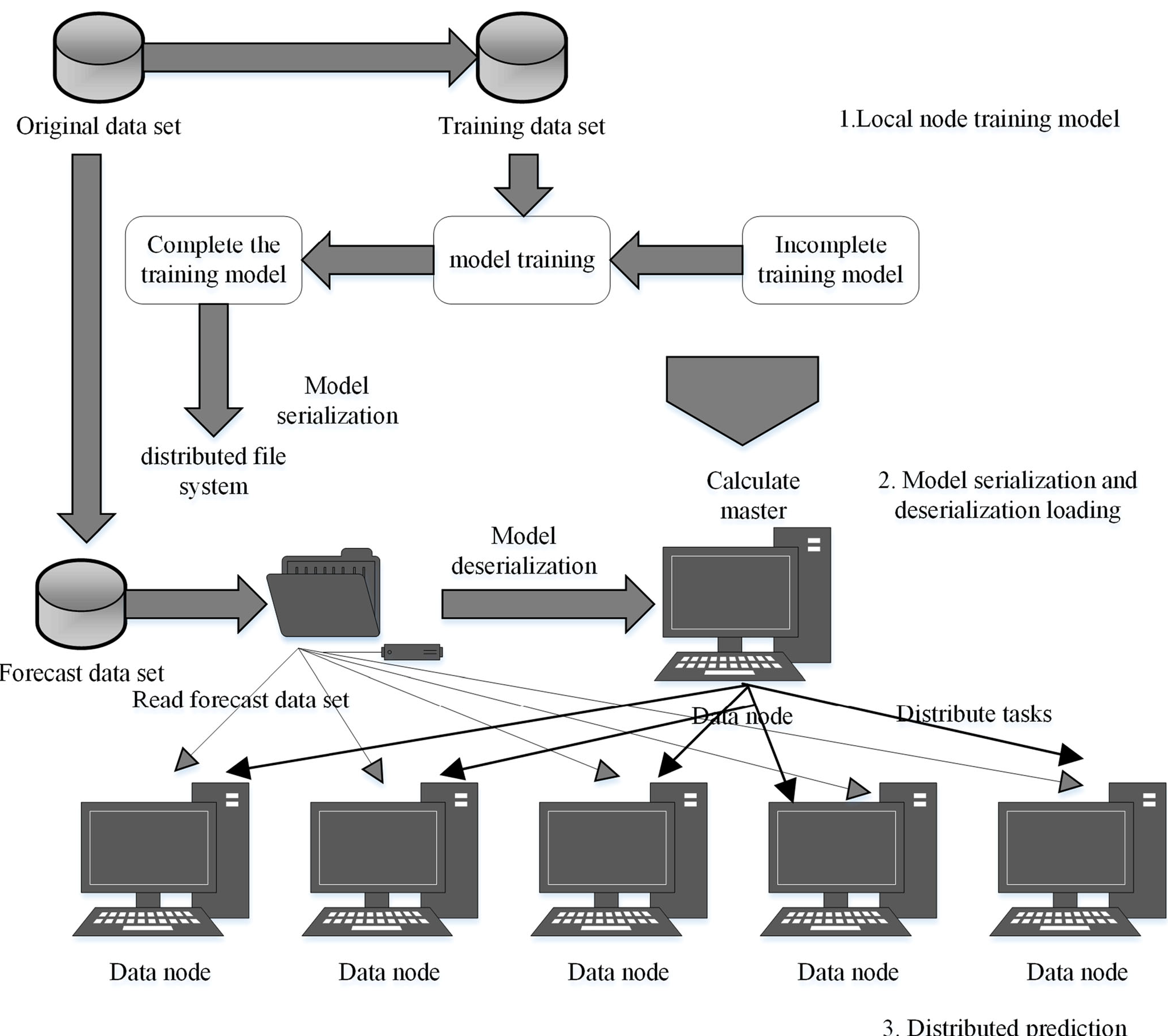 Figure: The structural design of the MapReduce processing framework.
Experiments & Results: Precision at Scale
Accuracy Gains
The improved model was tested against classical ID3, C4.5, and CART algorithms. The results were clear: for specific tasks like predicting "Unit Economy Type," the improved model outperformed the others by a margin of 6% to 22%.
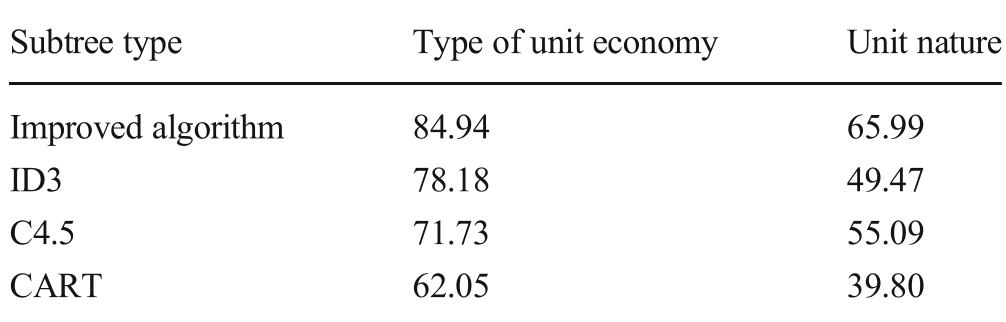 Table: Comparison of classification accuracy across different RF variants.
Computational Efficiency
The "Big Data" advantage only appeared at scale. For small datasets (700k entries), a single node was faster because it avoided the MapReduce startup overhead. However, when the data reached 19 million entries, the distributed system finished the task in 3 min 39 s, compared to 7 min 46 s on a single node—a performance boost of over 2x.
Critical Analysis & Conclusion
Takeaway
The paper successfully demonstrates that inductive bias (via manual weighting) is not always a weakness in machine learning. In specialized fields like education, "Expert Feature Weighting" can guide a model toward more logical decision paths than pure data-driven entropy ever could.
Limitations
- Weight Sensitivity: The accuracy depends heavily on the manual setting of . If the expert's intuition is wrong, the model's performance will degrade.
- Batch vs. Real-time: The MapReduce framework is designed for batch processing. Future work must address real-time data ingestion as educational platforms move toward live "streaming" analytics.
Future Outlook
As national education platforms unify, the ability to process global employment trends using these distributed, domain-weighted models will become vital for policy-making and personalized career guidance for students.