
MAPTRAITS 2014: Decoding the Dynamic Signature of Human Personality
MAPTRAITS 2014: The First Audio/Visual Mapping Personality Traits Challenge
The MAPTRAITS 2014 Challenge is a pioneering multimodal competition focused on the automatic analysis of "Big Five" personality traits and social dimensions (e.g., attractiveness, likability) using audio and visual signals. It provides the first standardized benchmark for mapping these traits in both discrete (quantized) and continuous time-space domains, utilizing the SEMAINE corpus.
TL;DR
The MAPTRAITS 2014 challenge marks a milestone in affective computing by shifting the focus from "what" a person's personality is to "how" it manifests over time. By providing the first dataset for continuous, multi-dimensional personality mapping, it enables machines to track social dimensions like Likability and Extraversion in real-time using audio-visual fusion.
Personality: From Static Labels to Dynamic States
Most psychological AI models treat personality as a fixed set of coordinates—the "Big Five" (Openness, Conscientiousness, Extraversion, Agreeableness, Neuroticism). However, the MAPTRAITS researchers argue that personality is experienced as a state that fluctuates during interaction.
The core motivation was the lack of benchmarks that handle:
- Continuous Time-Space: Tracking how "engaged" or "neurotic" a person seems at every 50ms interval.
- Multimodal Synergy: Understanding why a smile (visual) might contradict a shaky voice (audio).
- Situational Context: How interacting with different "virtual characters" changes the manifestation of one's traits.
Methodology: The Core Engine
The challenge utilizes a subset of the SEMAINE corpus, involving users interacting with virtual agents. The technical pipeline relies on two specialized feature sets:
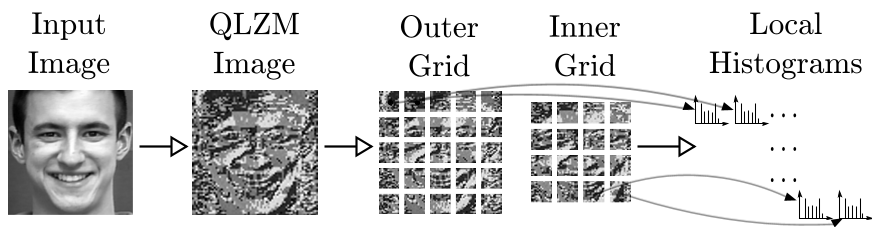
1. Visual: Quantized Local Zernike Moments (QLZM)
Instead of simple pixel values, the authors used QLZM to capture texture variations at multiple scales and orientations. This provides an Inductive Bias towards local facial geometry that is more robust to registration errors than standard raw inputs.
2. Audio: openSMILE Versatility
Acoustic features were extracted using the openSMILE toolkit, capturing 6,376 features including MFCCs, voicing descriptors, and psychoacoustic sharpness. This ensures that even subtle prosodic changes (vocal attractiveness) are quantified.
3. Continuous Annotation Alignment
Since raters have different reaction times, the ground truth for continuous traits isn't just a simple average. The authors used Dynamic Time Warping (DTW) to align human rater trajectories before averaging, ensuring the temporal "peaks" and "valleys" of personality expression were preserved.
Experimental Insights
The results reveal a fascinating divergence between modalities:
- Visual Dominance: Visual-only features generally showed higher correlation (COR) with human perception across most traits.
- The Power of Fusion: Combining audio and visual predictions at the decision level consistently lowered the Mean Square Error (MSE).
- Dimension Sensitivity: Some traits, like Extraversion and Likability, were significantly easier to model in continuous time compared to Conscientiousness.
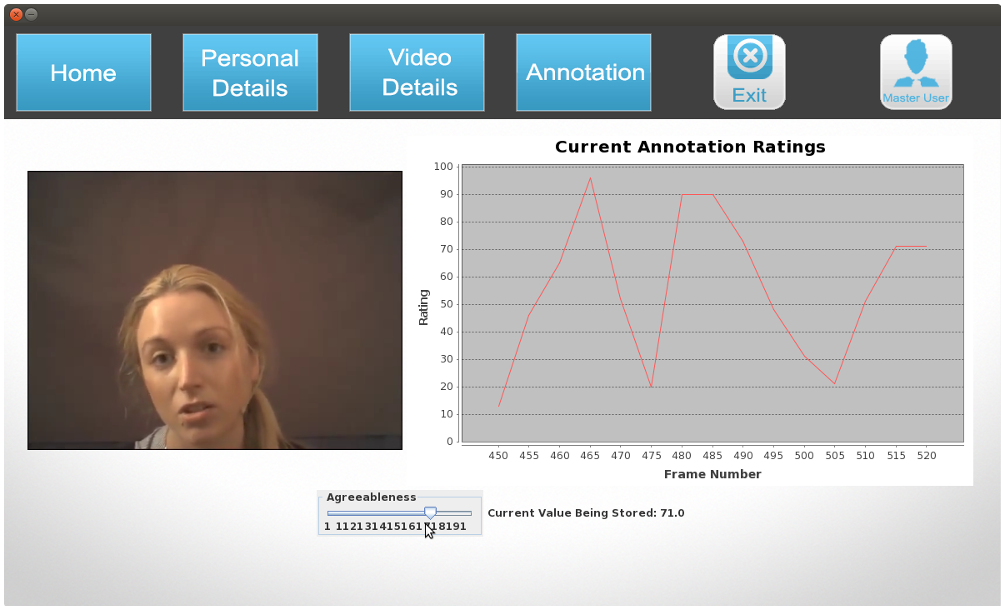 Figure: The red dashed line represents the synthesized Ground-Truth from multiple human raters for Agreeableness and Engagement.
Critical Analysis & Future Outlook
The MAPTRAITS 2014 challenge is a foundational "opening" of the field. However, its baseline results highlight the massive difficulty of the task—standard regression models (Ridge/SVR) struggle with the high variance of human social perception.
Key Takeaways for Future Research:
- Context is King: Personality isn't expressed in a vacuum. Future models must encode the "Agent" or "Partner" the subject is talking to.
- Feature-Level Fusion: The baseline used simple averaging. True breakthroughs likely lie in Feature-level fusion (e.g., Cross-modal Transformers) where audio and visual cues attend to each other.
- Subjectivity: The gap between Pearson Correlation and Concordance Correlation (CCOR) suggests that while models get the "trend" right, they struggle with the absolute intensity of perceived traits.
In conclusion, MAPTRAITS provides the blueprint for building socially intelligent systems that don't just "see" a face, but "understand" a persona.