
Marginal Gains to Maximum Reach: How Strategic Connections Revolutionize Social Spread
Marginal Gains to Maximize Content Spread in Social Networks
This paper addresses the Problem of Generalized Content Spread Maximization (GCMP), proposing two novel algorithms: the Marginal Increment-Based Sandwich (MIS) algorithm and the Influence Ranking and Fast Adjustment (IRFA) algorithm. By focusing on adding strategic edges rather than selecting seeds, the authors achieve significant spread boosts (up to 3x on Wikipedia datasets) while maintaining a data-dependent approximation guarantee.
TL;DR
When the "influencers" (seeds) are already fixed, how do you maximize the reach of a post? This paper proves that the answer isn't "more influencers," but more strategic connections. By introducing the MIS and IRFA algorithms, the authors demonstrate how to navigate the complex, non-submodular landscape of social networks to triple content spread by adding a tiny fraction of new edges.
The "Pre-Determined Seed" Dilemma
In academic literature, most researchers obsess over Influence Maximization—the art of picking the perfect people to start a trend. However, in the real world, companies often have a fixed set of advocates or limited budgets that pre-determine their "seeds."
The challenge then shifts: How do we boost the network itself? Previous attempts (like the RMPP model) used "submodular" shortcuts, essentially simplifying how information flows to make the math easier. The problem? Those shortcuts don't reflect the messy reality of social interactions, leading to suboptimal recommendations.
Methodology: The Power of Marginal Gains
The authors tackle the problem head-on by embracing non-submodularity. They define the content spread through a recursive marginal gain formula.
1. The Recursive Equation
Instead of simulating thousands of "Monte Carlo" runs, they calculate how much one added edge increases the activation probability of every other node in the network. This recursive approach ensures the spread calculation is as accurate as possible.

2. The Sandwich Framework (MIS)
Since the objective function isn't submodular (meaning the "diminishing returns" rule doesn't strictly apply), the authors create two "Submodular Bounds":
- Lower Bound: Restricts influence to existing paths.
- Upper Bound: Considers the maximum potential of all candidate edges. By "sandwiching" the real function between these two, the MIS (Marginal Increment-based Sandwich) algorithm provides a theoretical safety net for its performance.
3. IRFA: Scalable Intuition
For large networks, the authors propose IRFA (Influence Ranking and Fast Adjustment). It ranks nodes based on their "Impact Factor" () and quickly updates these rankings as new edges are added. It’s essentially a high-speed strategy for picking the "biggest bang for your buck" connections.
Experimental Proof: Quality over Quantity
The results across Facebook and Wikipedia datasets were striking.
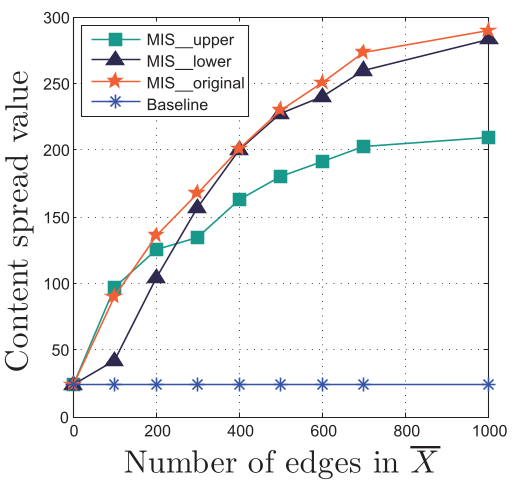
- Superiority: MIS and IRFA consistently beat PageRank and MaxDegree strategies.
- Power Law Alignment: The study found that you shouldn't give every seed node the same number of new links. Instead, the algorithms naturally assigned more edges to "high-potential" seeds, matching the power-law distribution found in real-world human behavior.
Deep Insight: Why it Works
The brilliance of this work lies in Property 1: while the total function isn't submodular, the marginal gain of each individual node is monotonically decreasing. By capturing this nuance, the authors can optimize networks that were previously thought too complex for exact calculation.
Conclusion
This paper shifts the paradigm from seed selection to topology optimization. For marketers and network engineers, the takeaway is clear: if you want content to go viral, focus on building the right bridges between users, not just picking the right people to post it.
Limitations: The current model assumes a Directed Acyclic Graph (DAG) for its cleanest updates. Dealing with high-frequency cycles in massive graphs remains the "final frontier" for this marginal gain approach.