
Beyond the Language Barrier: How "Familiars" Built a Unified Bilingual Game Community
Mario, Luigi and Dave: the effect of language on the social structure of a bilingual online mobile game
This paper investigates the social dynamics of "Familiars," a bilingual (English and Italian) asynchronous mobile game, using Network Analysis. The study reveals that officially supported languages do not lead to community segregation; instead, players form a single "small-world" network and develop creative cross-lingual strategies.
TL;DR
In the world of online gaming, we often assume that language is a wall that mandates segregation. However, research into the bilingual game Familiars suggests otherwise. By analyzing a social network of English and Italian players, researchers found that the community didn't split into two camps—it became a tightly woven "small world" where players used images, dual-language tasks, and even translation bots to play together.
Background: The Myth of Necessary Segregation
Historically, game developers have solved the "language problem" by creating regional servers or "shards." The logic was simple: if players can't understand each other, they can't play together. But as social games moved toward asynchronous interaction (think Facebook games or mobile collection games), the physical and temporal barriers of live chat disappeared.
The authors of this paper questioned whether the interface language alone would still cause implicit segregation. If the game is in Italian and English, will the "Marios" only play with "Luigis," leaving "Dave" out in the cold?
Methodology: Mapping the Social Graph
The researchers tracked 210 players in Familiars, a game where players adopt virtual creatures and complete tasks.
They categorized players using a sophisticated network-based approach:
- Hardcore Players (12%): The "shepherds" who drove 50% of all activity.
- Casual Players: Active participants who form the bulk of the content creators.
- Peripheral Players: The "long tail" who mostly interact with the superstars.
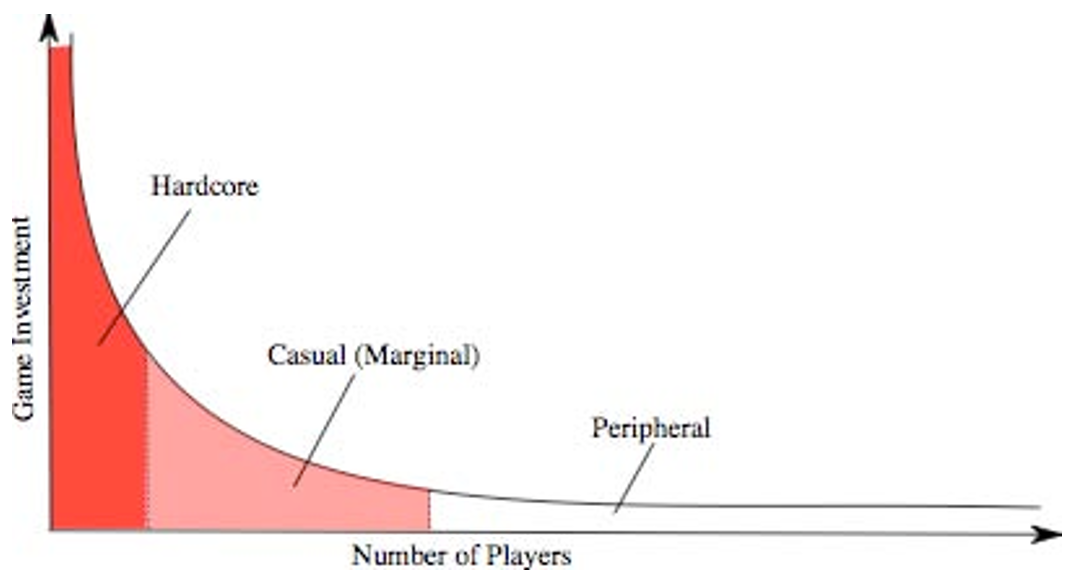 Figure: The classification split between Hardcore, Casual, and Peripheral players.
Why It Worked: The "Lingua Franca" of Images
The most fascinating discovery was how players overcame the language gap. It wasn't just through text; it was through Visual Evidence.
- Intentional Task Design: 65% of cross-lingual tasks were designed to be neutral or bilingual (e.g., "Best Colour? / Miglior Colore?").
- The Power of Pictures: Italians, in particular, used images in 100% of their responses when writing in English. The image became the "lingua franca"—a universal language that required no translation.
- Experimental Interaction: Casual players were actually the most likely to reach across the aisle, with 23.5% of their interactions being cross-lingual.
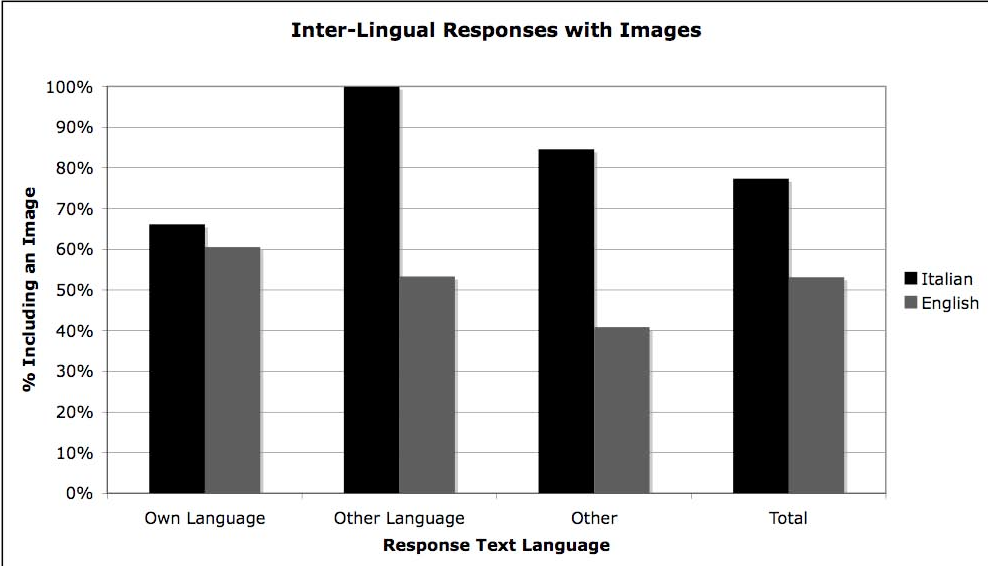 Figure: The usage of images in inter-language responses, highlighting the Italian players' reliance on visual aids to bridge the gap.
Key Results: A Scale-Free Small World
The social structure that emerged followed a Power Law ("the rich get richer"). Regardless of language, the network was contiguous.
- Average Path Length: 2.314 hops. This means any player was just two or three "friends" away from any other player, regardless of whether they spoke English or Italian.
- Hardcore Influence: The "Hardcore" group acted as bridges, receiving nearly 78% of all inter-lingual responses.
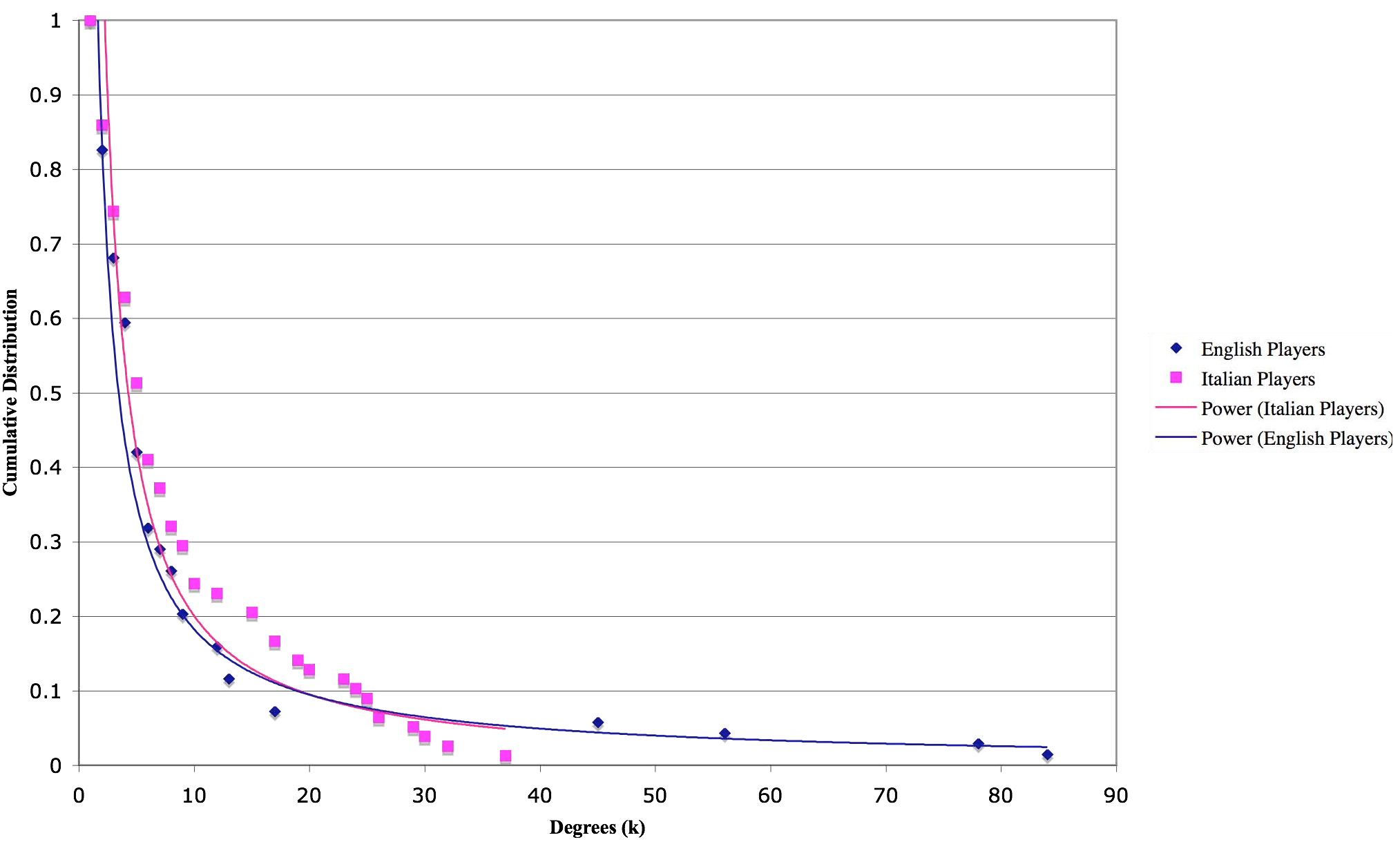 Figure: Network degree distribution by language, showing nearly identical social behavior patterns between English and Italian cohorts.
Critical Insight: Incentives Matter
Why did players try so hard to communicate? Incentives. The game scored players based on reciprocity and centrality. To win, "Hardcore" players had to find new people to interact with. If those people spoke a different language, the players simply found a way to make it work—using BabelFish, emoticons, or photos.
Conclusion & Future Outlook
This study proves that community segregation is often a choice made by designers, not a natural necessity of players. By providing:
- Multi-modal communication (Images + Text).
- Social scoring systems that reward diversity.
- Asynchronous loops that lower the pressure of "instant" understanding.
Developers can build global communities even with small budgets. The future of social gaming lies not in translating every word, but in giving players the tools to translate their intent.
Limitations: The study was conducted on a relatively small sample (210 players). In a community of millions, the "Small World" effect might face greater "tribal" pressures.