
Scheduling the Unfashionable: Navigating Negative Externalities in Social Networks
Schedules for marketing products with negative externalities
This paper investigates the marketing schedule problem for products with negative externalities in social networks (Rebel Networks). It proposes polynomial-time algorithms to maximize product adoption and achieve regret-proof equilibria, where consumers follow a minority-seeking purchase criterion.
Executive Summary
TL;DR: While most viral marketing strategies aim to create a "snowball effect" through positive externalities, luxury and fashion goods often exhibit the opposite: Negative Externalities. In these "Rebel Networks," the more people own a product, the less valuable it becomes to others. This paper, Schedules for marketing products with negative externalities, provides the first rigorous algorithmic framework for a monopolist to sequence sales. By strategically ordering when each consumer is approached, the authors demonstrate that a seller can guarantee significant adoption rates (at least 33% to 50% of the network) while ensuring "Regret-Proof" outcomes where no buyer feels their purchase was a mistake.
Problem & Motivation: The Rebel's Dilemma
In traditional social network theory, we assume Conformists: if your friends buy a iPhone, you are more likely to buy one. However, the world is full of Rebels. For high-end fashion, unique collectibles, or niche technology, the "social value" stems from being different.
The technical challenge is that in a rebel network, the sequence of purchases matters immensely. If a rebel buys a product and then all their neighbors buy it, the original buyer suffers from "regret." The central question is: In what order should a seller approach consumers to maximize sales while keeping everyone happy?
Methodology: Dual Schedules and Stable Cuts
1. The Rebel Scheduling Problem
The authors model the network as a graph . Each consumer follows a "minority criterion": they buy the product (or choice ) if the majority of their currently-purchased neighbors chose the alternative ().
2. Algorithmic Intuition: Dual Scheduling
To solve the NP-hard maximization problem, the authors introduce Algorithm 1. The core insight is the creation of "Dual Schedules." By partitioning the network and ensuring that for every node , one schedule results in choice and its "dual" results in choice , the seller can always pick the better of the two, guaranteeing at least adoption.
 Figure 1: Conceptual visualization of SNS-based precision marketing where interactions between neighbors drive decisions.
3. Regret-Proofing via Potential Games
A schedule is regret-proof if the final outcome is a Nash Equilibrium. The authors use the physical intuition of a Stable Cut. By treating the problem as a potential game where the "potential" is the size of the cut (links between -buyers and -buyers), they prove that simply moving "violating" nodes—consumers who regret their choice—eventually terminates in a stable state.
Experiments & Results: Guaranteed Adoption
The paper proves several lower bounds for adoption regardless of the underlying network structure:
- Maximum Y-Adoption: Guaranteed of the population.
- Maximum N-Adoption: Guaranteed (tightened by the "Triangle" counter-example).
- Regret-Proofing: The algorithms maintain high adoption while ensuring stability.
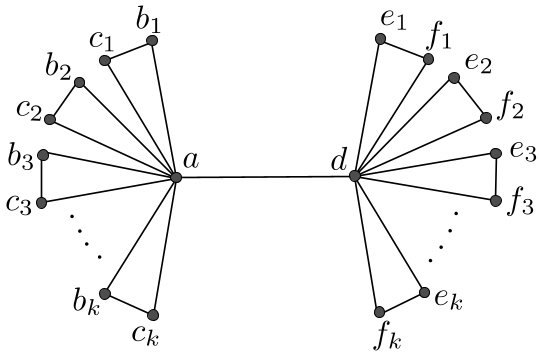 Figure 2: Example of a complex "Gadget" used in the NP-hardness proof, illustrating how localized rebel behavior can be used to encode logical clauses.
The "Triangle" Limitation
The authors identify that in a simple triangle network (3 nodes all connected), you can never satisfy all three rebels simultaneously. This structural bottleneck is why the general guarantee for choice is .
Critical Insight & Conclusion
The Takeaway: The "Word-of-Mouth" effect is a double-edged sword. In markets defined by exclusivity, the seller must act as a sophisticated "choreographer." By finding a Stable Cut in the social graph, a company can prevent the "devaluation" of their brand that occurs when a product becomes too common among a specific social circle.
Limitations:
- The model assumes a monopolist seller. In a competitive market with two luxury brands, the scheduling becomes a complex "Rebel War."
- The network is assumed to be undirected. In reality, influence (especially in fashion) is often directed/hierarchical (e.g., influencers vs. followers).
Future research should focus on Asymmetric Information—where the seller doesn't know exactly who is a rebel and who is a conformist—and how to robustly schedule under that uncertainty.