
Twitter as the New Job Market: Leveraging Siamese Networks for Professional Matching
Matching Recruiters and Jobseekers on Twitter
This paper proposes a job recommendation framework that matches recruiters and jobseekers using publicly available Twitter data. By employing a semi-supervised Siamese architecture with Bi-LSTM and Attention mechanisms, the authors achieve up to 97% accuracy in identifying relevant person-job fits in the computer science domain.
TL;DR
This study explores whether the noisy, public stream of Twitter can replace expensive, closed platforms like LinkedIn for job recommendations. By applying a Siamese Bi-LSTM architecture with Attention, the researchers successfully matched recruiters and jobseekers in the tech sector with an impressive 97% accuracy, proving that social media is a goldmine for talent acquisition.
Background & Positioning
In the hierarchy of recruitment tech, most "SOTA" (State-of-the-Art) models are locked behind the corporate walls of LinkedIn and CareerBuilder. This paper breaks that trend by shifting the "Person-Job Fit" problem to the public domain. It positions Twitter not just as a social hub, but as a decentralized job board where small companies and diverse candidates can meet without the "pay-to-play" barriers of commercial portals.
The Problem: The High Cost of Closed Portals
The primary pain points identified by the authors are:
- Data Silos: High-quality recruitment data is proprietary.
- Economic Barriers: Small businesses and lower-income jobseekers are often priced out of premium matching services.
- Semantic Complexity: Identifying that a "Data Scientist" and a "Machine Learning Engineer" might be looking for the same thing requires deep semantic understanding, which simple keywords cannot provide.
Methodology: The Power of Siamese Architectures
To solve the matching problem, the authors turned to Siamese Networks. These are ideal for "Text Pair Comparison" because they use two identical sub-networks to process two different inputs—in this case, a tweet from a recruiter and a tweet from a jobseeker.
Architecture Breakdown
The sub-networks share the same weights, ensuring that both tweets are mapped into the same vector space. The model then calculates the Euclidean distance between these vectors to determine if the pair is a "match."
The authors tested four configurations:
- CNN: For local spatial features.
- LSTM/Bi-LSTM: To capture long-term dependencies in the text.
- Attention Mechanism: To weigh critical keywords (like "Python," "React," or "Hiring") more heavily than filler words.
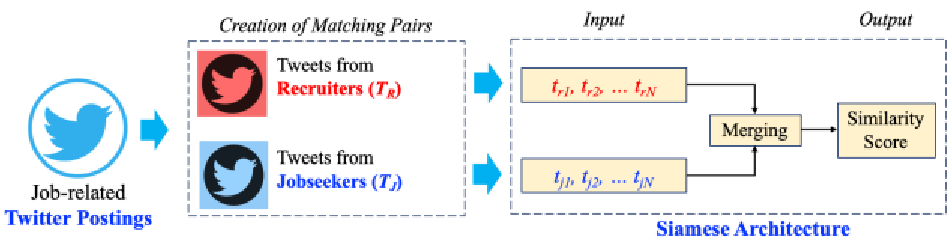 Fig 1: The overall pipeline from Twitter crawling to Siamese matching.
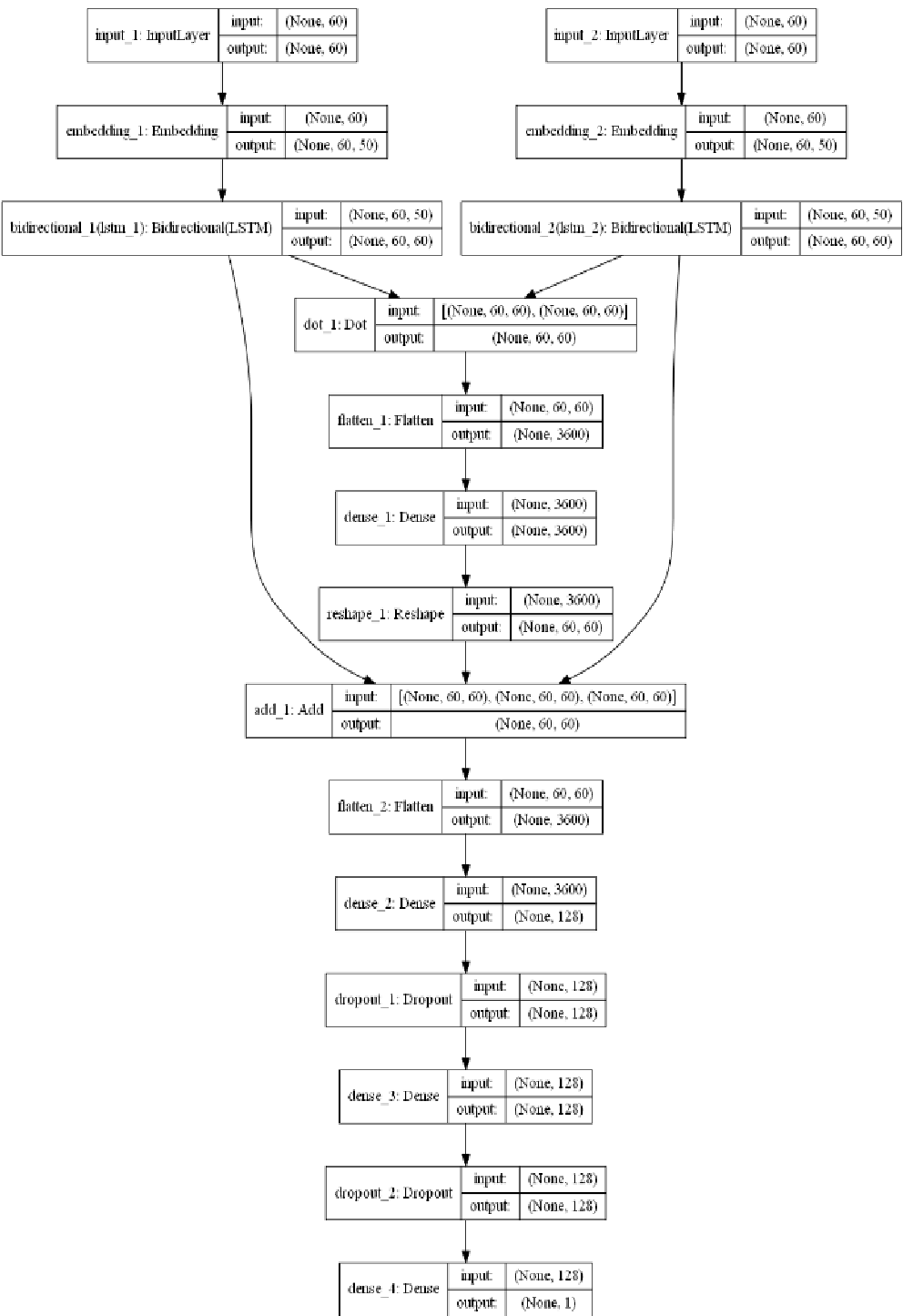 Fig 2: Detailed architecture showing how sub-networks share weights for semantic comparison.
Experiments & Results
The researchers curated a dataset of 0.76 million tweets, narrowing their focus to computer science roles (Web Dev, Data Science, etc.).
Key Findings:
- Bi-LSTM + Attention was the clear winner, achieving 97.49% accuracy.
- Sequence Matters: Recurrent models (LSTM) consistently beat CNNs, suggesting that the order and context of words in professional bios/ads are vital.
- Word Embeddings: Using GloVe embeddings trained on Wikipedia/Gigaword (6B tokens) actually performed better in some cases than those trained on Twitter (27B tokens), likely because professional job descriptions use more standard English than typical "social" tweets.
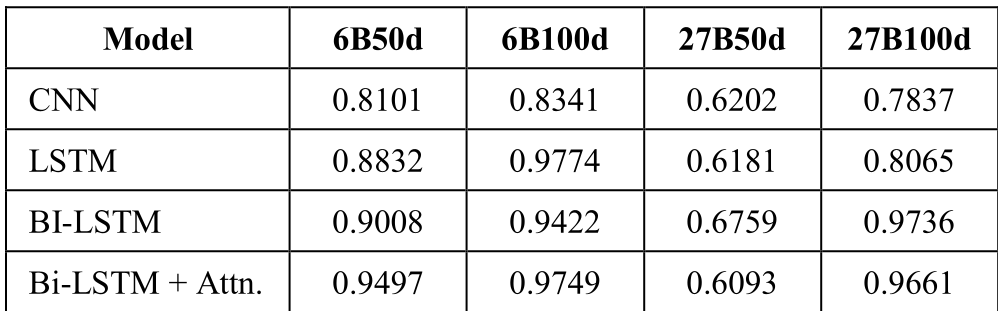 Table 1: Accuracy across different neural architectures and word embeddings.
Critical Insight: Why is it so accurate?
The authors performed a deep dive into "Word Share." Surprisingly, correctly matched pairs only shared about 6.3% of their words. This confirms that the model isn't just doing keyword matching; it is actually learning the Latent Space of job requirements and candidate skills.
Conclusion & Future Outlook
While the study is highly successful in the tech domain, it notes a limitation: roles requiring "soft skills" (like management or HR) might be harder to match on Twitter, as these traits are less likely to be captured in a 280-character post.
The Takeaway: For technical recruiting, social media mining is no longer a "casual" endeavor—it's a high-precision alternative to traditional hiring platforms. Future iterations using Transformer-based models (like BERT or GPT) could potentially push these results even further.