
Beyond Static Rankings: Unveiling Competitivity Groups in Social Networks
Mathematical and Computer Modelling
This paper introduces a novel classification method for Social Network Sites (SNS) users by leveraging the PageRank algorithm's personalization vector. It defines "Competitivity Groups"—sets of nodes that compete for ranking prominence—and "Leadership Groups" to identify dominant influencers within complex networks.
TL;DR
In the world of Social Network Sites (SNS), being "important" is often a matter of context. This paper moves beyond static PageRank values to introduce Competitivity Groups: clusters of users who directly compete for influence. By manipulating the "teleportation" mechanism of the Google Matrix, the author identifies who belongs in the "Top Flight" and who is playing in the "Minor Leagues."
Strategic Position: This work provides a mathematical bridge between global link analysis (PageRank) and local community structure, offering a more nuanced way to view influence in scale-free networks.
Problem & Motivation: The Illusion of Global Rank
Most ranking algorithms, including the standard PageRank used by Google, provide a single, global list of importance. However, social networks are inherently fragmented. A user might be a "big fish" in a small pond (a niche hobby group) but invisible globally.
The author's insight is that personalization—the ability to bias the random surfer toward specific nodes—reveals the hidden competitive structure of the network. If node A's rank stays higher than node B's rank regardless of who we "teleport" to, node A is in a different league of leadership.
Methodology: The Power of the Personalization Vector
The core of the methodology lies in the Google Matrix equation:
Where:
- : The transition matrix (who links to whom).
- : The personalization vector.
- : The damping factor (usually 0.85).
Determining the Competitivity Interval
Instead of using a uniform (where the surfer can land anywhere with equal probability), the author tests different personalization vectors . Each heavily favors a specific node .
By recording the minimum and maximum PageRank each node achieves across all these tests, the author defines a Competitivity Interval . If two nodes' intervals overlap, they are said to be in the same Competitivity Group.
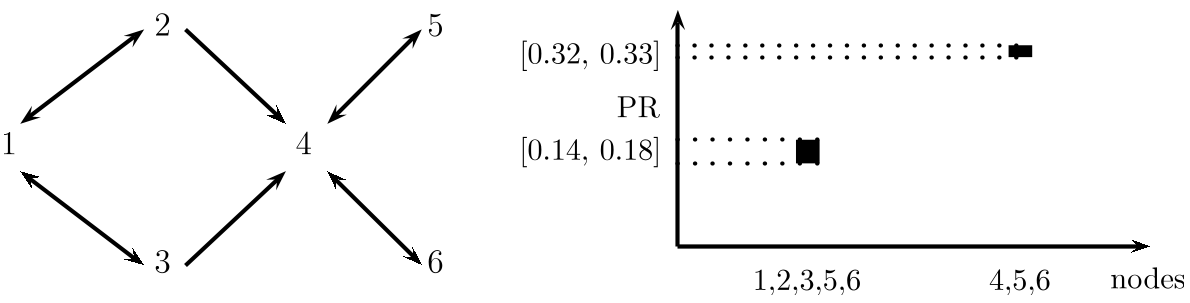 Fig 1: A graph and its resulting Competitivity Intervals, showing how nodes are grouped based on their ranking potential.
Experiments & Results: Identifying the Leaders
The paper applies this to several existing network models. A standout observation occurs in "Example 4," where the method overlaps different groups.
- Leadership Groups: The scholars define a "Leadership Group" as nodes that can achieve the #1 rank under at least one personalization scenario.
- The "Bridge" Effect: Unlike standard clustering (which puts nodes into silos), this method shows that some nodes belong to multiple groups. For example, a "middle-class" user might compete with both elite influencers and average users, acting as a structural bridge.
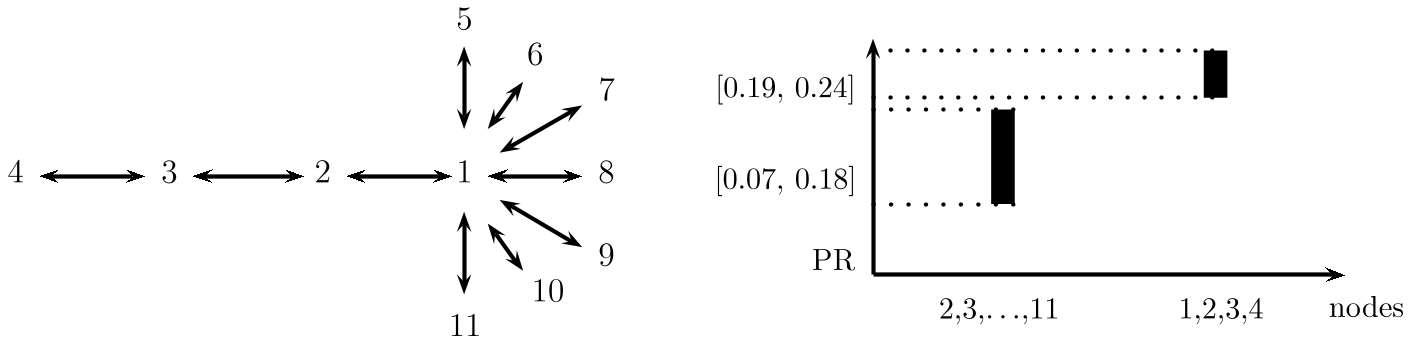 Fig 2: Comparison of graphical structures and the resulting leadership dominance of specific nodes.
Critical Analysis & Conclusion
Takeaway
The value of this approach is its inductive bias. It assumes that influence is not a fixed number but a range of possibilities. By defining the "Competitivity Matrix," SNS administrators can better understand which users are "rising stars" and which are entrenched leaders.
Limitations
- Computational Cost: Calculating PageRank vectors can be expensive for massive graphs, though the author argues SNS matrices are generally small enough for this to remain tractable.
- Parameter Sensitivity: The choice of (the amount of bias in the personalization vector) can shift the boundaries of these groups.
Future Outlook
This framework could be revolutionized by incorporating real-time user activity (likes, comments, time spent) into the personalization vector, allowing for a "Live Competitivity Map" of social networks that updates as trends shift.
Keywords: PageRank, SNS Analysis, Competitivity Groups, Link Analysis, Leadership Detection.