
Beyond Global Rankings: Reimagining Social Leadership via Personalized PageRank
Mathematical and Computer Modelling
The paper introduces a framework for identifying influential users in Social Network Sites (SNSs) using Personalized PageRank (PPR). It formalizes the concept of a "Leadership Group" (L) and introduces "Leadership Frequency" () as a novel centrality measure to rank nodes based on their robustness as leaders across varying personalization biases.
TL;DR
Is a social media "leader" someone who is globally popular, or someone who dominates when the focus shifts to specific niches? This paper moves beyond static rankings by introducing the Leadership Group framework. By leveraging Personalized PageRank (PPR), the authors show that leadership is a function of "bias" and "frequency," allowing us to identify influencers that traditional algorithms like basic PageRank often miss.
The Problem: The Flaw of "One Size Fits All" Rankings
Standard centrality measures (Degree, Betweenness, or basic PageRank) assume a uniform importance across the network. In the real world, influence is often contextual. A user might not be the most followed person on a platform, but they might be the undisputed authority when the conversation shifts toward a specific topic or sub-group.
The authors argue that the "Basic Leader" (the node at the top of the standard PageRank vector) is only part of the story. To truly understand a network's power structure, we must ask: How much "bias" does it take to make a specific node the leader?
Methodology: The Mechanics of Bias
The core of the paper lies in a specialized version of the Google Matrix (). Instead of a uniform teleportation vector, they use a personalization vector :
- Node : The node we are "rooting" for (biasing the search toward).
- : The "diffusion" parameter. A low means we are heavily biased toward node ; a high moves us back toward a uniform distribution.
1. Defining the Leadership Group ()
A node enters the Leadership Group if there exists any node such that, when we bias the network toward , node becomes the #1 ranked node.
2. Leadership Frequency ($
u_Lij$ taking the crown.
 Figure 1: Mathematical formulation of the stochastic matrix used to derive PPR.
Experimental Insights: Zachary’s Karate Club and Facebook
The authors applied this to the famous Zachary’s Karate Club network (34 members).
- The Basic View: Node 34 and Node 1 are the clear leaders.
- The PPR View: The authors found that at certain values of , Node 1 actually has a higher Leadership Frequency than Node 34, despite Node 34 having a higher basic PageRank score. This suggests Node 1 has a more diverse "base" of influence across the club's members.
Sensitivity to
The paper demonstrates a fascinating phase transition. As increases (meaning less bias toward individuals), the size of the Leadership Group shrinks.
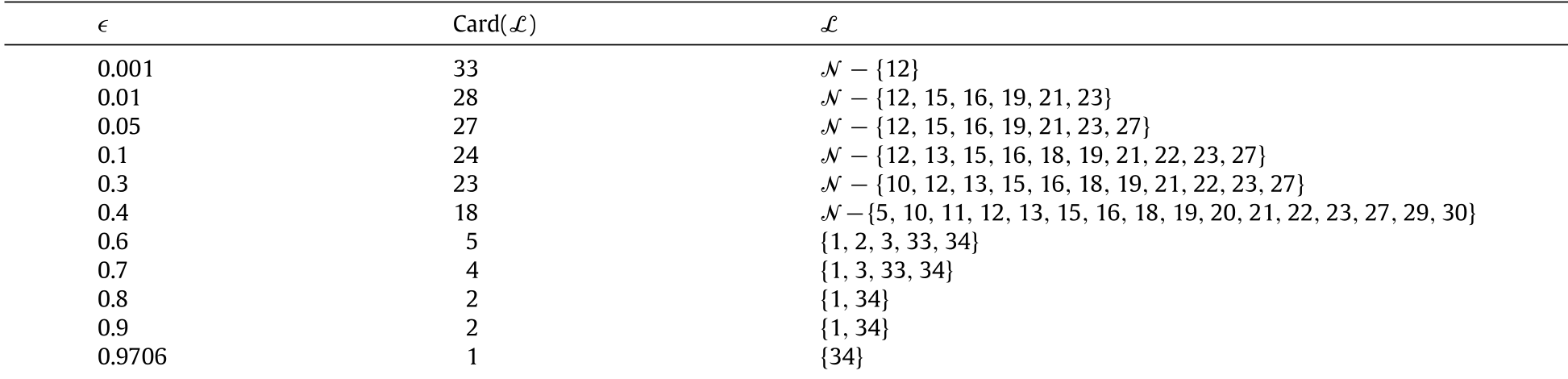 Table 2: The cardinality of the Leadership Group (Card(L)) decreases as the personalization parameter increases.
In the Caltech Facebook network (769 nodes), they found that if you allow enough personalization (), every single person in the network has the potential to be a leader for someone else. However, as you move toward a global view (), the group collapses to just 98 elite nodes.
Critical Analysis & Conclusion
This work provides a robust mathematical bridge between global centrality and local influence.
Key Takeaways:
- as a Metric: Leadership frequency is a more resilient measure of influence than a simple percentage-based rank.
- Community Identification: Nodes with similar values or those that appear together in leadership groups under specific ranges can be used to define more functional, influence-based communities.
Limitations: The computation of the full Leadership Group requires iterating through all nodes as personalization targets, which could be computationally expensive for massive networks (e.g., millions of nodes) without further optimization (like Monte-Carlo approximations).
Future Work: Applying this to "weighted" networks where links have specific meanings (e.g., financial transactions vs. social likes) could yield even deeper insights into how power shifts across different types of social exchange.