
The Danger Signal: A New Frontier in Mathematical Oncology
A mathematical model of tumor-immune interactions incorporated with danger model
This paper introduces a novel Ordinary Differential Equation (ODE) model of tumor-immune interactions by incorporating the "Danger Model." The system tracks tumor cells, CD8+ T-cells, NK-cells, dendritic cells (DCs), and IL-12, demonstrating how alarm signals from injured tissue trigger immune responses to eliminate tumors.
TL;DR
Researchers have developed a new mathematical model that moves beyond the "foreign vs. self" dichotomy in cancer immunology. By incorporating the Danger Model, the research demonstrates how dendritic cells and IL-12 act as the "alarm system" of the body. The model proves that while the immune system can kill small tumors, larger ones require precisely timed chemotherapy to "reset" the system to a tumor-free state.
Context: Why "Foreignness" Isn't Enough
For decades, the dominant view in immunology was that the immune system attacks anything "non-self." But tumors are technically "self" cells gone wrong, making them invisible to traditional models. This paper adopts Polly Matzinger’s Danger Model, which suggests the immune system responds to damage (danger signals) rather than just "foreignness."
The authors argue that a professional response requires two signals:
- Antigen Presentation: Provided by Dendritic Cells (DCs).
- Co-stimulation: The "danger signal" that turns on T-cells.
Methodology: The 6-Dimensional Battlefield
The authors construct a system of six Ordinary Differential Equations (ODEs) to track the following populations:
- : Tumor cells (growing logistically).
- : CD8+ T-cells (the "soldiers").
- : Natural Killer (NK) cells (the "scouts").
- : Mature Dendritic Cells (the "messengers").
- : IL-12 (the cytokine "radio signal").
- : Chemotherapy drug concentration.
The Core Equations
The model's novelty lies in the DC-T cell interaction term () and the recruitment of immune cells via IL-12 (). This represents the biological reality that T-cells don't just "see" tumors; they must be activated by "alarmed" DCs.
 Note: Table II in the paper provides the kinetic constants used to simulate these biological interactions.
Analysis: The Three States of Cancer
Through linearized stability analysis (Jacobian matrices), the authors found three mathematical equilibria:
- Tumor-Free (): A stable state where the immune system successfully manages the disease.
- Middle-Tumor (): An unstable state. This is the "tipping point." If a tumor stays below this threshold, the body might fix it. If it grows past it, the tumor takes over.
- High-Tumor (): A stable state where the tumor reaches its carrying capacity and evades the immune system.
Experimental Results: The Importance of Timing
The simulation results present a vital lesson for oncology: Frequency matters more than just dosage.
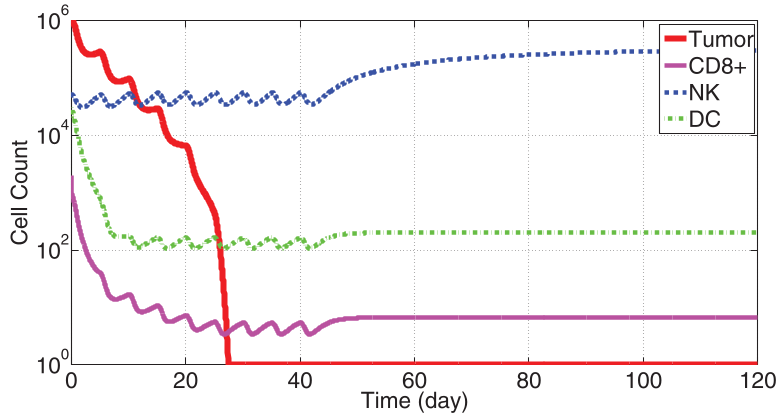
- Autoimmunity: Small tumors ( cells) are naturally eliminated by a healthy immune system.
- Immune Escape: Larger tumors ( cells) grow to the "High-Tumor" state if left untreated.
- Chemotherapy Success: Using a 5-day cycle of chemotherapy (9 doses) successfully eliminated the tumor.
- Chemotherapy Failure: When the same strength of drug was administered on a 15-day cycle, the tumor regrew because the immune system couldn't "gain enough ground" between doses.
Critical Insight: Takeaways for Future Therapy
The paper’s biggest contribution is proving that reducing tumor burden is not enough. Because the high-tumor state () is a "stable" equilibrium, merely killing 90% of a tumor will result in it eventually growing back to its maximum size once therapy stops.
The goal of therapy must be to push the system into the basin of attraction of the tumor-free equilibrium. This requires a synergistic approach—using chemotherapy to knock the tumor down and immunotherapy (enhancing the "Danger Signal") to ensure the immune system can finish the job.
Limitations
- The model assumes a homogeneous tumor population, whereas real tumors are genetically diverse and adapt to treatments.
- The parameters used are estimates based on various literature sources (melanoma models); clinical application would require patient-specific calibration.
Conclusion
By integrating the Danger Model, this research provides a more biologically plausible framework for cancer dynamics. It underscores that cancer treatment is not just a game of "cell counts," but a dynamic struggle between complex systems where the "alarm signals" of the body play a decisive role.