
MF-TD: Why Your "Enemies" are the Secret to Better Recommendations
Matrix Factorization with Explicit Trust and Distrust Side Information for Improved Social Recommendation
The paper introduces MF-TD, a novel matrix factorization framework that simultaneously integrates explicit trust and distrust relations for social recommendation. By enforcing a margin-based constraint between trusted and distrusted latent features, it achieves SOTA performance on the Epinions dataset, significantly mitigating data sparsity.
TL;DR
While most social recommenders focus on who you follow, this paper argues that who you block is just as informative. By introducing MF-TD, a matrix factorization model that treats distrust as a mandatory "similarity gap" in latent space, the authors achieve a breakthrough in accuracy, particularly for the dreaded Cold-Start problem where users have no prior rating history.
Background: Beyond the "Circle of Trust"
Most social-aware recommender systems operate on a simple heuristic: If I trust you, I likely share your taste. Mathematically, this pulls our "latent feature vectors" closer together. However, real-world platforms like Epinions or Slashdot have a darker side—explicit "Block Lists" or "Foes."
The technical challenge is that distrust is not transitive. If Alice distrusts Bob, and Bob distrusts Charlie, it doesn't mean Alice trusts Charlie. Standard Matrix Factorization (MF) struggles to incorporate this negative signal without breaking the underlying geometry of the user-item latent space.
The Intuition: Margin-Based Disagreement
The core "Aha!" moment of this paper is moving away from simple filtering to a margin-based ranking of latent features. Instead of just saying "Bob is different from Alice," the model forces a constraint:
Alice’s latent vector must be closer to her trusted friends than her distrusted ones by a specific safety margin ().
Technical Architecture
The authors define a set of triplets where user trusts user but distrusts . They then minimize a loss function that penalizes any violation of this margin:
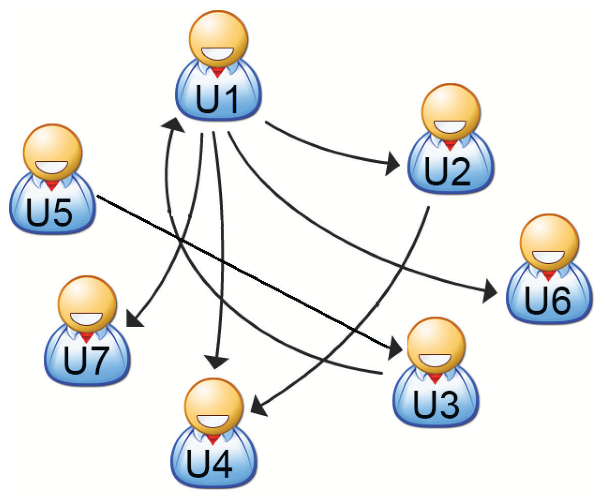 In the learned latent space (d), trusted users (u2, u4) are successfully pulled closer to the pivot user (u1) than those on the block list (u3, u5).
Scaling the "Hate": Mini-Batch SGD
Computing these triplets for every user is an nightmare. To make this practical for real-world networks with millions of users, the authors developed a Mini-Batch Stochastic Gradient Descent (Mini-SGD) approach. By sampling a small, representative set of triplets at each step, they maintain a high accuracy-to-efficiency ratio.
Experimental Showdown
The model was stress-tested on the Epinions dataset, which contains over 12 million ratings.
1. Accuracy Gains
MF-TD consistently beat pure MF, trust-only MF, and traditional neighborhood-based (CF) methods.
- RMSE Improvement: Dropped from 1.21 (Standard MF) to 1.08 (MF-TD). In the recommendation world, even a 0.01 improvement is often considered a major win.
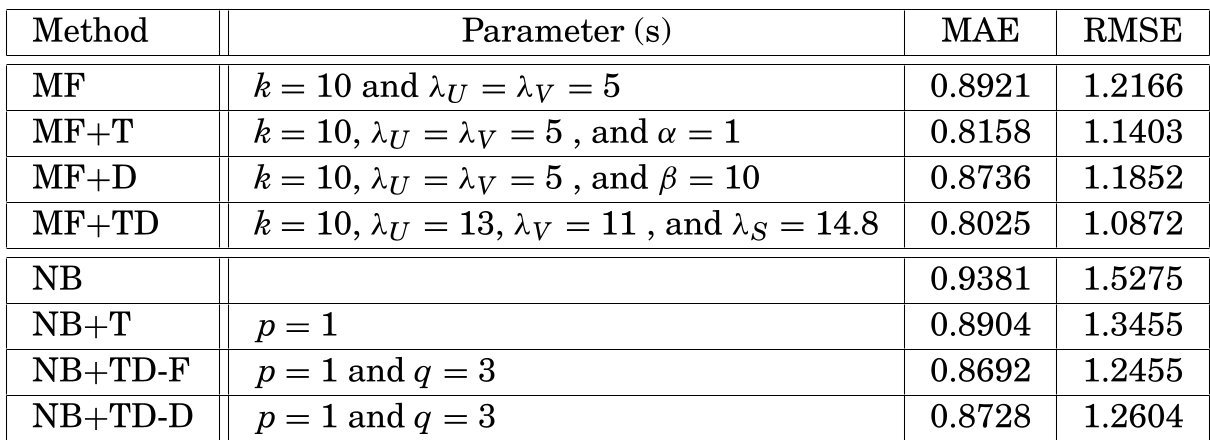 Table IX reveals that MF-TD significantly outperforms both memory-based (NB) and model-based (MF) baselines.
2. Solving the Cold-Start Problem
This is where the model shines. For "New Users" who haven't rated anything yet, the system uses their social links to "triangulate" their position in the latent space. MF-TD provided vastly superior recommendations for users with 0-5 ratings compared to methods that ignore distrust.
Critical Insight: Distrust is Efficient
A fascinating finding in the paper is that distrust relations are "denser" in information. The authors discovered that a small amount of distrust data could compensate for a large loss in trust data. This suggests that who we reject defines our "latent profile" more sharply than who we follow.
Conclusion & Future Look
The paper effectively moves social recommendation from simple "homophily" (similarity) to "structural balance." For the next generation of AI-driven platforms, the bridge between Social Graphs and Matrix Factorization must be built with both positive and negative reinforcement.
Limitations: The current model treats trust/distrust as binary (1 or -1). Future iterations could look at weighted relations (e.g., "strongly distrust") to capture the nuances of online social dynamics.
Academic Note: This work was published in ACM Transactions on Information Systems (TOIS).