
Hybrid Matrix Factorization: Bridging Physical Trajectories and Virtual Social Networks
Matrix Factorization for User Behavior Analysis of Location-Based Social Network
The paper proposes a hybrid user behavior analysis model for Location-Based Social Networks (LBSNs) that combines real-world GPS check-in data with virtual social network metadata. It employs Matrix Factorization (MF) to decompose large, sparse user-location matrices and integrates keyword similarity to enhance recommendation accuracy.
TL;DR
This research tackles the challenge of predicting user behavior in Location-Based Social Networks (LBSNs) like Foursquare. By combining Matrix Factorization (MF) to handle sparse location check-ins with a Keyword-based similarity model for social attributes, the authors achieve a more holistic and accurate similarity measure, significantly outperforming traditional methods like Jaccard similarity.
Context & Motivation: The Sparsity Trap
In the world of LBSNs, users "check in" at various venues. However, the resulting User-Location matrix is notoriously sparse—most users only visit a tiny fraction of available locations. Traditional analysis fails because:
- High Dimensionality: Millions of users vs. millions of locations create a computational nightmare.
- Missing Links: Simple overlap metrics (like Jaccard) cannot find "similar" users if they haven't visited the exact same spots, even if they share the same hobbies.
- Information Silos: Most models look at where you go or who you are, but rarely both in a unified mathematical framework.
Methodology: The Fusion of Two Worlds
The authors propose a dual-engine similarity model.
1. The Location Engine (Matrix Factorization)
Instead of using raw check-in counts, the paper decomposes the Access Matrix into two low-rank matrices: (User features) and (Location features).
- Intuition: The inner product captures the "latent" preference of a user for a location’s characteristics (e.g., "enjoys quiet cafes" or "frequents gyms").
- Optimization: They use Stochastic Gradient Descent (SGD) with a regularization term to prevent overfitting to sparse data.
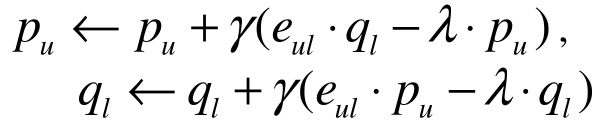 The update rule for user and location eigenvectors during training.
2. The Social Engine (Keyword Vectors)
The model extracts keywords from user profiles (age, gender, interests) and maps them into a multidimensional discrete space. Similarity here is calculated via Euclidean distance, capturing the "Virtual" persona of the user.
3. The Hybrid Fusion
The final similarity is a weighted sum: This allows the model to balance physical behavior with social identity.
Experimental Insights
The authors crawled live data from Foursquare to validate the model.
Finding the "Sweet Spot" (The Parameter)
A critical discovery was that when , the model reaches its peak performance. This suggests that while social keywords are important, our physical movements carry more weight (about 70%) in defining our behavioral similarity to others.
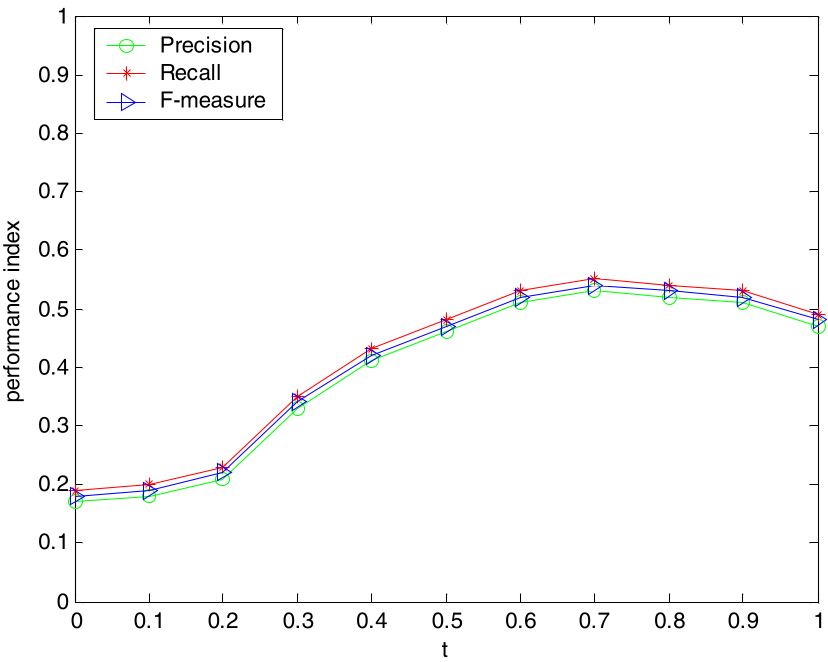 Performance metrics (Precision, Recall, F-measure) peaks when location and social data are balanced at 0.7.
The Power of Latent Features ()
Increasing the number of latent features () reduces the Root Mean Square Error (RMSE), but the authors found that provides the best balance between accuracy and computational cost.
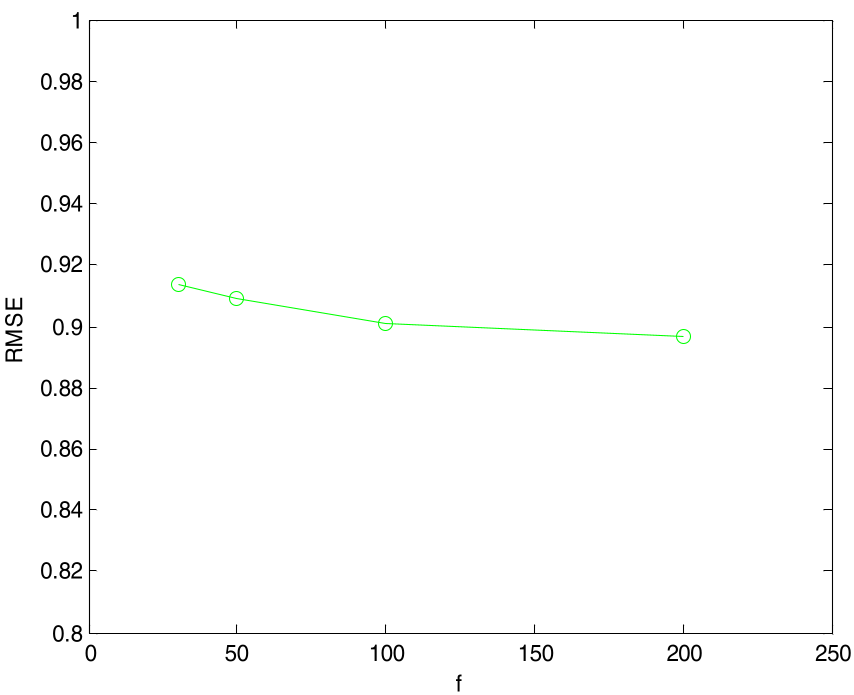 Impact of feature dimension on error rates.
Critical Analysis & Takeaways
Why it works: By projecting sparse check-in data into a lower-dimensional latent space, the model discovers "hidden" patterns of behavior that are invisible to raw count-based methods. Adding the social layer acts as a "prior" that helps disambiguate users when location data is particularly thin.
Limitations:
- The model treats location check-ins as static points, ignoring the temporal sequence (the order of visits), which is vital for trajectory prediction.
- The keyword extraction is currently based on simple discretization; modern NLP (like Transformers) could significantly improve the "Social Engine."
Future Outlook: This work paves the way for cross-platform recommendation systems where your LinkedIn professional profile could help suggest your next "work-friendly" cafe on Foursquare more accurately than check-ins alone.