
MAX-FLMin: Bridging Topology and Attributes for Deep Social Network Insights
MAX-FLMin: An Approach for Mining Maximal Frequent Links and Generating Semantical Structures from Social Networks
The paper introduces MAX-FLMin, a novel data mining approach designed to extract "Maximal Frequent Links" from social networks by integrating node attributes with topological structure. It moves beyond traditional subgraph mining to identify regularities in connections between groups sharing common features and uses these patterns to generate semantic "Aggregated Networks."
TL;DR
MAX-FLMin is a novel algorithm that redefines social network mining by looking for Frequent Links—patterns where groups of people with specific attributes (e.g., "Employed 40-year-olds") connect with other specific groups. Instead of just looking at the "shape" of a network, it looks at the "semantics" of the connections, reducing complex social graphs into intuitive, aggregated semantic maps with a performance boost of up to 99% over baseline methods.
Problem & Motivation: The "Blind Spot" in Network Science
Current network analysis is often "attribute-blind." While we have excellent tools for finding communities or frequent subgraphs (like gSpan or FSG), these methods usually only care about who is connected to whom. They ignore the rich metadata attached to nodes—age, gender, job status, or interests.
The authors argue that a connection in a social network isn't just a line; it's a social phenomenon driven by characteristics. If we only look at the topology, we miss the reason for the link. The challenge lies in the search space: combining every possible attribute combination with every possible link creates a combinatorial explosion that naive algorithms cannot handle.
Methodology: The Core of Frequent Link Mining
The authors introduce the concept of an Itemset (a logical conjunction of attributes) and define a Frequent Link as a connection between two itemsets that appears more often than a minimum support threshold .
1. The MAX-FLMin Algorithm
To avoid the exponential trap, MAX-FLMin uses a bottom-up approach:
- Level 1: It finds 1-itemsets (single attributes like "Gender=Male") that appear in enough links to potentially be part of a frequent pattern.
- Pruning: Using an "Apriori" property—where a super-link can only be frequent if its sub-links are also frequent—the algorithm discards thousands of irrelevant combinations early.
- Maximality: It only stores "Maximal" patterns. If "Employed Males" connecting to "Students" is frequent, and "Employed people" (a subset) connecting to "Students" is also frequent, only the most specific (maximal) version is kept to reduce redundancy.
2. Semantic Aggregation
Once the links are found, the algorithm generates an Aggregated Network. In this graph, nodes are no longer individuals but "Meta-nodes" (groups defined by attributes), and edges represent the frequent links between them.
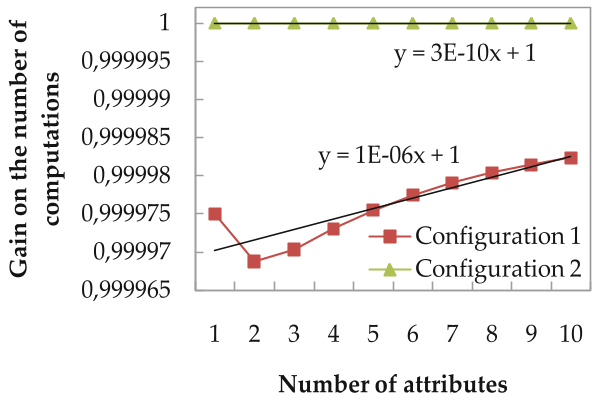 Figure: The process of generating an Aggregated Network from extracted maximal frequent links.
Experiments & Results
The researchers tested MAX-FLMin using a realistic simulation of human proximity in Portland (Episims).
Efficiency Gains
The optimization strategy (Algorithm 3 in the paper) shifts the work from iterating over every link to iterating over nodes and their neighbor structures. This results in a linear runtime increase relative to network size, rather than exponential. As seen in the performance charts, the gain over naive iteration is consistently above 90% in most configurations.
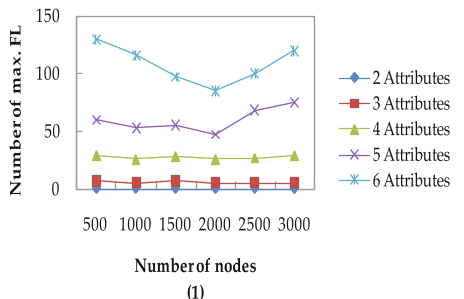 Figure: Runtime and Gain comparisons across different attribute counts (|R|) and support thresholds.
Unexpected Insight: Stability of Human Patterns
A fascinating quantitative takeaway was that the number of patterns remained stable as the network size grew. This suggests that the underlying social "rules" (how different demographic groups interact) are consistent whether you look at 500 people or 3,000 people. The number of attributes impacts complexity far more than the number of nodes .
Critical Analysis & Conclusion
Takeaway
MAX-FLMin shifts the paradigm from "Who is central in this graph?" to "What groups drive the network's activity?" The ability to distill a messy graph of 3,000 nodes into a semantic map of 10-20 meta-nodes is invaluable for social science and targeted marketing.
Limitations
- Categorical Bias: The current method relies on discrete attributes. Applying this to continuous data (like "income" or "distance") would require a discretization step that might lose information.
- Directed vs. Undirected: While the paper discusses adaptations for undirected graphs, the primary logic is built for directed links, which may behave differently in pure symmetric social relationships (like "friendship").
Future Outlook: Link Prediction
The most exciting future application is Link Prediction. By understanding that "Group A" and "Group B" have a "Frequent Link," we can predict with high probability that a new individual entering Group A will form a connection with someone in Group B. This moves link prediction from statistical guessing to semantic reasoning.